Fakeipedia: Building an Encyclopedia for Worlds That Don't Exist

Fakeipedia launched on Show HN, attempting to use the Wikipedia format to carry fictional world settings.
Fakeipedia is a new project that debuted in Hacker News' Show HN section, positioned as "building Wikipedia for worlds that don't exist." The article analyzes why the encyclopedia format naturally suits fictional content—entries can be decomposed, entities can reference each other, and writing into an encyclopedia is itself a consistency check on worldbuilding. It also identifies three major challenges: cold start, isolation and interoperability between fictional worlds, and the boundary between content quality and copyright, arguing that Fakeipedia's true value lies in testing whether structured writing can become a universal form of expression for fiction creators.
When Wikipedia Meets Fictional Worlds
On Hacker News' Show HN section, a project called Fakeipedia has drawn attention. Its positioning can be stated in a single sentence: building Wikipedia for worlds that don't exist.
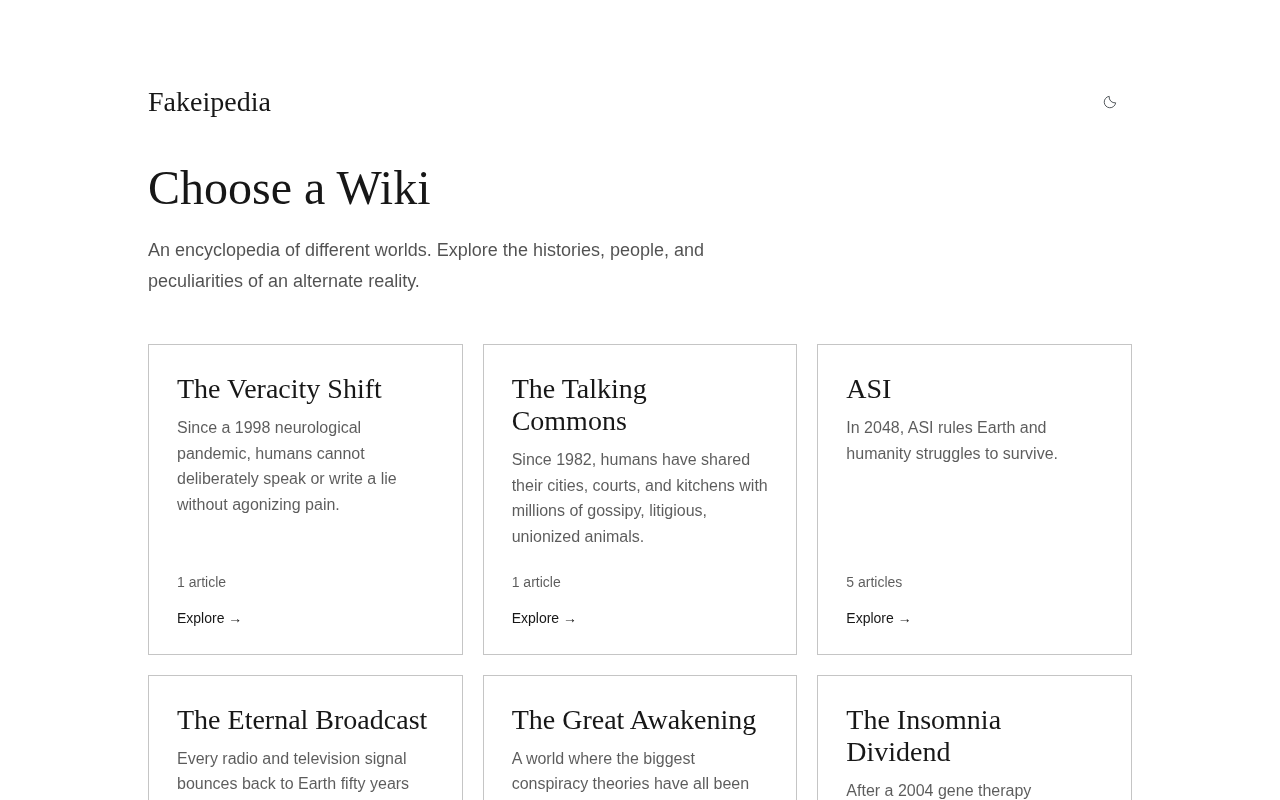
This idea taps into a less common but very real gap in internet products—humanity's fondness for "systematized fiction." From the thousands of self-built wiki entries in fan communities to the hand-written setting books of tabletop RPG players, people have long been accustomed to using the skeleton of an encyclopedia to carry the flesh of imagination. What Fakeipedia does is bring this spontaneous activity into a unified framework.
Show HN is a section of the Hacker News community dedicated to showcasing new works by individuals or teams, where users post links to projects they've developed and receive community feedback. What makes this section unique is that its audience is primarily developers, entrepreneurs, and tech enthusiasts, who tend to try products directly and offer concrete criticism, thus generating high-quality product discussions in a short time. For early-stage projects, appearing on Show HN means gaining a batch of seed users willing to deeply experience and spread the word—but it also means facing public, transparent, and sometimes rather sharp community scrutiny. If the product positioning and core mechanics aren't clear enough, key flaws are easily pointed out in the comments.
Why the Encyclopedia Format Suits Fictional Content
Wikipedia's form is not just a layout style—it's backed by a strong content organization logic: entries can be decomposed, entities reference each other, and definitions and details can be stored in layers. Applied to fictional worlds, this structure is a natural fit.
A fictional country can have its geography, political system, historical events, and cultural customs, each dimension existing as an independent entry, then linked into a network through internal links. Compared to linear narrative, the encyclopedia format allows readers to enter from any node and requires creators to organize their settings to a sufficiently self-consistent degree. In other words, the act of writing into an encyclopedia is itself a consistency check on the worldbuilding.
This is also why various fan-creation communities eventually grow wiki-like structures—it is currently the most mature paradigm for public knowledge collaboration, and fictional worlds happen to be able to reuse this paradigm.
Internal links are one of the core mechanisms of wiki-style systems: if a term in an entry has a corresponding page on the site, it will be automatically or manually linked to that page, forming a navigable knowledge network. This linking not only makes it easy for readers to follow the thread and explore related content, but also structurally forces creators to consider the relationships between entities—when a fictional character is repeatedly linked to a certain city or battle, cross-references between settings are naturally established. For fictional worlds, internal links act as a lightweight consistency-checking tool that can expose gaps or contradictions in the setting.
The Product Thinking Behind Show HN
Fakeipedia's choice to debut on Show HN means it targets early users who are sensitive to tool forms and willing to try things hands-on. This community has a natural fondness for "interesting weird stuff" while also being known for being picky: if a product is merely pretty in concept but hollow in practice, feedback in the comments tends to be quite direct.
What can be confirmed so far centers on the product positioning level: it defines itself as an encyclopedia platform for fictional worlds. As for how entries are created, how multi-user collaboration is managed, whether different fictional worlds are isolated, and what content moderation strategy is adopted—these will all be key details determining the product's success. For a platform focused on co-creation, boundary management of worldbuilding and the design of collaboration permissions are often more important than a beautiful interface.
The Real Challenges of a Fictional Encyclopedia
Making "writing an encyclopedia for worlds that don't exist" into a product inevitably runs into several hard problems.
The first is cold start. Wikipedia attracts readers with vast amounts of real knowledge, whereas a fictional encyclopedia relies on creators contributing content first. If a single fictional world has only a handful of entries, it's hard for readers to develop the motivation to browse, and creators will lose enthusiasm for maintenance.
The second is isolation and interoperability between worlds. Each fictional world should be a closed setting system, yet the platform also needs cross-world discovery mechanisms to distribute traffic. Balancing these two requires clever product design.
The third is the boundary between content quality and copyright. Borrowing the format of a real encyclopedia is fine, but if entries largely replicate the settings of existing IPs, the platform's positioning will slide toward a fan-creation community, and legal and operational risks will rise accordingly.
There are no standard answers to these questions, but whether a fictional encyclopedia product can survive long-term basically depends on how it responds to them.
Cold start is a common early-stage dilemma for platform-type products, referring to the phenomenon where a platform struggles to form a positive cycle when lacking sufficient content or users. For a fictional encyclopedia, the cold-start problem is especially prominent: readers need enough entries before they're willing to browse, and creators need to see views and interaction before they're willing to keep contributing—and these two are mutually preconditioned. Common approaches include the operator first building a demonstration fictional world in an official capacity, bringing in existing fan communities with established user bases to migrate wholesale, or reducing the creation cost per entry through editing tools and templates—but whether these methods work depends on the platform's ability to serve its first batch of creators.
Signals Worth Watching
Fakeipedia's value lies not only in being a new tool, but in testing a hypothesis: can encyclopedia-style structured writing become a universal form of expression for fiction creators? If the answer is yes, similar forms could extend to novel writing, game setting books, film and television worldbuilding management, and many other fields.
For content creators and product people, this project is worth adding to the watch list. Its subsequent evolution will tell us what a genuinely usable product form looks like when structured knowledge combines with free imagination.
One-line Summary
Fakeipedia launched on Show HN, attempting to use the Wikipedia format to carry fictional world settings.
Paragraph Summary
Fakeipedia is a new project that debuted in Hacker News' Show HN section, positioned as "building Wikipedia for worlds that don't exist." The article analyzes why the encyclopedia format naturally suits fictional content: entries can be decomposed, entities can reference each other, and definitions and details are stored in layers—the act of writing into an encyclopedia is itself a consistency check on worldbuilding. At the same time, the article points out that such products face three major challenges: cold start, isolation and interoperability between fictional worlds, and the boundary between content quality and copyright. It argues that Fakeipedia's true value lies in testing whether structured writing can become a universal form of expression for fiction creators, and that it is worth continuous observation by content creators and product people.
Related articles

Gemini 4 Argon Hands-On: AI Builds Board Games, Constructs Temples, and Trains Robots Autonomously
Gemini 4 Argon hands-on roundup: AI autonomously builds a desk racetrack and temple in Blender, writes a ray tracing engine, trains a humanoid robot to sink 7 shots, plus API pricing and developer access.

The Magic Octagonal Coin: Why Only 9% of People Can Predict Its Flip?
Only 9% of people can correctly predict the Magic Octagon coin flip. This article explains its spatial rotation mechanism, common cognitive pitfalls, and a new hypothesis based on Relevance Theory, exploring the limits of human spatial reasoning.

Sam Altman: AI Is Entering the Era of Scientific Discovery — Math Breakthroughs Will Replicate in Biology and Energy
Sam Altman says AI is entering the era of scientific discovery — math breakthroughs will replicate in biology, materials science, and energy to help develop new drugs and energy sources.