FastAPI Beginner's Guide: Four Core Advantages and ASGI Architecture Explained

FastAPI is a high-performance Python web framework built on async architecture, designed specifically for API development.
FastAPI is a modern, high-performance Python web framework built on Starlette (async web framework) and Pydantic (data validation library), designed specifically for developing API applications. Its four core advantages include: ASGI-based async IO delivering approximately 3x Flask's performance, type hints for improved development efficiency and collaboration, automatic interactive API documentation generation, and an easy-to-learn concise syntax. FastAPI is particularly well-suited for RESTful APIs, AI/LLM model services, microservices architectures, and data-intensive applications.
What Is an API Application?
Before diving into FastAPI, we need to understand a core concept—API applications.
The shopping websites, video platforms, financial apps, and mini-programs we use daily all share something in common: they contain massive amounts of data. When a user visits a page, the browser doesn't fetch all content at once—it completes the process through multiple requests:
- First request: Fetches the page layout structure (e.g., top carousel, left navigation bar, right-side list area)
- Subsequent requests: Fetch specific data for each section, filling content into the layout's "empty slots"
These request addresses that specifically respond with data are what we call APIs (Application Programming Interfaces). APIs are standardized protocols for communication between software systems. In web development, the most common API style is RESTful API, which is based on the HTTP protocol and uses methods like GET, POST, PUT, and DELETE to operate on resources. Each API endpoint corresponds to a URL address—clients send HTTP requests to that address to retrieve or manipulate data, and the server returns responses in formats like JSON or XML. This front-end/back-end separation architecture has become the mainstream paradigm in modern web development—the front end (browsers, mobile apps, mini-programs) is only responsible for interface display and user interaction, while all business logic and data processing is handled by back-end APIs.
A complete business system may contain dozens or even hundreds of endpoints. Integrating all these endpoints into a single program constitutes an API application.
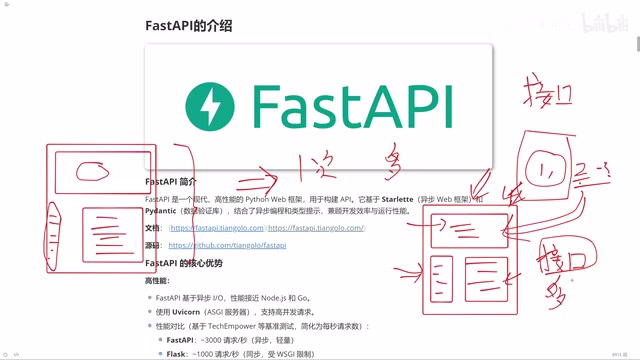
FastAPI is a Python framework specifically designed for developing these types of API applications.
What Is FastAPI? Why Is It Called a Modern Python Web Framework?
FastAPI is a modern, high-performance Python web framework designed specifically for building APIs. Here, "modern" means its coding conventions align with current mainstream development practices, while "high-performance" stems from its carefully designed underlying architecture.
FastAPI is built on two core technologies:
| Technology | Role |
|---|---|
| Starlette | Async web framework providing high-performance request handling |
| Pydantic | Data validation library that automatically performs type checking to boost development efficiency |
Starlette is a lightweight ASGI framework created by Tom Christie (who is also the author of Django REST Framework). It provides routing, middleware, WebSocket support, static file serving, and other foundational web framework capabilities while maintaining extremely high performance. FastAPI wasn't built from scratch—it stands on the shoulders of Starlette, inheriting all of its async processing capabilities and HTTP protocol support, then adding type validation, automatic documentation generation, and other higher-level features on top. This layered architecture ensures FastAPI maintains high performance at the base level while providing developer-friendly advanced features.
Pydantic is the most popular data validation library in the Python ecosystem. Its core philosophy is to use Python's type annotations to define data models, then automatically parse, validate, and serialize data at runtime. When client-submitted data doesn't match predefined type requirements (e.g., receiving a string when an integer is expected), Pydantic automatically returns clear error messages without requiring developers to manually write extensive if-else validation logic. Notably, Pydantic v2 rewrote its core validation logic in Rust, achieving 5-50x performance improvements over v1, which further enhances FastAPI's overall performance.
It's precisely the combination of these two technologies that makes FastAPI excel in both development efficiency and runtime performance. The official documentation (fastapi.tiangolo.com) provides complete tutorials and API references, and the source code is fully open-source on GitHub for free viewing and secondary development.
FastAPI's Four Core Advantages
High Performance: Async IO + ASGI Server
FastAPI's performance advantage is its most frequently mentioned feature, and its high performance comes from two sources:
Async IO support: FastAPI natively supports Python's async/await syntax, which can release threads to handle other requests while waiting for I/O operations (such as database queries or network requests), greatly improving concurrent processing capability.
Specifically, Python's async/await syntax is a coroutine mechanism introduced in Python 3.5. In traditional synchronous programming, when a program executes a time-consuming I/O operation (like reading from a database or calling an external API), the current thread is blocked and cannot handle other tasks. Async programming uses an event loop mechanism to return control to the event loop during I/O waiting, allowing the same thread to switch to processing other requests. This isn't true multi-threaded parallelism, but rather efficient concurrency achieved through cooperative multitasking. For I/O-intensive web applications, this pattern can handle a large number of concurrent connections with minimal system resources—this is the core reason FastAPI's performance far exceeds synchronous frameworks.
ASGI Server (Uvicorn): FastAPI uses Uvicorn, a server implementing the ASGI (Asynchronous Server Gateway Interface) protocol, which natively supports async and high concurrency. Uvicorn is currently the most mainstream ASGI server implementation, built on uvloop (a Python binding for libuv) and httptools—both underlying libraries are written in C, providing near-native network I/O performance. In production environments, Gunicorn is typically used as a process manager paired with Uvicorn Workers to achieve multi-process deployment, fully utilizing multi-core CPU computing power. Besides Uvicorn, Hypercorn and Daphne are also common ASGI server choices, with Daphne being the default ASGI server for the Django Channels project.
According to benchmark data, the requests-per-second comparison among three mainstream Python web frameworks is as follows:
| Framework | Requests/Second | Server Type |
|---|---|---|
| FastAPI | 3000+ | ASGI (async) |
| Flask | 1000+ | WSGI (sync) |
| Django | Relatively lower | WSGI (sync), with higher ORM and middleware overhead |
FastAPI's request handling capacity is approximately 3x that of Flask, and this gap primarily comes from the architectural difference between async and sync.
Type Hints: Boosting Development Efficiency and Team Collaboration
In real-world project development, multi-person collaboration is the norm. When one module needs to call another module's functionality, developers need to understand the parameter types and return data structures of the other's interface, which creates significant communication overhead.
FastAPI fully leverages Python's Type Hints to solve this problem. Here's a typical example:
from pydantic import BaseModel

class Item(BaseModel):
    name: str
    price: float
    is_sorted: bool

@app.get("/item")
async def get_item() -> Item:
    ...
With this code, any developer can immediately know: this endpoint returns an Item object containing three fields—name (string), price (float), and is_sorted (boolean). No additional communication needed, and IDEs can provide intelligent suggestions and auto-completion based on type information.
Automatic Interactive API Documentation Generation
After developing endpoints, you typically need to write API documentation to inform consumers how to use them. FastAPI can automatically generate interactive API documentation, supporting both Swagger UI and ReDoc styles.
Swagger UI and ReDoc are both API documentation rendering tools based on the OpenAPI Specification (formerly the Swagger Specification). OpenAPI is a language-agnostic RESTful API description standard that defines API endpoints, parameters, response formats, and other information in JSON or YAML format. At runtime, FastAPI automatically generates a JSON description file conforming to the OpenAPI 3.0 specification based on route definitions and type annotations in the code, which is then rendered by Swagger UI or ReDoc into visual, interactive web pages. Developers can fill in parameters and send real requests for testing directly on the documentation page, greatly facilitating front-end/back-end integration debugging. By default, the Swagger UI documentation is located at the /docs path, and ReDoc documentation at the /redoc path.
Developers just need to write code normally, and the framework automatically generates complete endpoint descriptions based on type hints and route definitions, including request parameters, response formats, and more—dramatically reducing documentation maintenance costs. This is especially practical for team collaboration and front-end/back-end integration.
Easy to Learn with an Active Community
FastAPI's syntax is concise and intuitive. If you have experience with Flask, learning FastAPI is virtually a seamless transition. Additionally, FastAPI has an active open-source community, with continuously growing GitHub stars, and abundant tutorials, examples, and third-party extensions available online.
Server Protocol Evolution: From CGI to WSGI to ASGI
Understanding FastAPI's performance advantage requires knowing the evolution of Python web server protocols. When a browser sends a request to a server, the server cannot communicate directly with a Python application—it needs a "middleman" to translate, which is the role of gateway interface protocols.
CGI (Common Gateway Interface): The earliest common gateway interface, solving the communication problem between servers and dynamic content generation programs. CGI was born in 1993 and was the first standard protocol in web history to enable dynamic web content generation. In the CGI model, a web server (like Apache) forks a new operating system process for every incoming request to execute the corresponding script (which can be written in Perl, Python, C, or any other language), and the script's standard output is captured by the server and returned to the client. This "one request, one process" model was acceptable during the low-traffic era, but as internet user scale grew explosively, frequent process creation and destruction brought enormous system overhead. FastCGI partially solved this problem through process pool reuse, but it was still fundamentally a synchronous blocking model, eventually being replaced by WSGI and ASGI.
WSGI (Web Server Gateway Interface): An iterative upgrade from CGI, it was the standard used in Python web development for many years. Django and Flask traditionally run on WSGI, but it's synchronous, handling only one request at a time.
ASGI (Asynchronous Server Gateway Interface): The async upgrade of WSGI, supporting async processing, WebSocket, and other modern protocols, while maintaining backward compatibility with WSGI. FastAPI is built on ASGI, which is the fundamental reason for its performance leadership.
From CGI to WSGI to ASGI, each evolution addressed the performance bottlenecks of the previous generation. Choosing FastAPI essentially means choosing the most advanced Python web server architecture available today.
Summary: What Scenarios Is FastAPI Best Suited For?
As a next-generation Python web framework, FastAPI is becoming a popular choice in API development thanks to the high performance brought by its async architecture, the development experience driven by type hints, and automatic documentation generation.
The following scenarios are particularly well-suited for FastAPI:
- RESTful API service development: Back-end interfaces for small, medium, and large-scale projects
- AI large model applications: Building LLM inference service interfaces—FastAPI's lightweight and efficient characteristics are an excellent fit
- Microservices architecture: As individual service nodes in a microservices system with fast startup and low resource usage. Microservices architecture is a design pattern that splits a monolithic application into multiple independently deployable small services, each focused on a single business function, with services communicating via APIs (typically HTTP/REST or gRPC). FastAPI's advantages in microservices scenarios include: fast startup (typically at the millisecond level), low memory footprint (compared to full-stack frameworks like Django), and native support for containerized deployment (Docker/Kubernetes). Additionally, FastAPI's dependency injection system can elegantly manage shared resources like database connections and authentication services, keeping each microservice's code structure clean and easy to test.
- Data-intensive applications: The async characteristics provide clear advantages in high-concurrency data query scenarios
For developers with existing Python knowledge, FastAPI has a very gentle learning curve and is one of the most worthwhile Python web frameworks to invest time in mastering today.
Related articles
 Tutorials
ChatGPT Plus Subscription Guide: Are GPT-5.5, image-2, and Codex Worth the Upgrade?
A detailed look at ChatGPT Plus features — GPT-5.5, image-2, and Codex — with a Plus vs Pro comparison and a complete step-by-step subscription guide for users outside the US.
 Tutorials
Harness AI Engineering in Practice: Using Claude Code to Master Enterprise-Level E-Commerce Development
Deep dive into Harness AI Engineering: master enterprise e-commerce development with Claude Code using the Rules, Skills, Wiki, and Changes framework.
 Tutorials
Cursor + Codex Dual-IDE Collaboration: A Practical Methodology for Open-Source Project Customization
A complete methodology for open-source project customization based on real-world experience, detailing the Cursor+Codex dual-IDE workflow, seven-stage process, MVP validation, and AI source code reading techniques.