FCC Approves SpaceX's Deployment of One Million AI Satellites, Kicking Off the Space Data Center Race
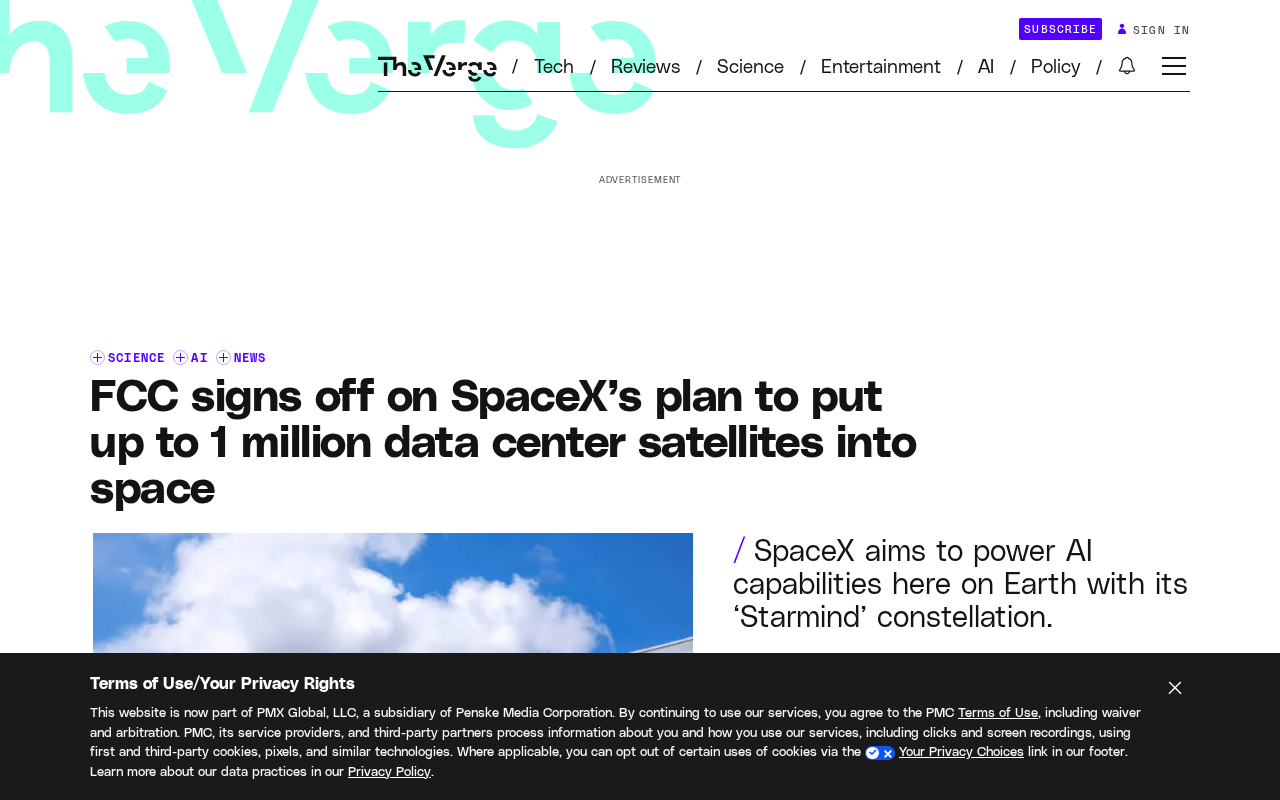
FCC authorizes SpaceX for the first time to deploy up to 1 million AI-chip satellites, launching the space data center race.
The FCC has for the first time approved SpaceX's deployment of up to 1 million AI-chip satellites under the "Starmind" program, aiming to put AI computing power in orbit. The first such authorization sets a precedent for Google, Blue Origin, and others. Space data centers offer continuous solar power and passive cooling but face launch costs, maintenance, orbital capacity, and astronomical impact challenges.
The U.S. Federal Communications Commission (FCC) announced on Wednesday that it has authorized SpaceX to deploy up to one million satellites equipped with AI chips as part of "Starmind," a program from Elon Musk's company. This is the first time the agency has approved such an application, and companies including Google and Blue Origin are also exploring the idea of sending AI data centers into space.
A Landmark FCC Approval
The FCC's statement explicitly authorizes SpaceX to deploy as many as one million AI-chip satellites. That number far exceeds the scale of any existing satellite constellation, marking a fundamental shift in how regulators view space-based computing infrastructure.
The core of the "Starmind" plan is to deploy AI computing power in orbit rather than relying on ground-based data centers. The FCC's approval clears the regulatory obstacle for SpaceX, but the specific deployment timeline and the technical details of the satellites have not yet been disclosed.
FCC (U.S. Federal Communications Commission) is an independent agency of the U.S. federal government responsible for regulating radio spectrum, wireline and wireless communications, satellite communications, and broadcasting. Any satellite system operating in or providing services to the United States must obtain FCC spectrum licenses and ground station authorizations. FCC approvals typically come with technical conditions such as orbital positions, frequency coordination, and interference protection, and may require operators to submit deployment progress reports. This authorization falls under the FCC's licensing scope for non-geostationary orbit (NGSO) satellite constellations, but a scale of one million far exceeds any previous application (SpaceX's Starlink, for example, has been approved for about 12,000 satellites), so how the regulatory framework will adapt to a constellation of such enormous size remains unknown.
Why Space Data Centers Appeal to Tech Giants
The idea of sending data centers into space is not unique to SpaceX. Google and Blue Origin are also pursuing similar projects, indicating that tech giants are seriously evaluating the feasibility of orbital computing.
Potential advantages of space data centers include: continuous power from solar energy, passive cooling via the cold space environment, and coverage of regions that ground networks struggle to reach. However, launch costs, maintenance difficulty, and space debris risks remain challenges that must be confronted.
Space data centers are built on the core idea of deploying computing, storage, and networking equipment on satellites or orbital platforms to operate directly using the characteristics of the space environment. Their technical feasibility depends on several key elements: first, solar power, since solar energy can be harvested almost continuously in orbit, unaffected by day-night cycles and weather; second, passive cooling, since the background temperature of space is about -270°C, but in a vacuum heat can only be dissipated through radiation, requiring large radiator panels rather than traditional fans; third, radiation hardening, since cosmic rays and single-event effects can cause chip computation errors or hardware damage, and AI chips require radiation-tolerant designs or redundant architectures. In addition, inter-satellite laser links and downlink bandwidth to ground stations determine the data interaction capability between space data centers and ground users.
Competitive Landscape and Regulatory Signals
The FCC's approval is the first of its kind and sets a precedent for future applicants. The follow-up efforts by Google and Blue Origin mean competition in the space computing sector is heating up.
The regulator's rapid clearance also sends a clear signal: the United States is willing to open a green channel for space-based AI infrastructure. This contrasts with the power, land, and environmental approval difficulties facing ground-based data centers.
Unresolved Questions
The scale of one million satellites raises concerns about orbital capacity and impacts on astronomical observation. It is not yet clear whether the FCC's authorization includes deployment conditions or milestone requirements. SpaceX has also not disclosed the computing specifications of individual satellites or the constellation architecture.
Whether space data centers can match ground-based facilities in economic terms still requires time to verify. But the FCC's approval has undoubtedly injected momentum into this track, and the race for space AI infrastructure has officially begun.
Orbital capacity refers to the upper limit on the number of satellites that low Earth orbit can accommodate while avoiding collisions and radio frequency interference. About 11,000 active satellites are currently tracked in low Earth orbit, with Starlink accounting for the majority. A scale of one million satellites would greatly increase collision risk, requiring more precise orbital forecasting, automated collision avoidance systems, and deorbit mechanisms for retired satellites. Impacts on astronomical observation refer to the fact that the reflection of sunlight by large numbers of satellites leaves light streaks in astronomical images, interfering with optical telescopes' observations of faint celestial objects and potentially affecting radio astronomy bands. The International Astronomical Union has repeatedly expressed concern about light pollution and spectrum interference from large constellations. Whether the FCC's authorization includes conditions such as orbital altitude limits, brightness controls, or deorbit deadlines will directly affect the degree to which these risks can be managed.
One-line Summary
FCC authorizes SpaceX for the first time to deploy up to one million AI-chip satellites, launching the space data center race.
Paragraph Summary
The U.S. Federal Communications Commission (FCC) has for the first time approved SpaceX's deployment of up to one million satellites equipped with AI chips as part of the "Starmind" program, aimed at deploying AI computing power in orbit. This is the first such authorization by regulators for space-based AI data centers and sets a precedent for future applicants such as Google and Blue Origin. Space data centers can use continuous solar power and the cold space environment for passive cooling, but face challenges including launch costs, maintenance difficulty, orbital capacity, and impacts on astronomical observation. The scale of one million satellites has raised concerns, and SpaceX has not yet disclosed the computing specifications of individual satellites, the constellation architecture, or the deployment timeline, while economic viability remains to be verified.
Related articles

S&P Weighs Downgrading Nvidia's Credit Rating: Governance and Key Man Risk in Focus
S&P is considering downgrading Nvidia's credit rating to AA-, citing corporate governance and key man risk rather than financial performance. We analyze the drivers, potential impact, and the broader trend of governance scrutiny for large tech companies in the AI era.

Generating a 3D Stacking Game from a Few Prompts: Hands-on with the Playground Experimental Platform
Playground lets users generate the 3D stacking game One More Pie from a few text prompts. This article examines the capabilities and limits of prompt-based web game generation.
AI Math Proofs Are Exploding: Humans Can't Read Fast Enough
AI math proof output now outpaces human reading speed. AINews roundup covers Erdős problems, new matrix multiplication bounds, and Fourier transform bounds—verification is the new bottleneck.