FDE Frontend Deployment Engineer: Entry Path and Seven Enterprise-Level Case Studies in the AI Era

FDE is an emerging role driven by large model adoption, with its core being embedding model capabilities into enterprise business workflows.
The article introduces FDE (Forward Deployed Engineer), an emerging role that has appeared with the wave of large model adoption, noting that its core value is not researching underlying models but transforming general-purpose large models into usable enterprise production tools. The entry path has four steps: prompt engineering, building an enterprise private knowledge base (RAG), mastering Agent workflow orchestration, and building a portfolio through real business scenarios. It lists seven enterprise-level project scenarios, including finance and tax reimbursement, intelligent logistics, hospital pathology management, intelligent dispatch, and e-commerce customer service, showing that FDE delivery embeds existing models into existing processes rather than training from scratch. It also reminds readers to remain rational: a 35,000 RMB salary corresponds to full delivery capability, the livestream content has course-traffic-generation features, technology iterates quickly, and newcomers should first master the three fundamentals before adding industry knowledge.
What Is an FDE? An Emerging Role Earning Fresh Graduates 35,000 RMB per Month
FDE (Forward Deployed Engineer) is a new role that emerged alongside the wave of large model adoption. It has existed for less than a year, yet it is already being hired en masse by major companies such as ByteDance, Meituan, Alibaba, and Tencent. In a livestream, Bilibili creator "Teacher Dayu" offered this assessment: the role has no major restrictions, even liberal arts graduates can try it, fresh graduates can earn up to 35,000 RMB per month, and in the short term it is unlikely to be replaced by AI itself.
The reasoning behind this conclusion deserves a closer look. An FDE is not an algorithm researcher, nor does it require grinding through low-level model architectures from day one. Its core value lies in "deploying" large model capabilities into a company's real business workflows—understanding prompts, knowledge bases, and Agent orchestration, and being able to transform a general-purpose model into a production tool that a specific company can actually use. What companies often lack is not the model itself, but the people who can connect the model to business processes. That is exactly where the FDE's survival space lies.

A Four-Step Entry Path: From Using AI to Delivering AI
The learning route given by the creator consists of four steps. The path is clear, and each step corresponds to a type of deliverable capability.
Step 1: Prompt Engineering—From "Using AI" to "Orchestrating AI"
Prompt engineering has the lowest barrier to entry, but it is also a dividing line. Knowing how to use ChatGPT to write a piece of copy is one thing; being able to make a large model consistently produce content that meets format requirements is another. The goal of this step is to build automation tools: automatically generating daily reports, batch-analyzing comments, and generating sales scripts. Once you reach this level, you have moved from being a user of AI to being an orchestrator of AI.
Step 2: Building an Enterprise Private Knowledge Base
A knowledge base is the most commonly used and most presentable skill an FDE brings to enterprise deployments. Enterprise data cannot be shared externally, and general-purpose models do not understand internal company documents. A private knowledge base combined with retrieval-augmented generation (RAG) thus becomes the standard solution. Mastering this step means you can handle real enterprise data-boundary issues.

Retrieval-Augmented Generation (RAG) is a technical architecture that enables a large model to first retrieve relevant snippets from an external knowledge base before answering, and then generate an answer based on the retrieved results. It addresses two major weaknesses of large models: first, training data has a cutoff date, so the model does not know the latest internal company documents; second, the model is prone to "hallucinations," fabricating content that seems plausible but is incorrect. A typical RAG pipeline includes document splitting, vector embedding, storage in a vector database, recall by semantic similarity, inserting the recalled content into the prompt, and then handing it to the model for generation. For enterprises, the greatest value of RAG is that data does not leave the internal network—the model itself does not touch sensitive data, only the retrieved snippets, which allows highly regulated industries such as finance and healthcare to use large model capabilities as well.
Step 3: Understand Agent Workflows
Combining multiple AI capabilities into an automated pipeline is the FDE's most core delivery capability. A single Agent can do only so much; only when multiple Agents are connected in series according to business processes can they cover end-to-end scenarios such as approvals, queries, and dispatch. This step determines whether you can take on enterprise-level projects rather than just building demos.
Agent (intelligent agent) differs from simply calling a large model API in its "autonomy": an Agent not only generates text, but can also plan steps, call tools (such as querying databases, sending emails, or invoking external interfaces), and reflect on execution results to adjust the next action. An Agent is usually composed of a large model as the "brain," a set of tool functions as the "hands and feet," and a memory mechanism. A multi-Agent workflow arranges multiple Agents with different responsibilities according to business processes—for example, one responsible for intent recognition, one for querying, and one for approval judgment—connected through message passing or orchestration frameworks (such as LangGraph, AutoGen, etc.). This architecture is suitable for end-to-end scenarios requiring multi-step collaboration, such as approvals, dispatch, and customer service, and it is also the most core engineering capability for FDEs delivering enterprise-level projects.
Step 4: Practice with Real Business Scenarios
Find processes in your own daily work that can be optimized with AI and build demos—that is your portfolio. The creator particularly emphasized this point, because in interviews there are too many people who "know an Agent" or "have a demo," while very few can clearly explain what specific problems they have solved.
Seven Enterprise-Level Project Scenarios: What FDEs Actually Deliver
The livestream listed seven directions for enterprise-level projects. They cover a wide range and can serve as samples for understanding the work content of an FDE.
- Multi-Agent system for finance, tax, and reimbursement: Large enterprises have complex financial approval and reimbursement processes, and multi-Agent systems handle the approval flow.
- Intelligent logistics system: Logistics nodes are complex and manual processing costs are high, involving cargo inspection, inventory queries, and supplementary reference data entry.
- Intelligent pathology management platform for hospitals: Top-tier hospitals have large case volumes, and doctors spend a great deal of manual effort writing cases. This combines multimodal RAG and multi-Agent systems for pathology management. According to the creator, this scenario involves a combination of multimodal retrieval and Agent orchestration.
- Intelligent dispatch: A standard requirement in traditional industries such as real estate, agriculture, and manufacturing, and also the link that business owners most want to transform with large models.
- E-commerce intelligent customer service and high-concurrency retrieval: Involves model selection and retrieval relevance optimization.
- E-commerce scenarios in the alcoholic beverages industry: The creator mentioned that the team had worked on a project for a listed domestic alcoholic beverages company based on a combination of multi-Agent systems, multimodal RAG, and vector databases. The background was declining interest in baijiu among younger consumer groups, and the company hoped to revitalize its business.
- Early-warning monitoring systems for healthcare and defense state-owned enterprises: These are real projects at major companies that lean more toward deep industry specialization.
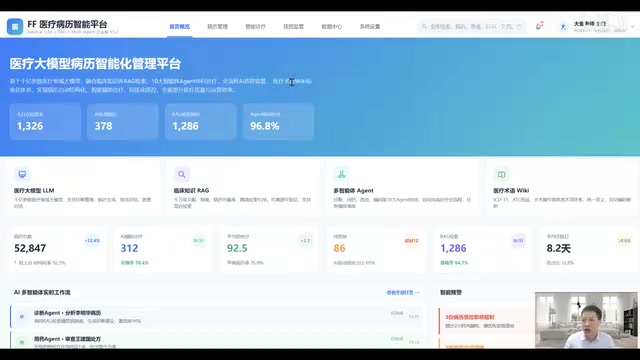
These projects share one common feature: none of them involve training a model from scratch; instead, they embed existing model capabilities into existing business processes. This is precisely the division of labor between FDEs and algorithm roles.
Multimodal RAG is an extended form of RAG in which the retrieval objects are no longer limited to plain text but also cover unstructured data such as images, tables, scanned documents, and audio. The medical pathology scenario is a typical example: cases contain both text written by doctors and pathology slide images and test report tables, and the system needs to vectorize content from different modalities in a unified way and then perform cross-modal retrieval. Implementation usually requires multimodal embedding models (such as CLIP-like models or specialized image-text embedding models) to map images and text into the same vector space, combined with OCR and layout analysis to process scanned documents. The engineering complexity of multimodal RAG is significantly higher than that of plain-text RAG, and it is also where FDEs' differentiated competitiveness lies in industries such as healthcare and manufacturing.
The Window of Opportunity and What to View Calmly
The creator repeatedly mentioned a reality: traditional roles such as Java, frontend, Python, big data, iOS/Android, blockchain, and data analysis have seen layoffs at some companies, while large-model-related roles are expanding. He advised learners to follow the direction of national policy, because traditional enterprises are using large models for cost reduction and upgrades.
This judgment holds directionally, but the livestream content itself has a clear course-traffic-generation angle—there are multiple prompts for viewers to type "6," add the teacher to receive materials, and an emphasis on attending the full class to get the project source code. When readers refer to this path, they need to separate "the role genuinely exists" from "course marketing rhetoric." Demand for FDE hiring is indeed growing, but a 35,000 RMB monthly salary corresponds to candidates with full delivery capability, not beginners who have just finished the four steps.

Another point worth noting is the speed of technological iteration. The creator himself admitted that many people study on their own for half a year and then find that new technologies have emerged by the time they finish, leaving them standing still. For engineering deployment roles like FDE, rather than chasing every new framework, it is better to practice the three fundamentals—prompting, knowledge bases, and Agent orchestration—until you can deliver independently, and then layer on specific industry knowledge.
A Few Pragmatic Suggestions for Newcomers
If you are considering moving toward FDE, you can start with three things: first, find a business scenario you are familiar with and use prompting plus a knowledge base to build a tool that actually works; second, draw the Agent orchestration flowchart clearly and be able to explain why each step is designed that way; third, accumulate a presentable portfolio instead of stopping at the level of "having taken a course." When companies hire FDEs, they look at whether you can get the model running inside the business. That will not change because of course advertising.
Related articles

Gemini 4 Argon Hands-On: AI Builds Board Games, Constructs Temples, and Trains Robots Autonomously
Gemini 4 Argon hands-on roundup: AI autonomously builds a desk racetrack and temple in Blender, writes a ray tracing engine, trains a humanoid robot to sink 7 shots, plus API pricing and developer access.

The Magic Octagonal Coin: Why Only 9% of People Can Predict Its Flip?
Only 9% of people can correctly predict the Magic Octagon coin flip. This article explains its spatial rotation mechanism, common cognitive pitfalls, and a new hypothesis based on Relevance Theory, exploring the limits of human spatial reasoning.

Sam Altman: AI Is Entering the Era of Scientific Discovery — Math Breakthroughs Will Replicate in Biology and Energy
Sam Altman says AI is entering the era of scientific discovery — math breakthroughs will replicate in biology, materials science, and energy to help develop new drugs and energy sources.