FedEx Places $300M Order for 2,000 Electric Trucks from Harbinger

FedEx orders 2,000 electric trucks from Harbinger in a ~$300M deal as the startup eyes an IPO.
Logistics giant FedEx has ordered 2,000 electric trucks from medium-duty EV startup Harbinger in a deal worth approximately $300 million — the largest single order in Harbinger's history. Specializing in medium-duty electric truck chassis and powertrains for last-mile delivery and similar applications, Harbinger's selection by FedEx signals real-world commercial validation. The order coincides with reports that Harbinger is considering an IPO, with the firm commitment from a marquee customer providing critical proof of commercial viability for capital markets. The deal also highlights broader trends: logistics fleets, with fixed routes and centralized charging, are among the most electrification-ready segments, and deep partnerships between major operators and startup manufacturers are emerging as a defining dynamic in the electric commercial vehicle market.
FedEx and Harbinger Close a $300M Electric Truck Deal
Logistics giant FedEx has placed an order worth approximately $300 million with electric truck startup Harbinger for 2,000 electric trucks. This is not only the largest single order in Harbinger's history, but also marks a major milestone as the emerging electric commercial vehicle manufacturer enters a phase of rapid expansion.
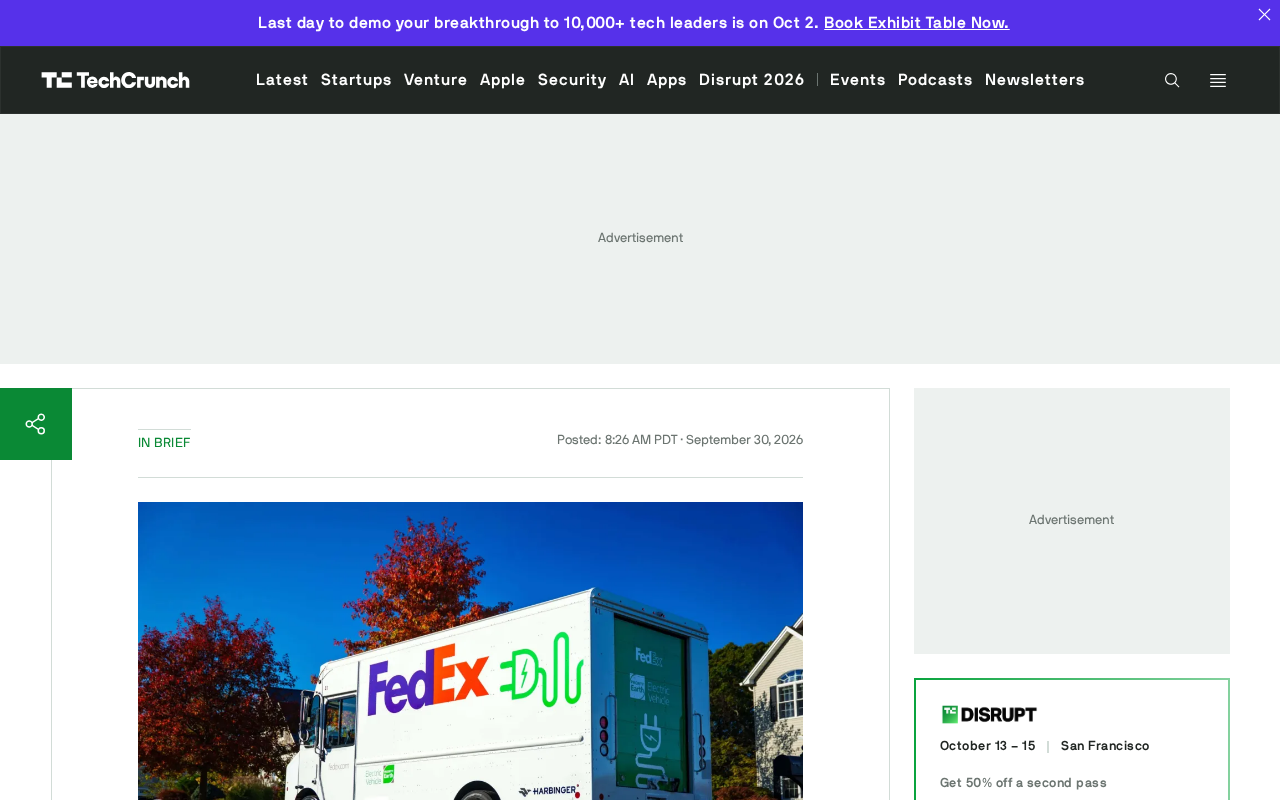
Fleet electrification is nothing new for the freight and logistics industry, but a company of FedEx's scale placing a single order for 2,000 vehicles still carries significant weight as an industry bellwether. The deal sends a clear signal to the market: major logistics companies are accelerating the integration of electric commercial vehicles into actual operations — well beyond the pilot phase.
Harbinger: An Electric Truck Startup Worth Watching
Harbinger is a startup that has emerged as a notable player in the electric commercial vehicle space in recent years, focusing on medium-duty electric truck chassis and powertrain development. Unlike most EV newcomers that target the passenger vehicle market, Harbinger has zeroed in on the medium-duty commercial vehicle segment — covering use cases such as last-mile delivery and RV chassis applications, where range and payload requirements are well-defined and the case for electrification is compelling.
Landing a marquee customer like FedEx is a weighty endorsement for any startup. Logistics industry customers apply extremely rigorous standards to vehicle reliability, maintenance costs, and total cost of ownership (TCO). Breaking into FedEx's supply chain means Harbinger's products have earned recognition against real-world commercial benchmarks.
Medium-duty trucks generally refer to vehicles with a gross vehicle weight rating between 6 and 26 tons — corresponding to Class 4 through Class 6 in the North American classification system. This segment has long been overshadowed by the passenger EV boom, yet it is the absolute workhorse of urban logistics — supermarket restocking, last-mile parcel delivery, and refrigerated food transport all rely heavily on these vehicles. Compared to heavy-duty trucks, medium-duty vehicles face lower range demands (typical daily mileage falls between 150 and 300 kilometers), making battery cost pressures more manageable. Compared to passenger cars, their use cases are highly concentrated, making charging infrastructure deployment far more feasible. For these reasons, medium-duty commercial vehicles are widely seen as the "lowest-hanging fruit" for electrification, attracting a cohort of focused startups including Harbinger and Xos Trucks. Total Cost of Ownership (TCO) is the core metric logistics operators use to evaluate vehicle economics, encompassing acquisition cost, fuel/electricity expenses, maintenance, and residual value. Electric vehicles are increasingly demonstrating a TCO advantage over conventional fuel-powered commercial vehicles, driven by lower energy and maintenance costs.
Behind the Big Order: Harbinger May Be Eyeing an IPO
According to reports, this record-breaking order comes as Harbinger is reportedly considering an initial public offering (IPO). The timing of these two developments is unlikely to be coincidental.
For a company planning to go public, a large, firm order from a well-known enterprise customer is a critical asset in demonstrating commercial viability to capital markets. It not only directly improves revenue visibility, but also signals to potential investors that the company has real, sustainable market demand — rather than a valuation propped up by concepts and vision alone.
Against a backdrop in which many EV startups have faced persistent profitability pressure and a cooling capital market sentiment over the past few years, Harbinger's approach of entering the IPO process backed by concrete large-scale orders appears notably pragmatic. It also reflects a broader shift in how capital markets evaluate electric commercial vehicle companies — reverting to fundamentals: orders, delivery capability, and cash flow are now valued far more than grand narratives.
Over the past several years, SPACs (Special Purpose Acquisition Companies) became the dominant IPO route for EV startups, with companies like Lordstown Motors, Canoo, and Arrival all going public via this mechanism — only to subsequently suffer dramatic stock price declines and production delivery failures, significantly reducing the market's tolerance for the sector. Traditional IPOs, while lengthier and subject to stricter scrutiny, demand greater transparency around business fundamentals. In this context, a genuine large-scale order carries dual value: it serves as direct proof of revenue visibility and as a powerful rebuttal to skepticism about "PowerPoint automakers." If Harbinger chooses to advance its IPO after securing this order, it signals that the core of its fundraising narrative has shifted from technological vision to commercial delivery — a posture well aligned with the current secondary market's preference for companies that can show orders and ship products.
The Broader Significance for Commercial Vehicle Electrification
FedEx's order reflects several broader trends in commercial vehicle electrification. Logistics fleets typically operate fixed mileage on predictable routes and can charge vehicles centrally — characteristics that make them better suited than passenger vehicles for early-stage electrification, and easier to build a compelling economic case around.
Driven by dual pressures of operational costs and carbon emissions, a growing number of leading logistics companies are beginning to purchase electric vehicles at scale. FedEx has previously stated public long-term goals for fleet electrification, and this collaboration with Harbinger represents a concrete execution of that strategy.
For the broader industry, deep partnerships between major customers and startup manufacturers give new entrants the order volume needed to scale production, while also allowing logistics operators to diversify supply chain risk. This mutual selection dynamic may become a key driver shaping the future competitive landscape of the electric commercial vehicle market.
Conclusion
A $300 million order for 2,000 vehicles is both a milestone in Harbinger's development journey and yet another data point underscoring the accelerating electrification of commercial vehicles. Set against the backdrop of IPO speculation, this startup is attempting to use tangible commercial results to secure a more favorable position in capital markets. Going forward, whether Harbinger can deliver on schedule and sustain product quality and cost discipline will determine how much long-term value this major order ultimately translates into.
Related articles

Why Does the Tesla Roadster Need to Fly? A Deep Dive into Musk's Wild Demo
Tesla's Roadster launch showed wall-climbing, upside-down driving, and flying stunts—but The Vergecast notes the demo car may lack a battery, the Rocket version is invite-only and not street-legal, and the website terms don't guarantee delivery. After nine years of delays, why does this car still need to exist?

AI Is Not a Replacement: Human-AI Collaboration Through the Lens of Factory Root Cause Analysis
Starting from factory root cause analysis, this article explains how AI accelerates evidence chain construction rather than replacing human experts, exploring the pragmatic implementation logic and business value of 'AI supporting people rather than replacing them.'

AI Agent Decision Auditing: Building an Evidence Chain in Regulated Workflows
Starting from a Reddit discussion, this article analyzes three core issues in AI agent decision auditing within regulated workflows: what fields audit records should contain, how to handle feedback latency for erroneous decisions, and how to continuously calibrate LLM judge consistency with human judgment.