Fighting Long Video Quality Degradation: A Two-Stage Refinement Experiment with H3 One-Shot-No-Cuts
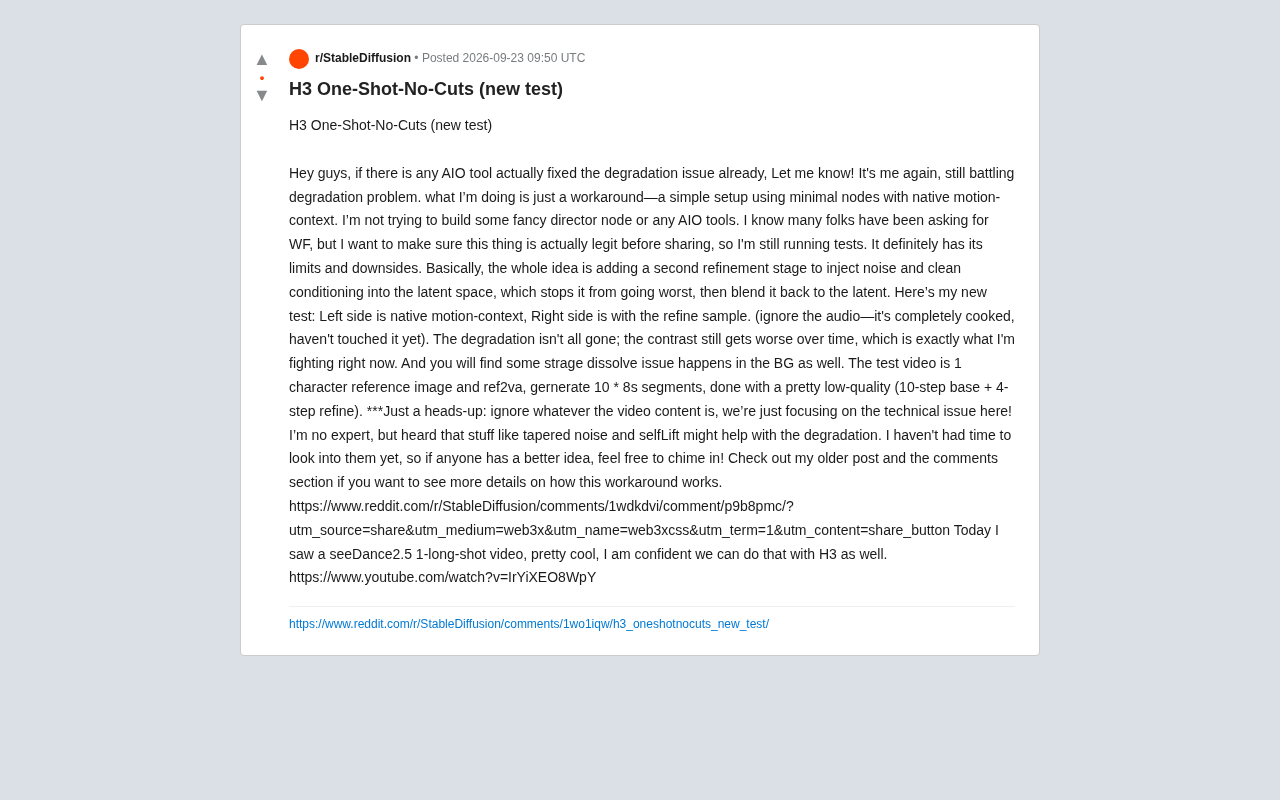
A developer proposes a two-stage latent refinement approach on H3 to combat quality degradation in long AI video generation.
A developer shared an experimental solution to long video quality degradation in the Stable Diffusion community: adding a second refinement stage to H3's one-shot workflow by injecting noise and clean conditioning into the latent space, then blending results back into the original latent. Tests at very low quality settings (10 base steps + 4 refinement steps) generated 10 segments totaling ~80 seconds, showing improvement but leaving contrast decay and background dissolve unresolved. The author openly sought community input on tapered noise and selfLift techniques.
In the realm of long-duration AI video generation, quality degradation remains an unavoidable challenge. A Reddit user in the r/StableDiffusion community recently shared their latest experiment tackling this issue — a "One-Shot-No-Cuts" approach built on the H3 model. This isn't a flashy director-level toolset, but a straightforward workflow constructed with minimal nodes, with one core goal: keeping long videos from getting progressively blurrier during continuous generation.
The Degradation Problem in Long Video Generation
Quality degradation refers to the gradual deterioration of visual quality as longer video sequences are generated over time. Contrast imbalance, loss of detail, and strange dissolve effects appearing in the background are all classic symptoms. This problem is especially pronounced in long video generation that relies on continuous motion-context inference — each segment builds on the previous one, causing errors to accumulate and amplify.
The author candidly admits they're "still fighting the degradation problem" and makes clear that this approach has "obvious limitations and drawbacks." Rather than packaging it as a mature AIO (All-In-One) tool, they treat it as a workflow for validating a viable mitigation strategy. This pragmatic attitude reflects the most authentic form of community-driven technical exploration.
From a technical standpoint, degradation is closely tied to the "context transfer mechanism" of autoregressive video generation. In diffusion-based video architectures like H3, long videos are typically generated using sliding windows or segmented continuation: each new segment takes several frames from the end of the previous segment (or their latent space representations) as motion-context input, and the model infers subsequent frames from there. While this design ensures temporal coherence, it also causes errors to snowball — tiny deviations introduced during each sampling pass are "inherited" and amplified by the next segment. Contrast shift is one of the earliest symptoms to appear, as diffusion models tend to regress toward the mean of training data after multiple iterations, compressing highlights and lifting shadows. Background regions, having low motion and being repeatedly rendered, are especially prone to pixel-level "dissolve" blurring. This bears some mechanistic resemblance to "drift error" in traditional video codec systems.
Core Approach: Second-Stage Refinement Injection
The technical core of the approach is adding a "refinement stage." The specific method involves injecting noise and clean conditioning into the latent space to prevent continuous image deterioration, then blending the processed results back into the original latent.
Simply put, this adds a "correction" sampling pass on top of the native motion-context generation. The author's test comparison is straightforward: the left side shows pure native motion-context output, while the right shows the result after adding the refine sample. From their description, the refined output does show improvement in degradation control — but the problem isn't fully resolved. "Contrast still degrades over time, and that's exactly what I'm working on now," they note, while strange dissolve effects continue to appear in the background.
The operation of "injecting noise into the latent space" draws on the SDEdit concept from diffusion models: adding a controlled amount of Gaussian noise to an existing clean latent, then resampling with fewer denoising steps to "refresh" details while preserving the overall structure. Adding clean conditioning serves as an anchor — providing the model with the current desired image state to prevent the resampling from drifting too far. Finally, blending the refined result with the original latent at a weighted ratio is a common approach for balancing "fidelity" against "correction strength": a higher blend ratio means stronger correction, but also a greater risk of disrupting inter-frame motion consistency. This logic closely mirrors the img2img refinement pipeline in image generation, simply extended to the temporal dimension — with the added consideration of inter-frame consistency costs.
Test Parameters and Real-World Limitations
The test configuration is quite informative: using 1 character reference image with ref2va, generating 10 segments of 8 seconds each (approximately 80 seconds total), with deliberately low sampling steps — 10 base steps + 4 refinement steps. The author explicitly emphasizes this is a "pretty low quality" setup, intended to expose degradation under extreme conditions rather than chase final production quality. They also advise viewers to ignore the video content itself and the "completely cooked" audio, and focus only on the technical aspects.
This approach of stress-testing with low step counts and long durations is commendable. Observing improvement even under the harshest parameters suggests the method has a degree of general applicability, while the remaining contrast decay and background dissolve clearly define the current boundaries of the approach.
Community Wisdom: Other Directions Worth Exploring
The author humbly acknowledges they're "not an expert," but mentions hearing that techniques like tapered noise and selfLift may help alleviate degradation — though they haven't had time to dig into them deeply — and openly invites the community to share better ideas. This open, collaborative attitude is exactly what drives continuous progress in the open-source generative AI community.
Notably, they also referenced a "long one-shot" video from SeeDance 2.5 as a benchmark, expressing confidence: "I believe it's possible to achieve this with H3 as well." This hints at a broader industry trend — long-duration, cut-free, highly coherent AI video generation is becoming the next frontier that every model is racing to conquer.
The tapered noise technique the author mentions is a strategy that applies "decreasing noise" to motion-context frames during video continuation: frames closer to the current generation window receive less noise to maintain near-end coherence, while earlier frames are allowed greater noise perturbation to reduce the persistent influence of distant errors. This shares a conceptual parallel with the "easy-to-hard" progressive approach in curriculum learning. selfLift, meanwhile, is a community-circulated self-bootstrapping refinement technique whose core idea involves using the local statistical properties of the current output (such as mean brightness and contrast distribution) to dynamically adjust sampling parameters — essentially letting the model self-correct using its own output as a reference, without needing additional reference images or manual intervention. Both are "plug-and-play" approaches that intervene only at inference time without modifying model weights, which is a key reason the open-source community is motivated to explore such techniques.
Closing Thoughts
The value of this experimental write-up lies not in providing a perfect answer, but in honestly documenting a real technical problem-solving process: a clearly defined problem, a reproducible methodological approach, frank acknowledgment of limitations, and an open call for help. For developers interested in AI video generation — especially long-video coherence challenges — the two-stage refinement injection approach offers a worthwhile starting point to test hands-on. Interested readers can check the author's earlier posts and comment threads for more details on the workflow.
Related articles

ProTok: A Unified Protein Tokenizer via Multi-Codebook Quantization
ProTok introduces a unified protein tokenizer using modular multi-codebook quantization and modality dropout to map sequence, structure, and function into one discrete vocabulary. It ranks 1.4 on average in StructTokenBench, reaches 0.939 lDDT on CATH, and generates 52% designable backbones.

Membership Inference Attacks on Tabular Data: An SoK Reexamination of Privacy Evaluation
An SoK paper systematically examines membership inference attacks in tabular machine learning, revealing how class granularity and majority class proportion affect vulnerability, and noting that single-out records remain highly exposed under common defenses. It calls for rethinking the privacy evaluation paradigm.

ReTerm: Teaching Terminal Agents to Recover from Their Own Mistakes
ReTerm proposes a self-recovery training method for terminal agents: SFT cold start with ReTerm-10K, then ReTerm-GRPO branching from failure states. ReTerm-9B built on Qwen3.5-9B reaches 34.8% Pass@1 on Terminal-Bench 2.0, a 14.6-point gain over the base model. Code and data are open-sourced.