Find Skills: A Skill That Helps You Find the Right Claude Skill

Find Skills uses natural language search to help users quickly locate the tools they need among thousands of Claude Skills.
The article introduces a meta-Skill called Find Skills, designed to solve the problem of "can't find the right Skill" after the Claude Skill ecosystem expanded. Claude now has thousands of available Skills covering design, video, code, and marketing, and manual filtering often takes hours. Find Skills lets users describe their needs in one sentence, and it searches the Skill library for matches, shifting the selection cost from the user to the tool side. Its installation is said to require only one command, keeping the barrier low. The article notes that as a meta-Skill, its value amplifies as the total number of Skills grows, but the video is mainly promotional and demonstrative and lacks key data such as retrieval accuracy, response speed, and the Skill library's source and update mechanism. It recommends trying it on a small scale first.
Claude's Skill ecosystem is expanding rapidly—design, video, code, marketing… there's a corresponding Skill for every type of task. But when it's actually time to use one, the problem usually isn't "there are no Skills"—it's "can't find the right Skill." A Skill called Find Skills emerged precisely to solve this search problem—it doesn't produce designs or code itself; instead, it helps you locate the one you actually need in the Skill library.
The New Problem Brought by Exploding Skill Numbers: Selection Cost
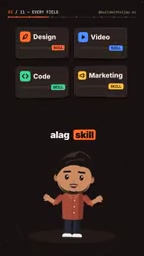
According to the video, the number of Skills available in Claude has reached the thousands, covering almost all common work scenarios such as design, video, code, and marketing. On the surface this is a good thing—it means ready-made tools are available no matter what task you're doing. But in practice, each type of task has multiple Skills, and pinpointing the one "best suited to the current task" requires extensive comparison and trial and error.
One detail mentioned in the video illustrates the pain point well: just finding the right Skill can take hours. This time neither produces content nor generates direct value—it's pure preparation cost. The more Skills there are, the higher this cost becomes, creating a somewhat ironic situation—the prosperity of the ecosystem itself becomes a barrier to use.
Claude Skill is an extensible capability mechanism Anthropic introduced for Claude: each Skill is essentially a packaged set of instructions, scripts, or workflow configurations that Claude automatically loads and invokes when it recognizes a matching task intent. Skills can cover different domains such as document processing, design generation, and coding assistance, and users can write their own or obtain them from the community. Its design philosophy is similar to "plugins," but it places more emphasis on describing trigger conditions in natural language, so the number grows extremely fast—which directly brings challenges in retrieval and governance.
How Find Skills Works: Describe Your Need in One Sentence
The interaction logic of Find Skills is straightforward: you only need to state "what you want to do," and it searches the Skill library and finds matching Skills.

This design shifts the selection work from the user side to the Skill side. Users don't need to know the naming conventions, classification system, or keyword habits of Skills in advance—they just describe the goal in natural language, and Find Skills handles the search and filtering. For users who don't know what tools exist in the ecosystem or can't remember specific Skill names, this layer of abstraction lowers the barrier to use.
From a product perspective, Find Skills is a typical "meta-Skill"—it doesn't execute tasks directly but serves the invocation of other Skills. The value of such tools amplifies as the total number of Skills grows: the larger the library, the less feasible manual retrieval becomes, and the stronger the need for automated discovery.

Meta-Skill refers to a category of tools that don't directly complete business tasks but are used to manage or orchestrate other Skills. Common meta-Skills include Skill discovery, dependency checking, version management, batch invocation orchestration, and more. They don't produce designs or code themselves; instead, they improve the usability of the entire Skill ecosystem. The utility of a meta-Skill is positively correlated with ecosystem scale: the fewer Skills there are, the easier manual selection is, and the more limited the value of a meta-Skill; once the number of Skills crosses a certain threshold, automated discovery and routing become essential. Find Skills is a representative of this category, leaning toward "retrieval and discovery."
Installation and Barriers to Use
The video's author says the complete installation configuration is ready, and the process can be summarized as "one command plus installation," with no complex additional setup required. For users who frequently try new AI tools in their daily work, the main appeal of such lightweight tools lies in their low integration cost and the ability to quickly verify whether they work well.
As a side note, the video content is mainly promotional and demonstrative. It doesn't provide data on Find Skills' specific retrieval accuracy, response speed, or mismatch rate, nor does it explain the source and update mechanism of the Skill library it relies on. This information is crucial for judging the tool's long-term usability, but the material doesn't cover it.
Retrieval accuracy (Precision/Recall) and mismatch rate are core metrics for evaluating search-type tools. Precision measures the proportion of returned results that are truly relevant, recall measures the proportion of all relevant Skills that are found, and mismatch rate reflects the frequency of recommending irrelevant Skills. For tools like Find Skills, if precision is insufficient, users still need to filter the results a second time, and the selection cost isn't truly eliminated; if recall is insufficient, the most suitable Skill may be missed. These metrics require benchmark testing based on real Skill libraries and task samples to draw conclusions—they can't be judged from a demo video alone.
A Brief Observation
The focus of competition in the Skill ecosystem is shifting from "whether it exists" to "whether it can be found." When quantity is no longer a scarce resource, indexing, retrieval, and recommendation become the new value links. Find Skills represents an attempt in this direction—whether it succeeds depends on whether its search quality is truly better than manual browsing, and that requires actual use to verify.
For users who chase new AI tools every day, this type of tool is worth watching, but it's advisable to try it on a small scale first before deciding whether to incorporate it into your daily workflow.
One-line Summary
Find Skills uses natural language search to help users quickly locate the tools they need among thousands of Claude Skills.
Paragraph Summary
The article introduces a meta-Skill called Find Skills, designed to solve the problem of "can't find the right Skill" after the expansion of the Claude Skill ecosystem. Claude now has thousands of available Skills covering scenarios such as design, video, code, and marketing, and manual filtering often takes hours. Find Skills lets users describe their needs in one sentence, and it searches the Skill library for matches, shifting the selection cost from the user to the tool side. Its installation is said to require only one command, keeping the barrier low. The article notes that as a meta-Skill, its value amplifies as the total number of Skills grows, but the video is mainly promotional and demonstrative and lacks key data such as retrieval accuracy, response speed, and the source and update mechanism of the Skill library. It recommends trying it on a small scale first.
Related articles
AWS AgentCore Gateway: Connecting AI A…
AWS AgentCore Gateway: Connecting AI Agents to Enterprise Backends with MCP
How AWS AgentCore Gateway acts as a primary MCP server to aggregate REST APIs, Lambda, and existing MCP services? Analyzing its AST real-time mapping, zero cold start, semantic search for tool overload, session isolation, and key injection security design, plus the architectural approach to decoupling enterprise AI agents from backends.

One Link Gives Figma AI a New Skill: Hands-On with MCP Connectors
Paste one MCP server link and the AI Agent in Figma gains new tool capabilities. We break down the setup flow, 20+ one-click apps, read/write permissions and execution policies, and the public HTTPS requirement.

Cognition SWE-2 in Practice: One Prompt to Handle the Whole Product Launch Process
Analyzing a YouTube creator's prompt for using Cognition SWE-2 to launch a product: a landing page, seven-email sequence, and non-buyer follow-up tool, plus how the 'test and report' constraint changes AI delivery quality.