Fine-Tuning a 9B Decision Classifier on a Budget: No Frontier Lab Required

Fine-tune a capable 9B decision classifier using SFT, public data, and two simple tricks — no big lab budget required.
An AI developer educator shared a low-cost recipe for training a decision classifier: SFT fine-tuning of a 9B Jev-style model on Fireworks, using only public datasets and two undisclosed "simple tricks" — with the full pipeline open-sourced. For well-defined classification tasks, SFT is sufficient without RLHF or DPO, and a 9B model beats larger ones on cost, latency, and deployability. The core value is educational: it proves ordinary developers can build production-ready classifiers without frontier lab resources.
You Don't Need to Be a Big Lab to Train a Reliable Decision Classifier
For a long time, training a robust classification model seemed like the exclusive domain of frontier AI labs — requiring massive compute budgets, vast proprietary datasets, and complex training pipelines. But a recent share from an AI developer education team is challenging that assumption: with nothing more than standard supervised fine-tuning (SFT), public datasets, and two simple tricks, you can build a usable decision classifier on a mid-sized model.
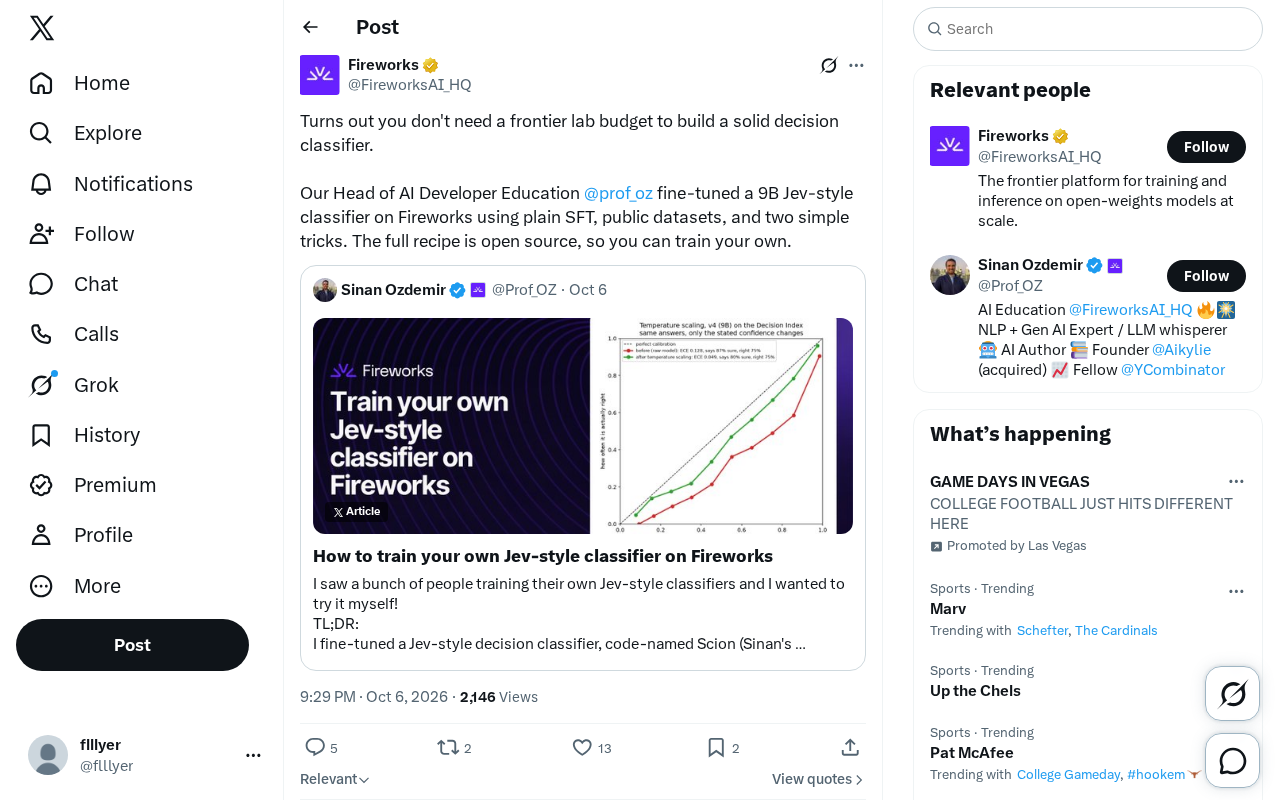
According to the tweet, @prof_oz, Head of AI Developer Education, fine-tuned a Jev-style classifier at the 9B scale on the Fireworks platform. The key insight: the entire approach relies on no closed-source data and no expensive custom pipelines — it's a fully reproducible path that anyone can follow.
Breaking Down the Method: SFT + Public Data + Two Tricks
Based on what's been shared, the recipe has three core components:
Supervised fine-tuning (SFT) as the backbone. Rather than using more complex alignment techniques like RLHF or DPO, the approach goes back to basics with SFT. For a task like classification — where objectives are clear and labels are well-defined — SFT is often more than sufficient. More complex reinforcement learning pipelines can introduce unnecessary engineering overhead and instability.
Entirely public datasets. This is the key to lowering the barrier to entry. Public data means anyone can access the same training material — there's no "data moat," and the results are both verifiable and reproducible.
Two "simple tricks." The tweet doesn't elaborate on the specifics, but emphasizes they're simple yet effective. This hints that improving classifier quality often comes down to smart choices in data processing, label design, or training strategy — not throwing more compute at the problem.
Supervised fine-tuning (SFT) involves directly updating model parameters using labeled input-output pairs, teaching the model to map specific inputs to desired outputs. By contrast, RLHF (Reinforcement Learning from Human Feedback) requires training a separate reward model, designing a reward function, and running a reinforcement learning loop — significantly more engineering complexity. DPO (Direct Preference Optimization) simplifies the RLHF pipeline but still requires paired preference data. For classification tasks, the label space is discrete and closed (e.g., "yes/no" or a fixed set of categories), the correct answer is unambiguous, and SFT's training signal is already clear enough. Introducing reinforcement learning only adds hyperparameter tuning difficulty and training instability — which is why SFT remains the dominant approach for classification models in production.
The Pragmatic Case for 9B Scale
Choosing the 9B parameter range over a much larger model is itself a meaningful signal. For decision classification tasks, a model doesn't need the full generative capability of a frontier LLM — the scope of reasoning and classification is relatively bounded. A 9B model far outperforms models with tens or hundreds of billions of parameters in terms of inference cost, deployment complexity, and response latency, making it far better suited for high-frequency classification in production environments.
This also reflects a broader industry trend: fine-tuning a "small but specialized" model for a specific task is often more cost-effective and controllable than calling a general-purpose large model via API.
The "Jev" in "Jev-style classifier" refers to a class of classification architectures designed with judgment as the core objective — emphasizing concise, deterministic outputs rather than open-ended generation. These classifiers are commonly used in scenarios like conversational intent recognition, content moderation, and routing decisions, where low latency and high throughput are required. Fireworks is a cloud platform offering LLM inference and fine-tuning services, allowing developers to upload custom datasets and run SFT on their infrastructure without building their own GPU clusters. For small and mid-sized teams without in-house compute, platforms like this dramatically lower the barrier to fine-tuning experiments — converting the "do you have GPUs?" obstacle into a more manageable pay-as-you-go cost.
Why Open Source Matters: Reproducibility Is the Real Value
The most commendable aspect of this share is that the full recipe has been open-sourced. For the developer community, a result that "sounds impressive" is far less valuable than a process that "actually runs." Open sourcing means:
- Anyone can retrain their own classifier using their own data;
- The effectiveness of the method can be independently verified, rather than taken on faith as marketing copy;
- The educational intent is explicit — this reads more like teaching material than a product announcement.
Given @prof_oz's role as Head of AI Developer Education, the project was clearly positioned around dissemination and empowerment — the goal is to help more developers build hands-on skills in low-cost fine-tuning.
What This Means for Developers
This seemingly brief share conveys a clear and practical message: don't be intimidated by the "frontier lab budget" narrative. For well-defined, vertical tasks, ordinary teams can absolutely use public resources and established platforms like Fireworks to train models that meet real business needs.
For teams currently weighing whether to "fine-tune a model vs. call an API" for a classification need, this offers a compelling middle path: grab a public dataset, run a low-cost SFT fine-tune, evaluate the results, and then decide whether to invest more resources.
One caveat: this tweet is light on detail. The specifics of the "two tricks," dataset details, and evaluation metrics all require checking the open-source repository for a complete picture. This article is based on publicly available information — developers who are interested should refer directly to the original open-source project for the full recipe.
Related articles

Should U.S. College Fraternities Be Banned? A Researcher's Incisive Observations
Why not just ban U.S. college fraternities? A researcher finds the key resistance comes from decision-makers' own fraternity identities and schools' "willful ignorance."

Microsoft Discovery: Accelerating Scientific Discovery with AI Agents
Microsoft's Discovery platform runs specialized AI agents to help researchers screen and prioritize the most promising compounds and experimental paths, reducing experiments and accelerating scientific discovery.

Cambridge Heavy Industries Secretly Develops Desktop-Scale Nuclear Fusion Device
Cambridge Heavy Industries is secretly developing a desktop-scale laser-driven nuclear fusion device, targeting the equipment supply market for fusion power plants. This article analyzes its miniaturization technology path, commercialization logic, and unique positioning in the fusion startup wave.