Fire at Starlink Site in Bulgaria After Suspected Sabotage in Poland

Fire at a Starlink site in Bulgaria follows suspected sabotage at a related facility in Poland, spotlighting ground segment security risks.
A fire occurred at a Starlink site in Bulgaria after a related facility in Poland was suspected of deliberate sabotage. The temporal and geographic proximity of the two incidents has sparked speculation about a coordinated campaign. Starlink's ground gateway stations, which connect satellite signals to terrestrial networks, are becoming potential physical attack targets due to their strategic value in military communications, emergency response, and remote connectivity. While Starlink's architecture has some redundancy, simultaneous damage to multiple ground nodes could test overall resilience. Official investigation conclusions have not yet been released.
Fire at Starlink Site in Bulgaria After Suspected Sabotage in Poland
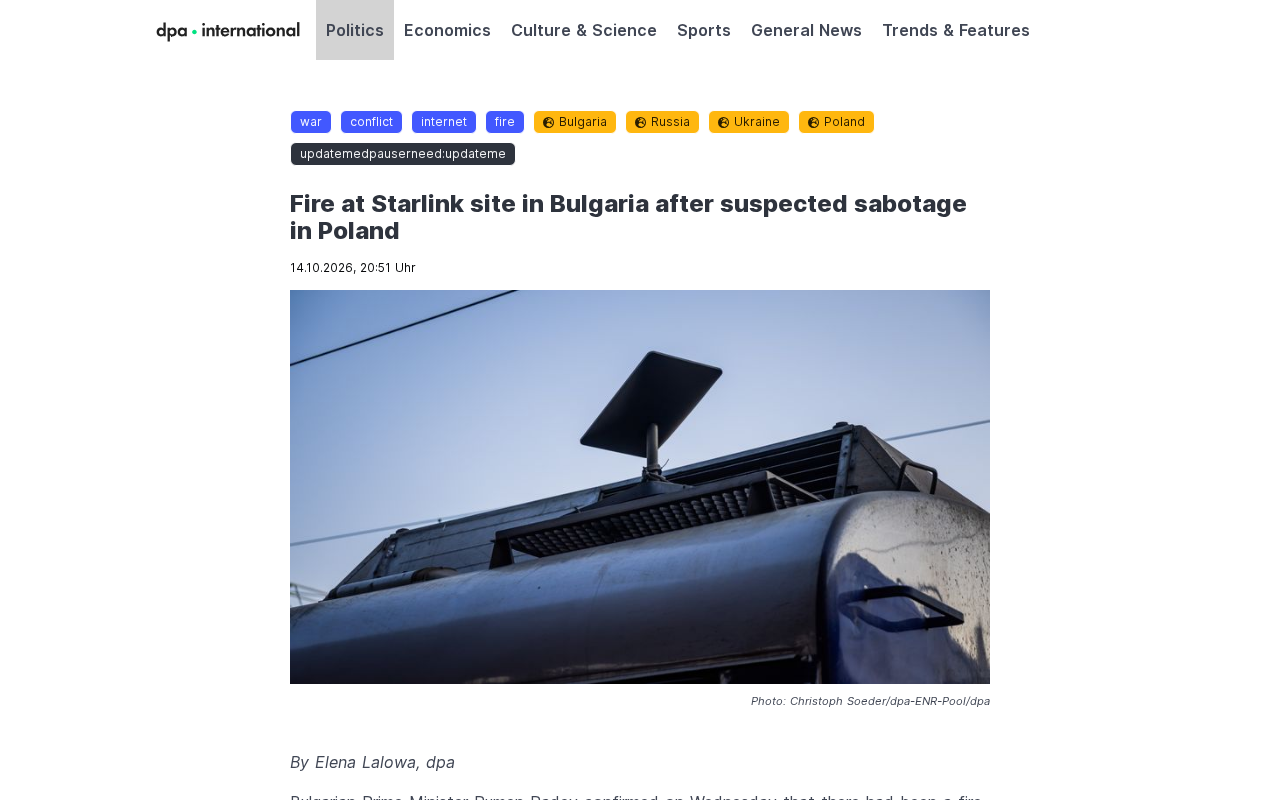
According to RSS sources, a fire targeting Starlink infrastructure has occurred in Bulgaria, following a suspected act of sabotage at a related facility in Poland. The string of incidents quickly drew attention in the tech community, particularly on platforms like Hacker News, where discussion centered on the physical security and geopolitical risks facing satellite internet ground stations.
Timeline: From Poland to Bulgaria
Based on available information, a Starlink-related facility in Poland was first suspected of being deliberately sabotaged, after which a Starlink site in Bulgaria caught fire. The temporal and geographic proximity of the two incidents has led observers to lean toward viewing them as a coordinated campaign targeting the same satellite internet network.
As a low-Earth-orbit satellite internet service under SpaceX, Starlink's ground infrastructure includes gateway stations, user terminals, and backhaul links. These facilities are distributed across multiple countries and play a critical role in connecting satellite signals to the terrestrial internet. If ground stations are damaged, service stability in localized areas may be affected.
Public information has yet to disclose the specific scale of the fire, the extent of damage, or whether there were any casualties. Whether law enforcement agencies have launched an investigation and whether the two incidents have been confirmed to be linked remains to be seen.
Why Starlink Ground Facilities Are Becoming Sensitive Targets
Starlink's role in military communications, emergency response, and connectivity for remote areas has become increasingly prominent. In conflict zones, it is often used as an alternative to traditional communications infrastructure. This strategic value means its ground stations are no longer merely commercial assets—they may be viewed as targets of military significance.
Physical security has thus become a new challenge for satellite internet operators. Unlike data centers, ground gateway stations are often located in remote or cross-border areas, making them difficult to protect. Poland and Bulgaria are both NATO member states, and if the sabotage is confirmed to be deliberate, its nature would go beyond ordinary criminal activity.
Low Earth Orbit (LEO) satellite internet refers to satellite constellation systems operating in orbits approximately 300 to 2,000 kilometers above the Earth's surface. Compared to traditional geostationary orbit (GEO, approximately 35,786 kilometers) satellites, LEO satellites are much closer to Earth, dramatically reducing signal round-trip latency—typically to within 20 to 50 milliseconds, approaching the level of terrestrial fiber optics. The trade-off is that a single satellite covers a smaller area and moves quickly relative to the ground, requiring hundreds or even thousands of satellites working in coordination to achieve continuous coverage. Starlink is a typical example of this architecture, with its satellite count already in the thousands. This "constellation" design also means that ground gateway stations must frequently switch connections with multiple satellites passing overhead, placing higher demands on the scheduling and stability of the ground segment.
Implications for Satellite Internet Resilience
Starlink's architecture inherently possesses a degree of redundancy: a single satellite failure can be compensated by others, and ground gateways have multi-site backups. However, if an attacker simultaneously targets multiple ground nodes, the network's overall resilience will be put to the test.
This incident serves as a reminder to the industry that competition in LEO satellite internet is not just about satellite count and bandwidth, but also about the security and rapid recovery capability of the ground segment. Operators may need to reassess the physical protection, monitoring, and emergency response procedures at critical sites.
For users relying on Starlink, the risk of localized service disruptions objectively exists. But as of now, there is no evidence suggesting that broader service has been persistently affected.
In the communications field, network resilience refers to a system's ability to maintain an acceptable level of service and recover quickly after failures, attacks, or natural disasters. For LEO satellite internet, resilience typically consists of three components: space segment redundancy, where a single satellite failure can be offset by neighboring satellites; ground segment redundancy, where multiple gateway stations serve as backups for one another; and link redundancy, including inter-satellite laser links and multi-path backhaul. The ground segment is often the most vulnerable part of the overall architecture, because physical sites are difficult to conceal, have relatively fixed locations, and require long construction periods. An attacker only needs to destroy a few critical nodes to cause regional service degradation, without having to touch the costly satellites themselves. This also explains why operators are treating ground segment protection and rapid recovery capabilities as core metrics in resilience assessments.
Cautious Interpretation Amid an Information Vacuum
One additional point: current information mainly comes from media reports and community discussions, and official investigation conclusions have not yet been released. It is premature to directly characterize the two incidents as a "coordinated sabotage campaign." Comments on Hacker News also reflect this caution: some focus on the geopolitical context, some question the reliability of information sources, and others discuss the actual level of protection at Starlink sites.
In the absence of official statements, readers should avoid jumping to conclusions. Key developments to watch include: investigation results from local police or fire departments, official responses from SpaceX, and whether more similar incidents occur.
In breaking security incidents, an "information vacuum" refers to the period when authoritative official information has not yet been released and the public mainly relies on media relay and fragmented messages from social platforms to form judgments. During this phase, the information chain often passes through multiple hands, details are easily amplified or misinterpreted, and given the geopolitical sensitivity of the events, various speculative narratives can spread rapidly. For readers, distinguishing between "confirmed facts" and "speculative associations" is particularly critical. Actionable judgment principles include: prioritizing official statements from local law enforcement, fire departments, or regulatory agencies; checking whether the information source is a first-hand witness or an organization with verification capability; and being wary of temporal and geographic "proximity," because correlation does not equal causation. Before official conclusions are issued, keeping multiple interpretations open is the more prudent approach.
Related articles

iPhone Duo Battery Life Tested: One Charge a Day Is Unavoidable, and the Large Screen Is the Culprit
iPhone Duo battery test: heavy use needs at least one charge a day, and about 30% remains after 6.5 hours of screen-on time. How often the large screen is unfolded is key; a MagSafe battery pack helps, and long-term degradation is also worth watching.

Kimi K3.1 Pro Open-Sourced: 2.8 Trillion Parameters Close In on Opus
Moonshot releases the open-source MoE model Kimi K3.1 Pro, with 2.8T total parameters and 104B activated, trailing Opus 5.5 by under 1 point on Terminal Bench 4.0.

Costco Tech Price Guessing: Are Monitors, Keyboards, Mice, and Bose Speakers Worth It?
A YouTube blogger guesses prices of Costco tech products: 2K 180Hz monitor, Logitech keyboard and mouse, Bose speaker, and CyberPower UPS, revealing warehouse-store selection and brand premium.