Flappy Bid: An Innovative Experiment Where Gaming Skills Win Ad Space

Flappy Bid lets players win ad space through Flappy Bird skills instead of money.
Flappy Bid is an experimental product that merges Flappy Bird gameplay with advertising competition. Instead of bidding with money, users compete for a 24-hour website takeover by achieving the highest game score daily. While unlikely to disrupt mainstream advertising, it raises thought-provoking questions about how attention should be allocated in a capital-dominated ad landscape.
An Advertising Experiment That Goes Against the Grain
In the world of digital advertising, there's seemingly only one rule: whoever bids the highest gets the most prominent spot. Search engine paid rankings, social media feed ads, app store promotions — they're all fundamentally a "highest bidder wins" capital game. The bidding mechanism originated around 2000 with Overture's innovation and was later popularized by Google AdWords (now Google Ads). Its core principle is that advertisers bid on specific keywords or placements, and the system determines display order based on bid amount and ad quality score. This mechanism drives over $500 billion in global digital advertising annually, but it also creates a significant Matthew effect — top brands leverage budget advantages to continuously dominate premium traffic sources, while customer acquisition costs for SMBs keep rising.
However, a product called Flappy Bid on Product Hunt has proposed a rebellious idea: Ad space shouldn't be bought with money — it should be won with skill.
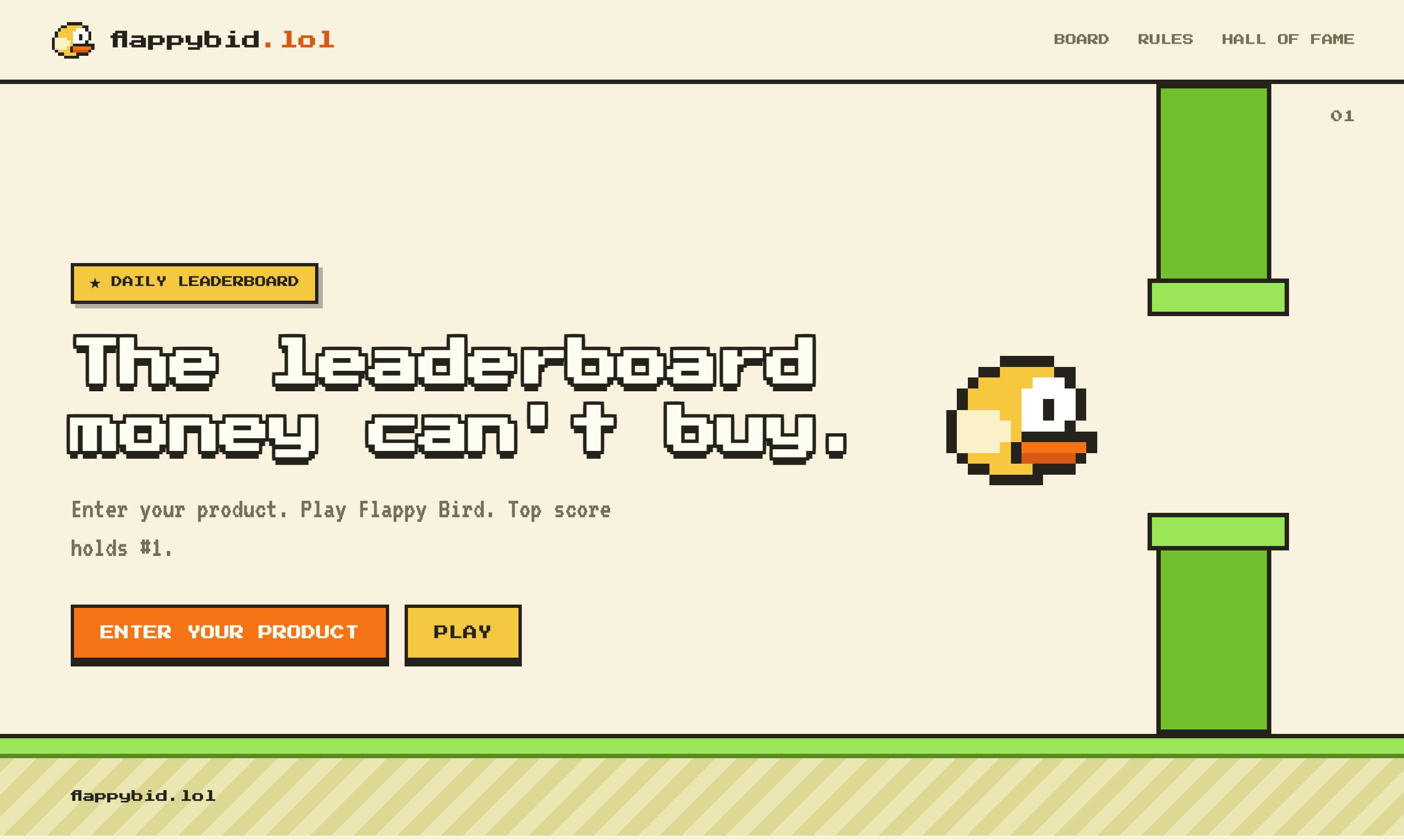
Its tagline is blunt and provocative — "The leaderboard money can't buy." The product combines classic Flappy Bird game mechanics with ad space competition, creating an entirely new "attention allocation" model based on player skill.
How Flappy Bid Works in Detail
Play Well and Own the Entire Website
Flappy Bid's logic is simple yet clever. Users submit their product information, then start playing Flappy Bird — the classic game notorious for its punishing difficulty. Flappy Bird was released in 2013 by Vietnamese developer Dong Nguyen. Players tap the screen to guide a bird through gaps between pipes, where any contact means instant failure. The game went viral thanks to its minimalist art style and maddening difficulty, reaching over 50 million daily downloads in early 2014 and generating $50,000 per day in ad revenue. Nguyen pulled it from stores due to public pressure, but the game became an iconic cultural symbol of the mobile gaming era, embodying the design philosophy of "simplicity taken to the extreme becomes difficulty." In Flappy Bid, you can play unlimited rounds, challenging yourself for higher scores again and again.
The key mechanism lies in the scoring rules: Every day at UTC 00:00, the highest-scoring product on the leaderboard "owns" the entire website for 24 hours. UTC (Coordinated Universal Time) is the international time standard unaffected by daylight saving time, widely used for scheduled tasks and global event synchronization in internet services, ensuring all participants compete under the same standard. During those 24 hours, the winning product is displayed to all visitors, accompanied by a live click counter tracking the real traffic it generates. After 24 hours, the "champion product" retires undefeated, yielding the stage to the next winner.
This design transforms ad exposure from a "purchasing act" into a "competitive achievement." You can't buy your way to the top — the only path is to master the game.
Fair Competition: Skill vs. Capital
The elegance of this mechanism lies in how it redefines "who deserves to be seen." Traditional ad platforms favor large companies with bigger budgets, while small teams and indie developers get pushed to the margins. Flappy Bid shifts the competitive threshold from "wallet size" to "skill level" through a universally accessible skill-based game.
In a sense, it's a humorous satire of the advertising industry's unspoken rule that "capital decides everything." An indie developer willing to invest time practicing Flappy Bird can earn exposure equal to or even better than that of major corporations.
A Novel Sample of Gamified Marketing
Binding Game Competition to Ad Scarcity
Flappy Bid is categorized on Product Hunt under "Action Games," "Marketing," and "Advertising" — a cross-disciplinary positioning that reveals its essence: it's simultaneously a game, a marketing tool, and a thought experiment about advertising fairness.
Gamification in marketing isn't new. The concept was first coined by Nick Pelling in 2002 and went mainstream in the 2010s through examples like Foursquare's check-in badges, Nike+'s running challenges, and Starbucks' rewards program. However, extensive practice has shown that superficial points and leaderboards rarely sustain long-term engagement. Truly effective gamification requires intrinsic motivation — the sense of achievement and enjoyment from participation itself, rather than external rewards alone. Flappy Bid chose a purely skill-driven game mechanism that can't be substituted with external resources, giving it a unique position on the gamification marketing spectrum.
It directly binds the "competitiveness" of gaming with the "scarcity" of advertising. The entire website belongs to only one winner at any given time, and this winner-take-all exclusivity creates powerful topicality and participation incentive. The live click counter is the finishing touch — it lets winners see the tangible traffic value they've "earned" while adding spectator appeal to the platform.
Viral Potential and Real-World Limitations
From a distribution perspective, Flappy Bid has natural viral DNA. Flappy Bird itself is a cultural symbol loaded with collective memory, and the counterintuitive premise of "winning ad space through gaming" easily sparks organic social media discussion.
That said, we should view its practical value objectively. As of now, the product has received 25 upvotes and 4 comments on Product Hunt, ranking 13th — a modest result indicating some attention but not yet viral breakthrough. Product Hunt, founded by Ryan Hoover in 2013, has become the go-to launch platform for tech entrepreneurs and indie developers. On the platform, 25 votes and a 13th-place ranking means the product entered the day's visible range but didn't break into the top tier — typically, the daily top 5 requires 200+ votes to generate significant spillover traffic.
As a conceptual, experimental project, its greater significance lies in raising questions rather than becoming a scalable commercial advertising solution. After all, for most people looking to promote products, grinding Flappy Bird may not be more cost-effective than simply running ads.
Flappy Bid's True Value Lies in "Asking the Question"
Flappy Bid may never replace Google Ads or Meta's ad systems, but it raises a question worth pondering: When attention becomes a scarce resource, what criteria should we use to allocate it?
The concept of the Attention Economy was first proposed by Nobel laureate Herbert Simon in 1971: "A wealth of information creates a poverty of attention." This theory was further developed by Michael Goldhaber in 1997, who predicted that attention would replace currency as the core scarce resource of the new economy. Today, global internet users average over 6.5 hours of daily screen time, encountering more than 6,000 ad messages per day, yet fewer than 100 are truly noticed. This makes "who decides which information deserves to be seen" one of the most power-laden questions of the digital age.
Is it financial power, or something else? Flappy Bid's answer is "skill and dedication." While this answer may not hold up in real-world commerce, it pokes at a long-standing pain point in the advertising industry in a lighthearted, humorous way — exposure is monopolized by capital, while creativity and capability often have nowhere to shine.
For indie developers and small startup teams, Flappy Bid also offers food for thought: rather than competing on budget within established pay-to-play rules, seek out and create those "money can't buy" exposure opportunities — winning user attention through creativity, engagement, and differentiated experiences. This is perhaps the most valuable insight this little game project leaves us with.
Key Takeaways
Related articles

GitHub Daily · October 22: Claude Code Tutorial Soars to 40K Stars
Claude Code tutorial project gains 428 stars in a day, topping GitHub Trending as AI coding tools shift toward ecosystem and onboarding methods.

Python 3.15 New Feature: Is the sentinel Type Better Than None?
Python 3.15 adds the sentinel type, using named unique sentinel objects to replace None and bare object(), resolving confusion among missing values, explicit emptiness, and invalid input while avoiding type hint failures.

Deep Learning's Three Architectures and the Universal Approximation Theorem: A Complete Guide to MLPs, CNNs, and Transformers
Explaining the inductive bias differences among MLP, CNN, and Transformer, the existence meaning of the Universal Approximation Theorem (UAT), and the role of Taylor expansion in approximation analysis, while clearing up common misconceptions.