FlashProve-Next: How Verifiable Inference Provides Zero-Knowledge Proofs for LLM APIs

FlashProve-Next generates zero-knowledge masking proofs for LLM API responses, enabling verifiable inference without leaking weights.
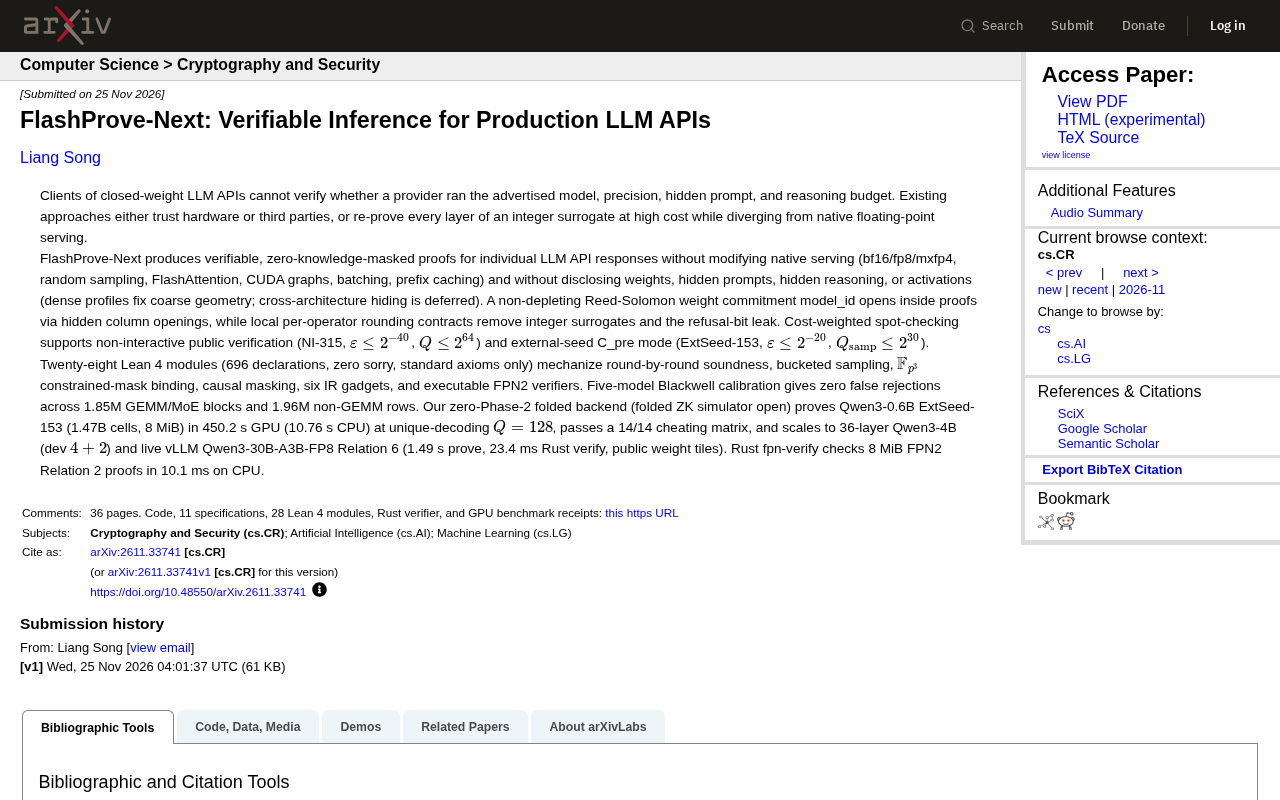
FlashProve-Next proposes verifiable inference for closed-source LLM APIs, generating zero-knowledge masking proofs per response without modifying native floating-point services. Core mechanisms include non-exhaustive Reed-Solomon weight commitments that reveal model_id via hidden column openings without publishing weights, and local per-operator rounding contracts that remove reliance on integer surrogate models and close rejection-bit leakage. It supports bf16/fp8/mxfp4 and production features like FlashAttention, CUDA graphs, batching, and prefix caching. Lean 4 modules mechanically prove soundness and sampling, five-model Blackwell calibration reports zero false rejections, and proofs are completed on Qwen3 with millisecond-level CPU verification for 8 MiB proofs—though cross-architecture hiding remains open and GPU proof generation still takes hundreds of seconds.
Why LLM APIs Need Verifiable Inference
Developers calling closed-source LLM APIs face a fundamental puzzle: you cannot confirm whether the provider actually ran the claimed model, precision, hidden prompts, and inference budget. Existing approaches either rely on hardware trust or third-party audits, or re-prove integer surrogate models layer by layer, which is costly and disconnected from native floating-point services.
FlashProve-Next attempts to solve this problem without modifying the native service. According to its technical documentation, the system generates a verifiable zero-knowledge masking proof for a single LLM API response, while supporting production-grade features such as bf16/fp8/mxfp4 precision, stochastic sampling, FlashAttention, CUDA graphs, batching, and prefix caching—without leaking weights, hidden prompts, hidden reasoning processes, or activations.
Zero-Knowledge Proof (ZKP) is a cryptographic protocol that allows a prover to convince a verifier that a statement is true without revealing any information beyond the statement itself. In the LLM API context, ZKP can be used to prove that a provider actually ran a specific model and inference process without exposing model weights, user prompts, or intermediate activations. Traditional ZKP schemes typically require converting computation into arithmetic circuits, which is prohibitively expensive for floating-point-intensive LLM inference. FlashProve-Next's "masking proof" approach applies cryptographic constraints to key operators without changing the native computation flow, thereby balancing proof overhead and practicality. Understanding the basic trust model of ZKP (completeness, soundness, zero-knowledge) helps grasp the security boundaries of such schemes.
Core Mechanism: Weight Commitments and Local Rounding Contracts
FlashProve-Next's design revolves around two key components. The first is a non-exhaustive Reed-Solomon weight commitment: the model identity (model_id) is revealed inside the proof through hidden column openings rather than by publishing all weights. The second is a local per-operator rounding contract, which eliminates dependence on integer surrogate models while closing the channel for rejection-bit leakage.
This combination allows the proof system to align with the native floating-point service flow. The documentation states that a cost-weighted spot-check mechanism supports non-interactive public verification and offers two modes: NI-315 mode claims an error bound within 2^{-40} with a query limit of 2^{64}; the external-seed C_pre mode (ExtSeed-153) has an error bound of 2^{-20} and a sampling query limit of 2^{30}. These parameters mean verification can be performed in a public setting without requiring the verifier to stay online continuously.
Reed-Solomon commitment is a cryptographic commitment scheme based on erasure codes. It treats data as evaluations of a polynomial at several points, hides the original data through polynomial interpolation and evaluation, and allows verification of values at specific positions without revealing all the data. In FlashProve-Next, weights are encoded as Reed-Solomon codewords and committed, and the model identity (model_id) is revealed inside the proof through a "hidden column opening" mechanism rather than publishing all weights. This "non-exhaustive" design means the verifier only needs to check a small number of randomly sampled columns to confirm with high probability that the weights match the commitment, thereby binding the model identity under zero-knowledge conditions. This mechanism is key to understanding how the system achieves verifiability without leaking trade secrets.
Formal Verification and Calibration Results
Formal guarantees are one aspect that distinguishes FlashProve-Next from most similar schemes. The project uses Lean 4 modules to mechanically prove round-by-round soundness, bucketed sampling, F_{p^3} constraint mask binding, causal masking, six IR gadgets, and an executable FPN2 verifier, claiming zero sorries and only standard axioms.
In a five-model Blackwell calibration, the system reports zero false rejections across 1.85 million GEMM/MoE blocks and 1.96 million non-GEMM rows. The so-called zero Phase-2 folding backend opens through a folded ZK simulator and completes proofs in Qwen3-0.6B's ExtSeed-153 mode (1.47 billion cells, 8 MiB) with unique decoding Q=128 in 450.2 seconds on GPU and 10.76 seconds on CPU. The implementation passes 14/14 cheating matrix tests and scales to 36-layer Qwen3-4B as well as Qwen3-30B-A3B-FP8 Relation 6 (public weight tiling) on a live vLLM.
Lean 4 is an interactive theorem prover that can also be used as a programming language. It allows developers to write mathematical definitions, algorithms, and protocol specifications as formal propositions and guarantees those propositions hold through machine-checked proofs. In FlashProve-Next, Lean 4 modules are used to mechanically prove key properties such as round-by-round soundness, bucketed sampling, constraint mask binding, and causal masking; claiming "zero sorries" means all proofs are complete with no remaining unproven goals. The value of formal verification lies in eliminating the risk of human reasoning gaps or implementation-specification mismatches, especially for cryptographic protocols where correctness requirements are extremely high. Readers can think of Lean 4 as an "executable mathematical rigor checking tool" rather than an ordinary testing framework.
Performance and Engineering Significance
From an engineering perspective, FlashProve-Next's verification overhead is noteworthy. The Rust implementation fpn-verify checks an 8 MiB FPN2 Relation 2 proof on CPU at the millisecond level (exact numbers vary by runtime environment). For scenarios requiring auditing of API responses, this magnitude makes public verification practically feasible.
The system's zero intrusion into native services is another highlight. It does not require providers to switch to an integer inference stack, nor does it require disclosing model weights. The hidden column opening mechanism makes model_id self-consistent within the proof, while dense profiles are used to fix the coarse-grained geometry. The documentation also acknowledges limitations: cross-architecture hiding is deferred, and the current scheme is mainly oriented toward verification within a single architecture.
FlashAttention is an efficient attention algorithm for Transformers that reduces GPU memory access through tiled computation and recomputation, significantly improving training and inference speed without approximating attention results. CUDA graphs is an optimization technique in NVIDIA CUDA that captures a series of GPU kernel launches into a graph and submits them at once to reduce launch overhead and CPU-GPU synchronization costs. Prefix caching in LLM serving reuses the KV cache for identical prompt prefixes to avoid redundant computation. FlashProve-Next's claimed support for these production-grade features means its proof generation can be embedded into existing high-performance inference stacks (such as vLLM) without sacrificing throughput or latency for verifiability. Understanding these terms helps assess the system's compatibility and performance impact in real deployments.
Implications for Developers and Providers
For API consumers, verifiable inference means shifting from "trusting the provider" to "verifying the response." For providers, zero-knowledge proofs can offer compliance evidence without leaking trade secrets. FlashProve-Next demonstrates a path: attaching a publicly checkable proof to each response while maintaining native floating-point service performance.
However, the system is still at the research stage. Cross-architecture hiding, broader model coverage, and proof generation cost (hundreds of seconds on GPU) are factors to watch before deployment. For teams focused on AI transparency and auditability, this work is worth following closely.
One-line Summary
FlashProve-Next generates zero-knowledge masking proofs for LLM API responses, enabling verifiable inference without leaking weights.
Paragraph Summary
FlashProve-Next proposes a verifiable inference scheme for closed-source LLM APIs, generating zero-knowledge masking proofs for a single API response without modifying the native floating-point service. Its core mechanisms include a non-exhaustive Reed-Solomon weight commitment, which reveals model_id through hidden column openings without publishing weights, and a local per-operator rounding contract, which eliminates dependence on integer surrogate models and closes rejection-bit leakage. The system supports bf16/fp8/mxfp4 precision and production features such as FlashAttention, CUDA graphs, batching, and prefix caching. Lean 4 formal modules mechanically prove soundness and sampling mechanisms, and a five-model Blackwell calibration reports zero false rejections. Proofs and verification are completed on the Qwen3 series, with the Rust verifier checking an 8 MiB proof on CPU at the millisecond level, but cross-architecture hiding remains unresolved and proof generation still takes hundreds of seconds on GPU.
Related articles

Nothing CMF Buds 2A Drops to $17.89 on Black Friday: A New Low for ANC Earbuds
Nothing CMF Buds 2A wireless earbuds Black Friday deal: just $17.89 on Amazon, about $11 off retail and a record low. ANC earbuds at an entry-level price.

When AI Creation Gets Accused of "Spitting": Hacker News Heats Up Over the Glaude Controversy
A Hacker News post, "Spitting in the Face of Glaude," sparks debate on AI creation transparency and attribution ethics. This analysis examines the blurred creator identity behind the controversy and offers practical advice for AI content production.

Akai Embraces Custom Firmware: MPC Sample 1.4 Lets Users AI-Program Their Sampler
Akai embraces the modding community with MPC Sample 1.4 firmware, supporting vibe-coded custom firmware and effects. We analyze the impact of this open strategy on music hardware and AI-assisted programming.