Flown App Review: Flight Log Visualization Maps & Automatic Delay Compensation Alerts
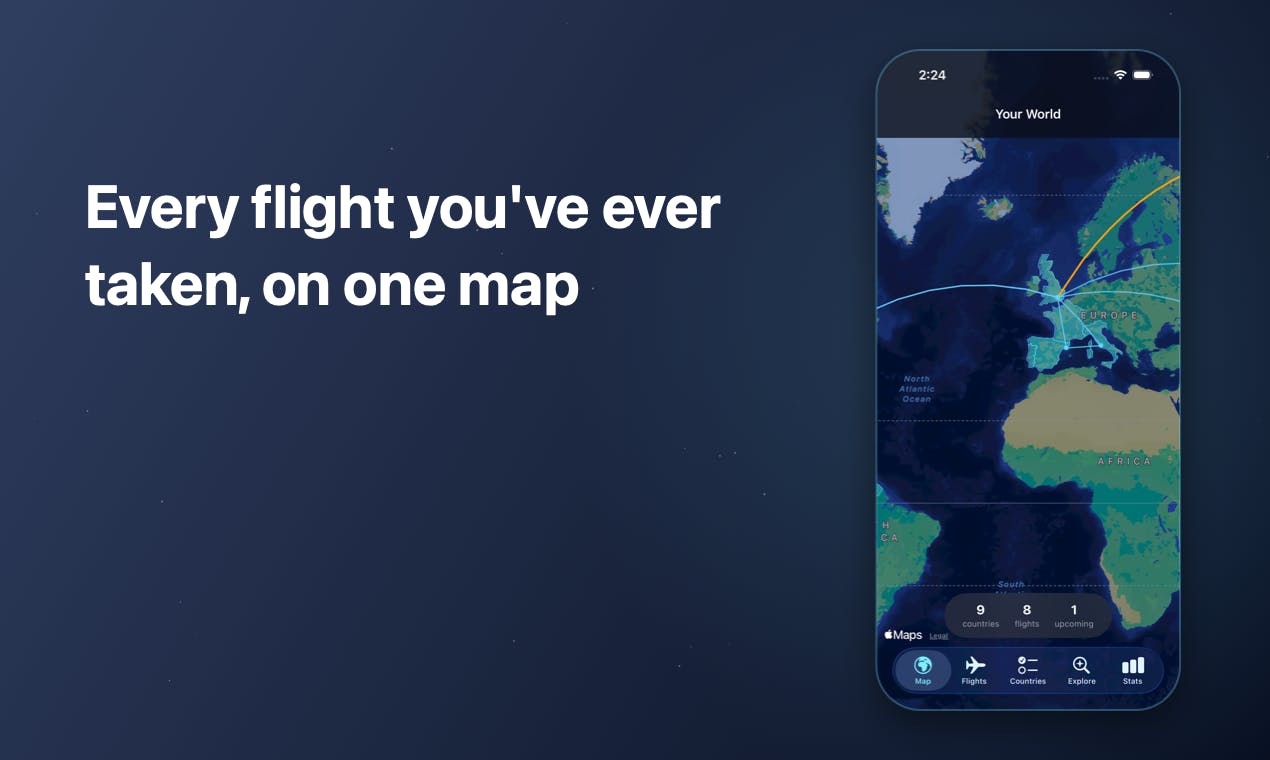
Flown maps all your flights privately on-device and auto-alerts you to unclaimed delay compensation.
Flown is a privacy-first iOS app that visualizes your entire flight history on a single private map. With gamified features like 197-country check-ins, passport stamp collecting, and annual flight reviews, it transforms scattered trip data into an engaging travel archive. Its standout practical feature auto-calculates EU261 delay compensation, helping users claim hundreds of pounds they might otherwise miss. All data stays on-device with no account required.
Flown: One Map to Record All Your Flight Journeys
For frequent travelers, flight records tend to be scattered everywhere—boarding passes, email confirmations, airline apps, frequent flyer accounts, or even just memories. The iOS app Flown offers a simple yet elegant idea: plot every flight you've ever taken on a single private map.
This flight logging app's tagline is "Every flight you've ever taken, on one private map." On its Product Hunt launch day, it received 64 upvotes and ranked 13th, categorized under iOS, Travel, and Maps.
Core Features: Flight Data Visualization and Gamification
World Map and the "Check-In" Experience
Flown's core value lies in transforming dry flight history into a sense of visual achievement. Users can see all their flight routes on a map and "check in" across 197 countries worldwide. This design draws on the "light up the map" mechanic common in travel social apps, turning every trip into an accumulating mark on the map.
Gamification—the strategy of applying game design elements to non-game contexts—has been widely validated in travel applications. Its core psychological mechanisms include achievement-driven motivation (collecting badges, unlocking milestones), progress visualization (progress bars, map filling), and social comparison (leaderboards, sharing accomplishments). Early classic examples include Foursquare's check-in badge system and TripAdvisor's traveler levels. In the flight logging space, apps like Flighty and App in the Air have adopted similar map markers and statistics dashboard designs. The "light up the map" mechanic is particularly effective because it transforms abstract travel experiences into intuitive visual achievements—the more areas filled on the map, the stronger the user's sense of satisfaction. This positive feedback loop creates intrinsic motivation for continued use.
Beyond the country dimension, Flown also incorporates the following gamification elements:
- Passport stamp collection: Simulates the real passport stamping experience, collecting stamps from various countries
- Annual flight review: A "Your Year in the Air" feature that summarizes the entire year's flight data
- Route visualization: Intuitively displays all flight trajectories on a world map
For frequent flyers, this gamified presentation consolidates scattered trip data into a personal travel archive with genuine emotional value.
Automatic Flight Delay Compensation Calculation
If the map feature appeals to sentiment, Flown's other feature is decidedly practical—automatic calculation of flight delay compensation.
Under EU air passenger rights regulations (such as the EU261 regulation), airlines are required to compensate passengers when flights are significantly delayed or canceled. EU261 (officially EU Regulation No. 261/2004) is one of the world's most influential air passenger rights protection laws. Since taking effect in 2005, it has provided legal protection to millions of travelers. The regulation stipulates that when a flight is delayed by more than 3 hours, canceled, or a passenger is denied boarding due to overbooking, the airline must pay fixed compensation ranging from €250 to €600, depending on the route distance. Notably, this right applies to all flights departing from EU airports, as well as flights arriving in the EU operated by EU-registered airlines—meaning even non-EU citizens are entitled to claim compensation as long as the flight qualifies.
Flown automatically analyzes your flight records, and when claim conditions are met (compensation typically ranges from £220 to £520), the app calculates the specific amount and proactively notifies you.
This feature addresses a real pain point: it's estimated that billions of euros in legitimate compensation go unclaimed each year because passengers are unaware of their rights or find the application process too complex. This has given rise to companies like AirHelp and Flightright that specialize in helping travelers file claims. In reality, many passengers don't know they're entitled to compensation, or they give up due to the cumbersome process. Flown makes this "hidden benefit" visible, providing users with tangible financial value.
Privacy-First Design Philosophy: Local Data Storage, No Registration Required
In an era where data security is increasingly important, Flown's most commendable aspect is its privacy-first product philosophy.
The app explicitly states "On-device, no account"—all data processing is completed locally on the device, with no account registration required. This means:
- Flight history is never uploaded to cloud servers
- Travel trajectory data is not shared with any third parties
- Sensitive data such as passport information stays entirely on the user's device
On-device Processing refers to performing data processing and AI inference tasks directly on the user's end device rather than uploading data to cloud servers. This concept has been strongly championed by Apple in recent years—from Face ID facial recognition data being stored entirely in the iPhone's Secure Enclave security chip, to the Apple Intelligence framework introduced at WWDC 2024 emphasizing "if it can be done on-device, don't send it to the cloud." On-device first has become a core design principle in the Apple ecosystem. For developers, adopting on-device processing means no need to build and maintain backend servers, significantly reducing operational costs and data compliance risks (especially under strict privacy regulations like GDPR).
For travel apps, itinerary data is inherently highly sensitive privacy information—it can reveal a person's activity patterns, spending power, and even social relationships. Flown's choice of on-device processing both reduces the risk of data breaches and spares users the hassle of "having to register yet another account." This design philosophy aligns closely with Apple's push for on-device computing and privacy protection.
Product Positioning Analysis: A Small but Beautiful Flight Logging Tool
Flown is a quintessential "small but beautiful" utility app. Rather than trying to become an all-encompassing travel platform, it focuses on two clear use cases:
- Visual collection of flight records—fulfilling emotional needs
- Automatic delay compensation alerts—fulfilling financial needs
From a product logic perspective, there's an elegant synergy between these two features: users input flight data for the satisfaction of "lighting up the map," and that same data serves as the foundation for calculating compensation. The former provides ongoing motivation to use the app, while the latter delivers practical retention value.
Of course, apps like this face some inherent challenges. First is the convenience of data entry—how frictionlessly users can import their historical flight records directly determines the quality of the initial experience. Current mainstream methods for obtaining flight data include: manually entering flight numbers (most basic but most time-consuming), scanning boarding pass barcodes or QR codes (using IATA's BCBP standard for parsing), authorizing access to itinerary confirmation emails in your inbox (e.g., structured extraction of booking information via the Gmail API), connecting to airline frequent flyer account APIs, and importing data from third-party itinerary management tools like TripIt. For apps that opt for on-device processing like Flown, the automatic email scraping and cloud API connection pathways are essentially ruled out, meaning users will most likely need to enter data via manual input or scanning. Some apps mitigate this pain point by supporting CSV bulk imports, allowing users to export flight history from airline websites and import it all at once.
Second, while on-device processing protects privacy, it also means data cannot sync across devices, and users risk losing data when switching or losing their device. Some apps compromise by using iCloud end-to-end encrypted backups, enabling device migration without exposing plaintext data—this is perhaps a direction Flown could consider in the future. Overall, this requires a trade-off between privacy and convenience.
Summary: Who Should Use Flown
Flown demonstrates the qualities an excellent utility app should have: a clear entry point, practical functionality, and respect for user privacy. It transforms "flight records"—originally fragmented data—into a product experience with both emotional value (maps, stamps, annual reviews) and financial value (delay compensation alerts).
The following groups should especially consider trying Flown:
- Business professionals who fly multiple times a year
- Travel enthusiasts who love "checking in" to different countries
- Users who care about data privacy and don't want to register for yet another account
- Travelers who frequently fly European routes and may have unclaimed delay compensation
Especially if you may have unknowingly missed out on hundreds of pounds in compensation that was rightfully yours, Flown's automatic calculation feature is well worth trying.
Related articles

Hermes Agent Hands-On: Full Workflow for Building Apps Locally with an Autonomous AI Agent
Hands-on review of Hermes Agent: from installation to building a local calorie tracker in three steps. Covers local memory, Anthropic API setup, and progressive prompt workflows.

Fable 5.1 vs GPT-6 Astra: A Hands-On Comparison of 3D Modeling Capabilities
A detailed comparison of Fable 5.1 and GPT-6 Astra for 3D model generation, analyzing geometry, topology, UV quality, and materials in Blender asset creation.
Building a Game Prototype in 2 Hours with Astra: A Real-World Test of AI Coding Tool Costs and Efficiency
A Reddit developer built a game prototype in just 2 hours using AI coding tool Astra, consuming 42% of the Pro plan's weekly quota. Deep dive into Ultra vs High speed modes, real costs, and optimization strategies.