FLUENT: Teaching Looped Models That Practice Makes Perfect, Nearly Doubling Efficiency via Early Exit

FLUENT trains looped models with distillation and anchoring, letting shallow iterations give reliable predictions early.
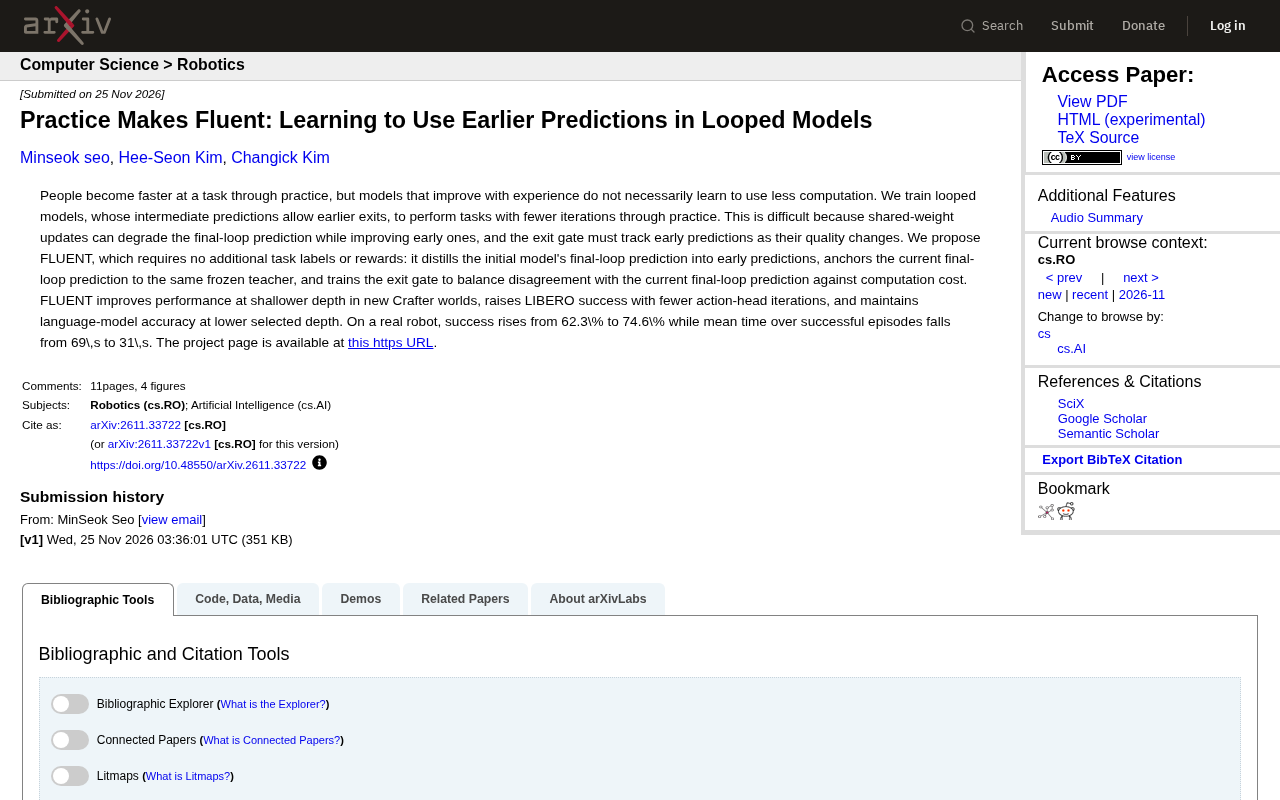
The article introduces the FLUENT method from the paper *Practice Makes Fluent*, which addresses the computational dilemma of looped models—"gaining experience without becoming more skilled": shared weights harm final prediction quality when optimizing early predictions, and the exit gate struggles to judge stably. Through three synergistic mechanisms—early prediction distillation, final prediction anchoring, and exit gate training—FLUENT requires no extra labels or rewards to let models achieve near-final-loop results with fewer iterations. On Crafter, LIBERO, and language model tasks, shallow inference improves or maintains performance; on a real robot, success rate rises from 62.3% to 74.6%, and average time for successful episodes drops from 69s to 31s. The article sees this as efficiency optimization via the computational path and notes that applicability to non-looped architectures and gate robustness remain to be verified.
The Computational Dilemma of Looped Models: The Trade-off Between Accuracy and Efficiency
Looped models process tasks by reusing the same set of weights across multiple iterations, and their advantage lies in achieving stronger expressive power with fewer parameters. However, a fundamental contradiction always persists: the model pursues prediction accuracy at the final loop during training but rarely actively learns how to complete tasks with fewer iterations. In other words, the model gains "experience" but does not become more "skilled"—it does not, like humans, compress the thinking steps required for a task through practice.
According to the paper Practice Makes Fluent: Learning to Use Earlier Predictions in Looped Models, the core of this problem lies in the dilemma brought about by shared weight updates: when the model tries to optimize predictions at early loops, it often harms the prediction quality at the final loop; and the Exit Gate must dynamically adjust its judgment criteria as the quality of early predictions changes. This is like a person practicing mental arithmetic—if they simplify intermediate steps in pursuit of speed, they may well get the final answer wrong.
Knowledge Distillation is a model compression and knowledge transfer technique: first train a larger-capacity "teacher model," then have a smaller "student model" fit the teacher's output distribution (typically soft labels/probability distributions) rather than only hard labels. The intuition is that the teacher's relative probabilities contain "dark knowledge" about similarities between classes, carrying more information than one-hot labels. The classic approach was systematically proposed by Hinton et al. in 2015, with the loss function often using temperature-scaled KL divergence. In looped models, teacher and student can share the same set of weights, differing only in iteration depth—deep iterations act as the teacher and shallow iterations as the student, so distillation can be completed internally within the model without an external large model. This idea is the prerequisite for understanding FLUENT's "early prediction distillation" mechanism.
FLUENT's Design Approach: Decoupling Training Objectives with Distillation and Anchoring
To resolve the above contradiction, the researchers proposed the FLUENT method. It requires no additional task labels or reward signals and relies entirely on the model's own prediction structure to drive learning. Specifically, FLUENT consists of three synergistic mechanisms:
- Early prediction distillation: Distill the predictions of the initial model's final loop into the predictions of early loops, so that shallow iterations learn to "imitate" the outputs of deep iterations.
- Final prediction anchoring: Anchor the current final-loop predictions to the same frozen teacher model, preventing degradation of final prediction quality caused by shared weight updates.
- Exit gate training: Train an exit gate to balance the relationship between "divergence from the current final-loop prediction" and "computational cost," enabling the model to exit early at the appropriate time.
These three mechanisms work together, enabling the model to gradually learn during training to achieve prediction results close to the final loop with fewer iterations. According to the authors, this is equivalent to letting the model internalize an ability through "practice": to give a reliable judgment as early as possible while ensuring answer quality.
Frozen Teacher / Anchoring draws on the ideas of momentum encoders and methods such as BYOL and MoCo in self-supervised learning: maintaining a copy of parameters that does not participate in gradient updates as a stable reference, preventing the main model from "chasing itself" during training, which would cause representation drift or collapse. In looped models, shared weights are repeatedly updated, and the objectives of early loops and the final loop pull against each other. Anchoring the final-loop predictions to a frozen teacher is equivalent to adding a fixed "baseline" to the optimization process, so that the distillation target of early loops does not continuously drift with weight updates. The frozen teacher is typically obtained from a weight snapshot early in training or from an exponential moving average (EMA); it is computationally cheap but can significantly improve training stability.
Exit Gate and Adaptive Computation originate from research on "early exit" networks and dynamic depth: lightweight classifiers or gating modules are attached to intermediate layers of the network to decide, based on the confidence of the current representation, whether to return a prediction early—thereby computing less for easy samples and more for difficult ones. The gate's training objective is typically a multi-objective trade-off—both staying consistent with the final prediction (small divergence) and penalizing excessive iterations (low cost)—which can be implemented with Lagrange multipliers or weighted losses. In looped models, the gate's input is the hidden state at each iteration round, and its output is the probability of continuing/exiting; after joint training with distillation, the model acquires a learnable policy for "when to stop thinking," corresponding to the phenomenon in which humans compress solution steps once proficient.
Multi-Scenario Experimental Results: Performance Gains from Shallow Inference
FLUENT validated its effectiveness across multiple task scenarios. In the new Crafter world, the model's performance improved at shallower depths; on the LIBERO benchmark, success rates improved even with fewer action-head iterations; and for language models, accuracy was maintained at lower selected depths.
These results show that FLUENT is not tuned for a single specific task but has cross-domain generality. According to the source paper, on a real robot, the success rate increased from 62.3% to 74.6%, while the average time for successful episodes dropped from 69 seconds to 31 seconds. A time reduction of more than half means the model can make decisions and complete tasks faster in real physical environments, which is especially critical for scenarios with high real-time requirements such as robot control.
The Art of Balancing Efficiency and Precision: What FLUENT Reveals
FLUENT's approach reveals an important trend: optimizing model efficiency should not focus only on parameter compression or hardware acceleration but can also start from the "computational path" itself. Looped models inherently have a multi-iteration structure, and intermediate predictions themselves carry task information. Through distillation and anchoring, FLUENT makes early predictions "usable" and then uses a gate to decide when to stop—this effectively establishes an adaptive computation allocation mechanism inside the model.
From a broader perspective, this method is in line with the research thread of "adaptive computation"—allowing the model to dynamically adjust the amount of computation according to input difficulty. FLUENT's contribution lies in providing a training framework that achieves this goal without additional supervision signals, lowering the barrier to application. For developers who need to deploy looped models on edge devices or in real-time systems, this means significantly reducing the number of inference iterations without sacrificing too much accuracy.
The project page is now public, with more experimental details and visualization results: https://msseok96-cpu.github.io/FLUENT/.
Limitations and Outlook
FLUENT currently targets looped model architectures, and its applicability to non-looped architectures remains to be verified. In addition, the training of the exit gate relies on the current final-loop prediction as a reference; if the final prediction itself is unreliable on some samples, the gate's judgment may also be affected. Future work may need to explore more robust gate training strategies and extend FLUENT's ideas to a broader range of sequential decision-making models.
One-line Summary
FLUENT uses distillation and anchoring to train looped models, enabling shallow iterations to give reliable predictions early.
Paragraph Summary
The article introduces the FLUENT method proposed in the paper Practice Makes Fluent, which addresses the computational dilemma of looped models—"gaining experience without becoming more skilled": shared weights harm final prediction quality when optimizing early predictions, and the exit gate struggles to make stable judgments. Through three synergistic mechanisms—early prediction distillation, final prediction anchoring, and exit gate training—FLUENT requires no additional labels or reward signals to teach the model to achieve results close to the final loop with fewer iterations. On Crafter, LIBERO, and language model tasks, shallow inference performance improved or was maintained; on a real robot, the success rate rose from 62.3% to 74.6%, and the average time for successful episodes dropped from 69 seconds to 31 seconds. The article argues that this reflects an approach to efficiency optimization starting from the computational path, and notes that its applicability to non-looped architectures and gate robustness remain to be verified.
Related articles

Nothing CMF Buds 2A Drops to $17.89 on Black Friday: A New Low for ANC Earbuds
Nothing CMF Buds 2A wireless earbuds Black Friday deal: just $17.89 on Amazon, about $11 off retail and a record low. ANC earbuds at an entry-level price.

When AI Creation Gets Accused of "Spitting": Hacker News Heats Up Over the Glaude Controversy
A Hacker News post, "Spitting in the Face of Glaude," sparks debate on AI creation transparency and attribution ethics. This analysis examines the blurred creator identity behind the controversy and offers practical advice for AI content production.

Akai Embraces Custom Firmware: MPC Sample 1.4 Lets Users AI-Program Their Sampler
Akai embraces the modding community with MPC Sample 1.4 firmware, supporting vibe-coded custom firmware and effects. We analyze the impact of this open strategy on music hardware and AI-assisted programming.