Fluree AI: A Trusted Data Layer Alternative to RAG, Providing Verifiable Context for AI Agents

Fluree AI provides AI agents with verifiable enterprise context by querying structured data instead of RAG.
Fluree AI is a trusted data layer that replaces traditional RAG approaches by directly querying structured enterprise data. It delivers cited, verifiable answers with built-in permission checks on every request, leveraging graph database technology and MCP protocol support to seamlessly integrate with modern AI agent workflows. Targeting developers and data teams building production-grade AI applications, it addresses critical enterprise needs for data trustworthiness, auditability, and compliance.
When AI Agents Face an Enterprise Data Trust Crisis
As enterprises accelerate AI deployment, a core challenge remains unresolved: how do you give AI agents accurate, trustworthy, and permission-controlled enterprise data context? Most teams rely on RAG (Retrieval-Augmented Generation) — chunking documents, embedding them into vector databases, and letting LLMs "guess" answers from retrieved fragments. The problem with this approach: results are hard to verify, lack source citations, and often bypass the data's own permission systems.
RAG (Retrieval-Augmented Generation) has been the most mainstream architecture pattern for enterprise AI applications since 2023. Its core workflow involves splitting enterprise documents (PDFs, web pages, database records, etc.) into small chunks (typically 256-512 tokens), converting them into high-dimensional vectors via embedding models (like OpenAI's text-embedding-ada-002), and storing them in vector databases (such as Pinecone, Weaviate, or Milvus). When a user asks a question, the system converts the query into a vector, retrieves the most relevant document fragments using cosine similarity algorithms, and injects those fragments as context into the LLM's prompt to generate an answer. While this approach is simple to implement and low-cost, its limitations are clear: the vectorization process loses structural information (table relationships, hierarchical structures), temporal information, and permission metadata. Moreover, semantic similarity doesn't equal logical relevance, making it easy to retrieve fragments that "seem related but are actually irrelevant," causing the LLM to produce confident but incorrect outputs.
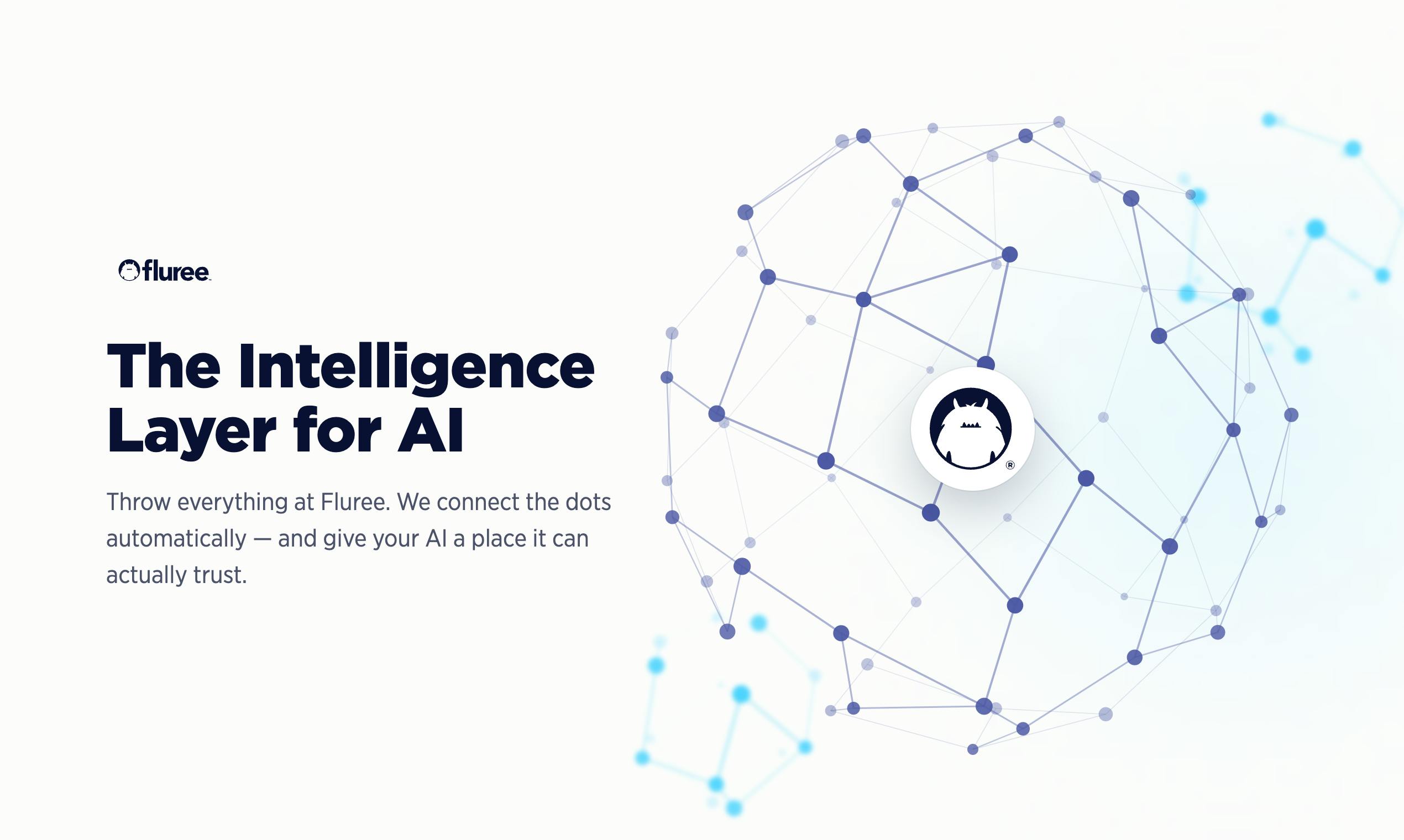
Fluree AI, which recently surged to #3 on Product Hunt's daily rankings with 322 upvotes and 69 comments, targets precisely this pain point. Its tagline is concise and powerful — "Give every AI agent trusted context."
Fluree AI's Core Approach: From RAG Guessing to Structured Queries
Directly Querying Structured Data Instead of Fuzzy Matching
Fluree AI's biggest differentiator is that it no longer relies on RAG's fuzzy matching — instead, it directly queries structured data. According to the official description, it provides every application and AI agent with "the same trusted context from your company's data." When users ask questions, they receive cited, verifiable answers from a unified live data layer.
In traditional RAG workflows, data extracted into vectors often loses its original structural relationships and permission metadata. The LLM can only retrieve fragments based on semantic similarity, easily producing hallucinations that "seem reasonable but can't be traced back." By directly querying structured data, Fluree AI can theoretically return answers traceable to specific data sources — which is critically important for finance, healthcare, legal, and other domains with extremely high accuracy requirements.
Notably, Fluree's technical foundation lies in Graph Database and Semantic Web technologies. Unlike traditional relational databases that organize data into rows and columns, graph databases store data as nodes (entities) and edges (relationships), making them naturally suited for expressing complex associations. Fluree's earlier product was an immutable graph database based on JSON-LD and W3C standards, featuring built-in time travel (preserving complete history for every data change) and fine-grained permission control (access rules precise down to individual data records). These characteristics — data provenance, tamper-proof audit logs, declarative permissions — are exactly the capabilities most desired in enterprise AI scenarios. Fluree AI can be seen as packaging these underlying capabilities into an AI-native data access layer, letting the graph database's structural advantages directly serve LLM context retrieval.
Permission Verification on Every Request
Another key design is permissions checked on every request. In enterprise environments, data permissions are a non-negotiable red line — the same AI assistant should return different scopes of information when answering questions from HR versus regular employees. Many existing AI integration solutions handle this crudely, either opening everything up or relying on external middleware.
In enterprise environments, data access control typically follows RBAC (Role-Based Access Control) or ABAC (Attribute-Based Access Control) models. A typical scenario: salary data in an HR system is visible only to the HR director and finance department, department managers can only see direct reports' information, and regular employees can only view their own records. When an AI assistant connects to enterprise data, this permission system must be strictly inherited. However, most RAG implementations chunk all documents uniformly into a single vector store, with permission filtering either implemented coarsely via metadata tags after retrieval or entirely dependent on external gateways. This creates the so-called "permission bypass" risk — attackers might craft questions to trick the system into retrieving document fragments they shouldn't have access to. Building permission checks into the data query layer rather than bolting them onto the application layer is the fundamental architectural choice for addressing this security risk.
Fluree builds permissions into the data layer, meaning that whether applications, dashboards, or AI agents access data, they all pass through unified permission filtering. This architecturally reduces data leakage risk and makes compliance auditing clearer.
Agent Ecosystem Integration via MCP Protocol
Connecting to Modern AI Workflows in Minutes
Fluree AI particularly emphasizes support for MCP (Model Context Protocol). MCP is a standard protocol rapidly emerging in the AI agent space, designed to establish standardized connections between LLMs and external tools and data sources. Fluree claims it can connect to MCP-ready agents, dashboards, and applications "in minutes."
MCP (Model Context Protocol) was officially released by Anthropic in November 2024 as an open standard protocol aimed at establishing unified communication specifications between AI models and external data sources and tools. Before MCP, every AI application connecting to external tools (databases, APIs, file systems) required custom integration code, creating an "M×N" integration challenge. MCP simplifies this into a standard client-server architecture: AI applications act as MCP clients initiating requests, while data sources or tools implement MCP server-side interfaces. The protocol defines standard operations for resource discovery, tool invocation, and context passing. As of early 2025, mainstream AI tools including Claude Desktop, Cursor, and Windsurf support MCP, and GitHub, Slack, PostgreSQL, and others have released official MCP servers. MCP is becoming the "USB port" of the AI agent ecosystem — its rapid adoption means any data layer product that natively supports MCP can seamlessly integrate into the growing agent toolchain.
This positioning is quite smart. As MCP gradually becomes the universal interface for AI agents connecting to external resources, being among the first to offer an MCP-compatible trusted data layer effectively secures a critical position in agent infrastructure. Developers don't need to rewrite prompts or build custom retrieval pipelines for each AI application — they can use Fluree as a unified data access point.
Tooling Positioned for Developers and Data Teams
From the Product Hunt categorization, Fluree AI is classified under Developer Tools, Artificial Intelligence, and Data. This clearly indicates its target users are developers and data teams building AI applications, not end consumers. The product was built by team members including Kevin Doubleday, backed by Fluree — a company with a long-standing focus on data management and graph databases.
Technical Value and Real-World Implementation Considerations
Core Problems Fluree AI Solves
Objectively, Fluree AI addresses real pain points in enterprise AI deployment: trustworthiness, verifiability, and permission control. Replacing "RAG guessing" with "direct structured data queries" is conceptually more aligned with enterprise rigor requirements. Cited answers also move AI output from "black box" to "auditable."
Challenges Still to Be Validated
However, several questions deserve attention:
- Data governance threshold: Directly querying structured data presupposes that enterprise data has already been well-governed and structured — which remains a significant challenge for many organizations plagued by data silos.
- Natural language to precise query translation: Accurately translating natural language questions into precise queries against the underlying data layer is itself a complex technical challenge — this still requires language model involvement, and whether it can truly avoid hallucinations remains to be proven in practice.
Converting natural language questions into precise database queries (i.e., Text-to-SQL or Text-to-Query) is a classic challenge in natural language processing. Even with top-tier models like GPT-4, accuracy for complex queries (involving multi-table joins, nested subqueries, aggregate functions) remains limited. Academic Spider benchmark tests show that state-of-the-art systems achieve approximately 70-85% accuracy on complex queries, with even lower rates in real enterprise environments (abbreviated table names, ambiguous field meanings, implicit business logic). Common strategies for addressing this include: using schema descriptions and example queries as few-shot prompting, building intermediate semantic layers that map business terminology to technical fields, and multi-round verification mechanisms (generate query → execute → check result reasonableness → correct). How Fluree AI handles this step — whether it leverages the graph database's semantic layer to reduce query complexity or introduces additional query validation mechanisms — will directly determine its reliability in production environments.
Market Signal: Developer Demand for Trusted AI Data Layers
The 322-upvote, #3-ranking performance reflects the developer community's strong interest in the "trusted AI data layer" direction. At a time when RAG is widely adopted but frequently exposes limitations, more and more teams are seeking more reliable alternative paradigms. Fluree AI's popularity is, in a sense, a microcosm of market demand for next-generation AI data infrastructure.
Conclusion: Is a Trusted Context Layer Worth Considering in Your Tech Stack?
Fluree AI represents a pragmatic shift in thinking: rather than letting AI guess answers from document fragments, let it directly and securely query the enterprise's trusted data sources. For teams building production-grade AI applications — especially those with strict accuracy and compliance requirements — this type of "trusted context layer" is worth including in technology selection considerations. Of course, how well it ultimately performs still needs to be validated against query accuracy and integration costs in real enterprise data environments.
Related articles

Poison-Resistant Concept Anchoring: A New Approach to Defending Against AI Data Poisoning
Deep dive into Poison-Resistant Concept Anchoring, defending against data poisoning via signed anchors and bounded updates. Experiments show 62% poison isolation with 0% false rejection rate.

Hungarian Algorithm Explained: Principles, Complexity, and Engineering Implementation Guide
In-depth explanation of the Hungarian Algorithm: core principles, O(N³) time complexity advantages, and engineering implementation. Covers assignment problem definition, step-by-step algorithm walkthrough, Python/C++ libraries, and applications in multi-object tracking and resource scheduling.
OpenAI's First Enterprise AI Report: H…
OpenAI's First Enterprise AI Report: How ChatGPT Is Changing the Way Organizations Work
OpenAI's first enterprise AI report reveals three key traits of ChatGPT Enterprise adoption: the shift from novelty to necessity, writing and coding as top use cases, and data governance as a core prerequisite.