Flyweel: Giving AI Agents Ad Budget Cards with MCP Auditing for Campaign Performance

Flyweel issues virtual ad cards with spending limits to AI agents, combining MCP auditing and cash flow financing to close the financial loop for agent-driven campaigns.
Flyweel is a financial infrastructure product on Product Hunt for paid advertising businesses, offering virtual cards with custom spending limits for AI agents to autonomously spend within budget, cash flow financing for growth-stage gaps, and MCP protocol auditing to reconcile actual charges with real-time ad results. It received 73 upvotes and ranked 14th. The article notes its value in lowering the barrier to letting agents touch money, but risk control details remain undisclosed.
Title
Flyweel: Giving AI Agents Ad Budget Cards with MCP Auditing for Campaign Performance
Meta Description
Flyweel launches on Product Hunt, offering virtual ad spend cards, cash flow financing, and MCP protocol auditing for AI agents, enabling them to autonomously spend within budget and reconcile charges with ad performance.
Article Content
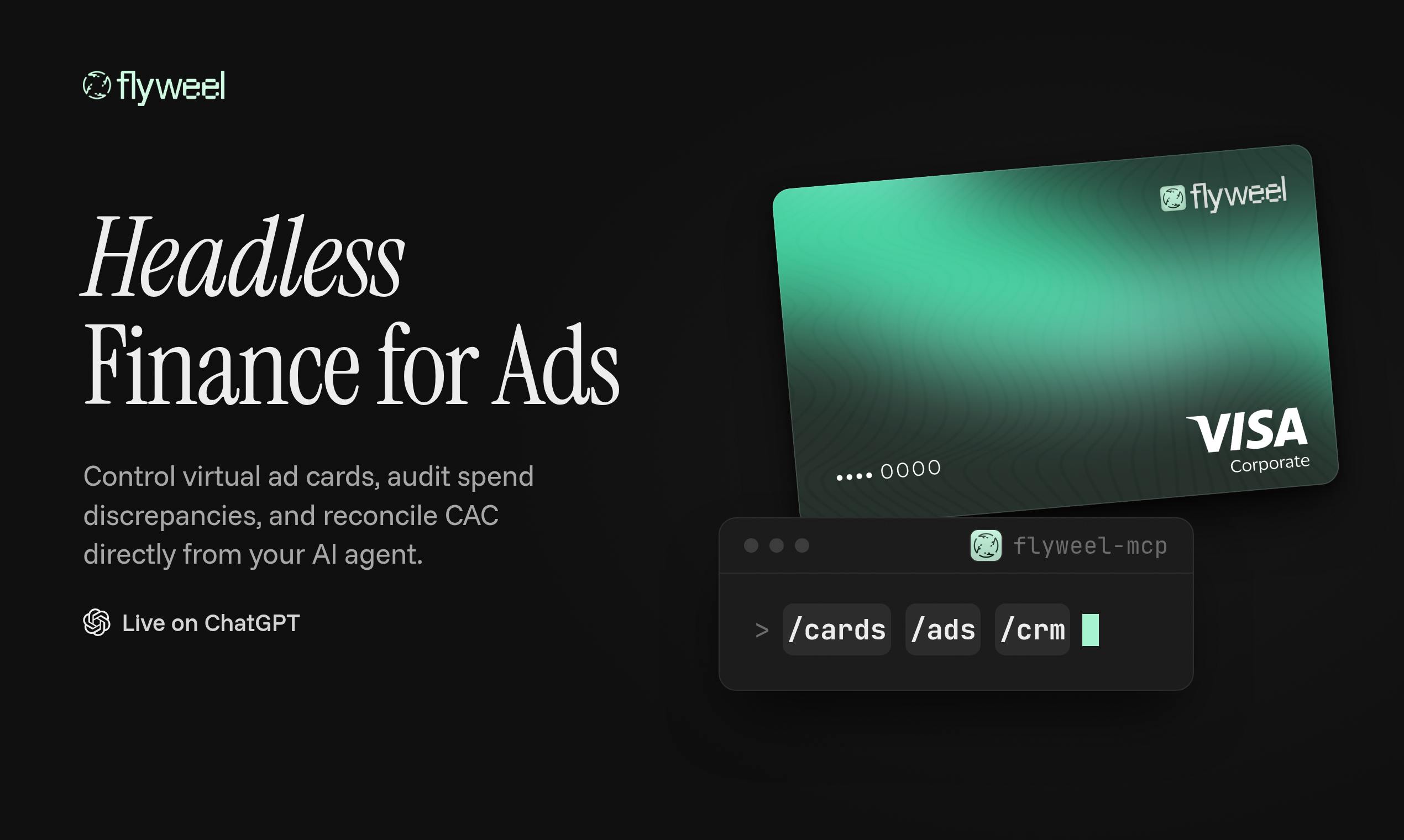
Advertising is becoming one of the earliest commercial use cases for AI agents, but a key problem persists: AI can automatically bid and adjust creatives, yet it cannot directly touch the money flow. Flyweel, launched on Product Hunt, aims to bridge this gap—it lets enterprises issue virtual cards with spending limits to AI agents, and provides cash flow financing and campaign auditing under the MCP protocol.
Product Positioning: Giving AI Agents "Financial Rails"
Flyweel's self-description is straightforward: "Give your AI agent financial rails for paid ads." It targets businesses scaling growth through paid advertising and addresses three core needs:
- Virtual ad spend cards: Enterprises can issue virtual cards to AI agents with custom spending limits, allowing agents to autonomously complete ad spending within budget.
- Cash flow gap financing: When campaigns perform well but revenue collections haven't caught up, Flyweel provides advance funding so winning campaigns can continue to scale.
- MCP protocol auditing: Agents can reconcile actual charges with real-time ad results via MCP (Model Context Protocol).
Together, these three capabilities form a closed loop from "spending money" to "verifying the effectiveness of spending." On Product Hunt, the product received 73 upvotes, ranking 14th for the day, categorized under Fintech, Marketing, and Advertising.
MCP Auditing: Making Agents More Than Just "Hands That Spend"
The most notable design of Flyweel is its MCP integration. MCP is a protocol that enables standardized connections between AI models and external tools and data sources. Flyweel uses it to place two datasets—"ad charge records" and "ad campaign results"—into the same context accessible to the agent.
This means the agent can not only execute campaigns but also answer "was this money well spent?" In traditional workflows, budget approval, charge reconciliation, and performance attribution are often scattered across finance, media buying, and data analytics teams; Flyweel attempts to compress this chain into the agent's workflow, making auditing part of the campaign action rather than a separate post-hoc step.
For high-frequency bid adjustment scenarios, this real-time reconciliation capability has practical value—the agent can promptly scale back budget when it detects a mismatch between a charge and conversion data, without waiting for month-end reconciliation.
MCP (Model Context Protocol) was introduced by Anthropic in late 2024 as an open protocol designed to let AI models connect to external tools and data sources in a standardized way. It uses a client-server architecture: AI applications act as clients, invoking resources, tools, and prompt templates exposed by various MCP servers through a unified interface specification. Compared to the previous approach where each tool required custom integration, MCP reduces connection costs, enabling agents to access multiple heterogeneous data sources simultaneously within a single context. Flyweel encapsulates ad charge records and campaign results as MCP-accessible data, allowing the agent to complete reconciliation within the same reasoning process. However, MCP itself does not specify data refresh frequency; the real-time nature of auditing still depends on Flyweel's data pipeline design.
Cash Flow Financing: A Real Pain Point During Growth
Businesses scaling paid advertising often encounter a timing gap: campaign effectiveness has been validated, but revenue collections have payment terms, and cash flow can't sustain continued scaling. Flyweel's financing feature is designed for this gap.
A detail worth noting: the combination of finance and advertising also brings compliance and risk control challenges. Setting virtual card spending limits, credit assessment for financing, and liability attribution after autonomous agent spending are all questions such products must continually answer. Flyweel's currently disclosed information focuses on product capabilities; specific risk control mechanisms and funding partners have not yet been detailed.
Cash flow financing in advertising is essentially short-term financing based on ad spend data. Enterprises use validated campaign performance as credit evidence, with the funder advancing ad costs first, to be repaid upon collection. Such models have precedents in ad tech, such as credit lines or buy-now-pay-later services offered by some ad platforms. Core risk control relies on continuous monitoring of campaign ROI: once conversion data deteriorates, the funder needs to promptly reduce the credit line. By binding financing to the agent's campaign actions, Flyweel can theoretically obtain more granular spend data for credit assessment, but it also means the risk model must handle volatility from autonomous agent decisions, raising higher requirements for real-time credit evaluation.
Who Should Use It, and What to Watch Out For
From its positioning, Flyweel's target users are small to mid-sized teams that have established stable campaign models and want to delegate campaign execution to agents. It lowers the barrier to "letting agents touch money," rather than replacing ad campaign strategy itself.
Potential users should pay attention to several points: whether the agent's spending permission boundaries are granular enough, how much data latency exists in MCP auditing, and how financing costs are priced. These details determine whether the product is an efficiency tool or a new risk point in actual operations.
Advertising automation has reached the financial layer, and Flyweel represents a new product direction—providing auditable, bounded financial infrastructure for AI agents. Whether this direction succeeds ultimately depends on whether risk control design can keep pace with agent autonomy.
One-line Summary
Flyweel issues virtual ad cards with spending limits to AI agents, combining MCP auditing and cash flow financing to close the financial loop for agent-driven campaigns.
Paragraph Summary
Flyweel is a financial infrastructure product launched on Product Hunt for paid advertising businesses. Its core offering is virtual cards with custom spending limits for AI agents, enabling autonomous ad spending within budget. It also provides cash flow financing to address growth-stage funding gaps when campaign effectiveness is validated but collections haven't arrived, and uses the MCP protocol to let agents reconcile actual charges with real-time ad results, embedding auditing into the campaign workflow. The product received 73 upvotes and ranked 14th on Product Hunt, categorized under Fintech and Advertising/Marketing. The article notes that its value lies in lowering the barrier to "letting agents touch money," but risk control details such as permission granularity, audit latency, and financing pricing have not been disclosed—key points to verify before adoption.
Related articles

Tencent WorkBuddy Hands-On: How AI Agents Crush Traditional Chat Assistants
WorkBuddy vs Doubao tested: how AI Agents directly operate computers to convert PPT to PDF, archive files and more. Analysis of WorkBuddy's low barrier, domestic ecosystem, pricing and plugin marketplace, plus AI Agent selection advice.

Azure Cross-Tenant Attack Chain: Root Cause Analysis of Five Paths
Binary Security analyzes five full cross-tenant compromise paths in Azure, trending 271 points on HN. This article interprets their shared root cause perspective and offers defense recommendations for cloud tenant isolation and reflections on responsibility boundaries.

Recreating a Real Bubble Tea Station in Isaac Sim: Script-Driven Unitree G1 Brews Tea
Developers recreated a real self-service tea station in NVIDIA Isaac Sim, using scripts to drive a Unitree G1 through a five-step tea-brewing process, exploring whether physics simulation can be a source of synthetic robot demonstration data and discussing contact stability and imitation learning.