Foldable iPhone Latest Models Leaked: Passport Form Factor and Pro Max New Colors Revealed

Latest foldable iPhone dummy units show a passport-style design, while "18 PM" models hint at an all-Pro Max lineup with new colors.
A tech blogger received the latest batch of iPhone dummy units from China's supply chain. The foldable model — now in its third generation of leaks — shows significantly improved finish with an integrated hinge, rounded body, and a wide-screen passport form factor similar to Samsung's Galaxy Fold 8. Models labeled "18 PM" suggest the next iPhone lineup may go all-Pro Max, with a striking rose crimson color among the new options. The blogger considers a foldable iPhone nearly confirmed given the consistent form factor across multiple generations, though specific details like colors and speaker placement may still change.
A tech blogger received the latest iPhone dummy unit package from China — this marks the third generation of foldable iPhone replica models to surface. Compared to the earlier rough aluminum structural versions, this batch shows a noticeably higher level of detail and finish. It includes not only the rumored foldable model, but also multiple color variants of the next-generation non-folding iPhone labeled "18 PM." While these remain models fabricated based on supply chain information and cannot represent Apple's final product, three consecutive generations converging on the same form factor makes the foldable iPhone increasingly difficult to dismiss.
Foldable Model: From Aluminum Frame to a Near-Finished Passport Form Factor
The blogger recapped the previous generations of models received: the earliest was just an aluminum structure with a detachable hinge, providing only a rough outline; the second added a front display indicator for a better overall impression; the third was so thin it felt "impossibly slim" — stunning but widely considered unrealistic.
The latest generation has been described as "noticeably more finished." The hinge is no longer a loose, detachable structure; the body lines are more rounded; the Apple logo uses an extremely subtle matte finish that's nearly invisible, while the logo area itself has a glossy texture. Camera cutouts and volume button placement also more closely resemble a real product than the previous generation.

One notable change is the swapped positions of the port and speaker — in previous models, the charging port was at the bottom and the speaker at the top, while the new version reverses this, moving the Type-C port to one side of the front panel and adding a side speaker opening. The blogger specifically noted that the diagonal speaker layout — one at the top-left and one at the bottom-right — could easily be covered by the palm during normal use, flagging it as a questionable design detail.
Compared to Samsung Fold 8: Apple's Passport Form Factor Strategy
The blogger stated bluntly that after seeing the Samsung Galaxy Fold 8, Apple is "under real pressure," as Samsung's foldable is impressively well-built. Based on the models, Apple's foldable shares a similar form factor with the Fold 8, adopting a wide-screen "passport form factor" design.
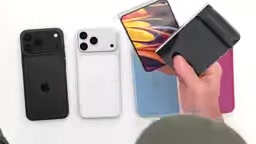
Also worth noting is the difference in product strategy between Apple and Samsung. In Samsung's lineup, the foldable is just one variant among many — the Flip (clamshell), Ultra (candy bar), and others continue to be sold in parallel. For Apple, however, the foldable model appears to be its singular entry into the folding space — just the one passport form factor. This means Apple is betting on a single folding design rather than casting a wide net like Samsung.
The blogger also weighed in on the model's thickness: this generation is more believable than the previous "impossibly thin" version. His reasoning: a foldable screen requires driving a large display area, and if battery capacity is compressed for the sake of extreme thinness, battery life would likely fall short of user expectations. So the slightly thicker version actually aligns better with mass production reality — and it nearly matches the thickness of the very first generation model.
The "passport form factor" refers specifically to a horizontal folding design where the unfolded screen has a near-square or wide aspect ratio — when unfolded, the display approaches square or landscape widescreen; when folded, the device is relatively wide but extremely thin, similar to the dimensions of a passport. This is fundamentally different from the Galaxy Z Flip's "clamshell" approach: the Flip unfolds to a standard portrait smartphone ratio and folds into a small square, whereas the passport form factor produces an inner screen that is far wider than it is tall when unfolded, closer to a tablet-like visual experience. Samsung's Fold series follows a similar route, though its aspect ratio is more "book-like," with the inner screen remaining more portrait-oriented when open. Apple's choice of passport form factor means a relatively large outer screen area when folded — enabling a more conventional single-hand experience — while the inner screen when unfolded offers content consumption area approaching that of an iPad mini. It's a compromise strategy that seeks to balance portability with large-screen experience.
"18 PM" Colors: From Rose Crimson to Classic Black and White
Aside from the foldable, the package included multiple models labeled "18 PM," which the blogger speculates may hint at the next generation going all-Pro Max across the lineup, along with several new color options.

The most eye-catching is a shade described as "rose crimson" — a reddish-pink tone. The blogger is cautious about this color: even on the model, the front panel and frame colors aren't fully consistent, leading him to conclude the final product "won't look exactly like this." However, Apple very likely will introduce a dedicated new shade in the red-pink family. His reasoning: when the overall design remains largely unchanged, a distinctive new color becomes an important way for users to signal to others that they have the latest model — so Apple needs a signature new color each generation.
The remaining colors are more conventional: a light metallic blue, a classic silver (very close to existing options, "nothing new"), and a deep "space black." The blogger thinks the blue looks good; the black and white speak for themselves.
Is the Foldable iPhone Really Coming?
On the authenticity of these models, the blogger's stance is cautiously optimistic. He says that with three consecutive generations of highly consistent models, if the whole thing turns out to be a hoax and Apple releases nothing, that would be "genuinely shocking." China's supply chain, when preparing for a major new product, produces protective cases, accessories, and increasingly reliable dummy units well in advance — and the accuracy of these leaks has been improving year over year.
Of course, models are still just models. Whether the colors are carried over, the hinge design, the speaker layout — all of these remain variable, and Apple could delay the launch due to production issues. But judging by the trend, a passport-form-factor foldable iPhone is fast becoming a near-certainty, and this batch of models is likely the closest preview yet of its actual dimensions and design.
The blogger concluded by saying he'll likely receive more similar packages before the official announcement, suggesting we may yet see versions even closer to the final product.
Supply chain dummy units are a pre-production information channel that runs throughout the smartphone industry. Months before an official announcement, Apple's shell manufacturers and accessory makers produce metal or plastic replica models based on engineering drawings, used for tooling accessories, evaluating ergonomics, and showing retail channels what the device will look like. These models typically contain no internal electronics and only replicate the body dimensions, cutout positions, and button layout. Because so many factories are involved in production, models inevitably leak into the market. Early models may be made from preliminary drawings and lack precision; as mass production approaches, the finish level improves and alignment with the final product increases. This is the industrial logic behind what the blogger describes as "three consecutive generations looking increasingly like the real thing" — the closer to release date, the more reliably the leaked models reflect the actual product.
Related articles

Why Does the Tesla Roadster Need to Fly? A Deep Dive into Musk's Wild Demo
Tesla's Roadster launch showed wall-climbing, upside-down driving, and flying stunts—but The Vergecast notes the demo car may lack a battery, the Rocket version is invite-only and not street-legal, and the website terms don't guarantee delivery. After nine years of delays, why does this car still need to exist?

AI Is Not a Replacement: Human-AI Collaboration Through the Lens of Factory Root Cause Analysis
Starting from factory root cause analysis, this article explains how AI accelerates evidence chain construction rather than replacing human experts, exploring the pragmatic implementation logic and business value of 'AI supporting people rather than replacing them.'

AI Agent Decision Auditing: Building an Evidence Chain in Regulated Workflows
Starting from a Reddit discussion, this article analyzes three core issues in AI agent decision auditing within regulated workflows: what fields audit records should contain, how to handle feedback latency for erroneous decisions, and how to continuously calibrate LLM judge consistency with human judgment.