Ford Fathom: The Cheapest US EV That Can Power Your Home
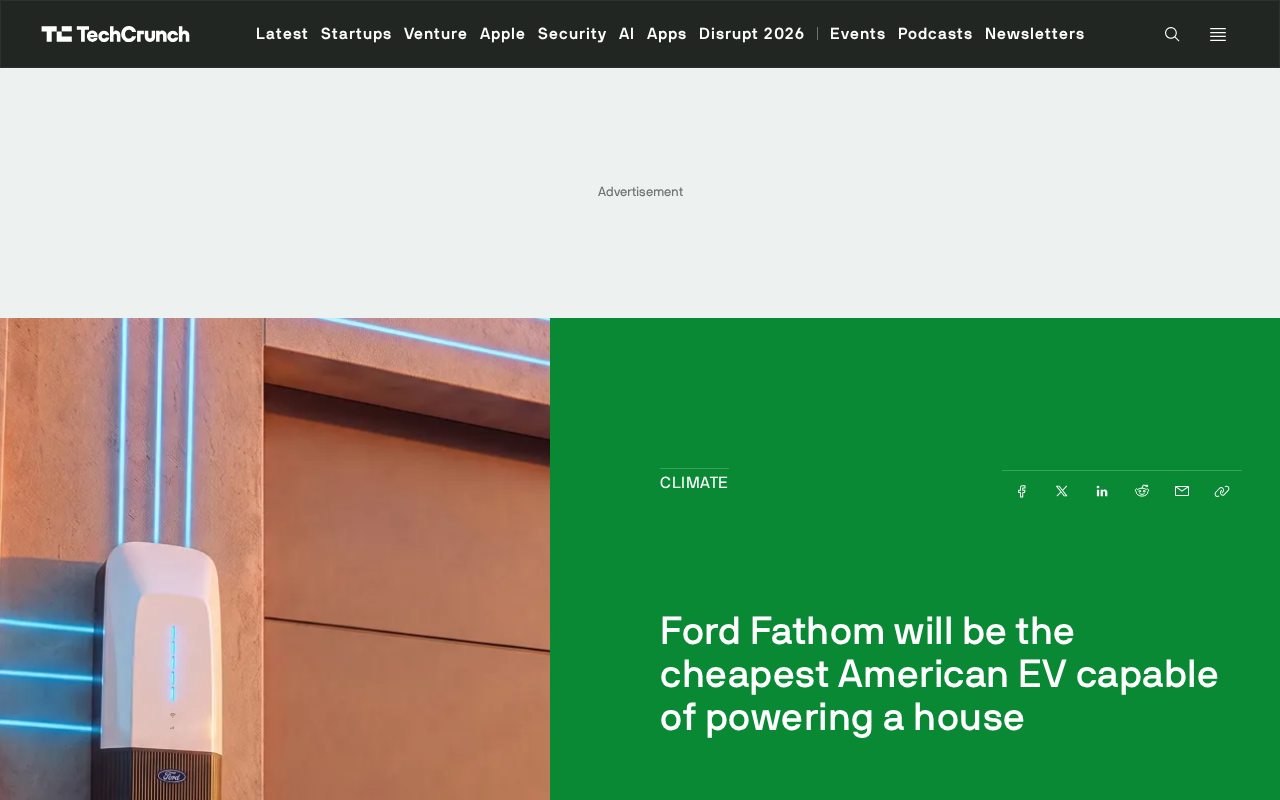
Ford launches two V2x chargers, making the Fathom the cheapest US EV that can power a home.
Ford has released two new chargers supporting V2x (Vehicle-to-everything) capability, enabling EVs to feed power back to a home or the grid. The upcoming affordable Fathom model will be the first to carry this capability, becoming the cheapest EV on the US market with home power functionality. The article covers V2H (Vehicle-to-Home) and V2G (Vehicle-to-Grid) forms of V2x and notes that Ford's integrated vehicle-plus-charger approach lowers the barrier to home energy management. Compared with similar features previously available only on high-priced pickups and SUVs, the Fathom's positioning could drive V2H adoption and provide a distributed storage foundation for grid peak shaving and renewable energy integration. Specific specs and pricing await Ford's official announcement.
Ford is launching two new chargers capable of powering a home or the grid, enabling so-called V2x (Vehicle-to-everything) capability. According to RSS sources, these chargers will first support the upcoming Ford Fathom model, making it the cheapest EV on the US market with home power capability.
Ford Fathom and V2x Technology
Ford's two new chargers support V2x functionality, allowing EVs to supply power to a home or the grid. This means the vehicle can not only charge from the grid but also feed power back during outages or peak electricity pricing. As an affordable EV, the Fathom will be the first to carry this capability, giving it a unique advantage in value for money.
V2x technology (Vehicle-to-everything) is an umbrella term for how EVs interact with the outside world, including V2H (Vehicle-to-Home) and V2G (Vehicle-to-Grid). Ford's new chargers are designed precisely to enable these functions, turning EVs into mobile energy storage units.
Ford is launching two new chargers capable of powering a home or the grid, enabling so-called V2x capability.
V2H (Vehicle-to-Home) is the branch of V2x technology most relevant to consumers' daily use. It refers to an EV using bidirectional charging equipment to invert the DC power in its traction battery into household AC power to supply a residence. A typical implementation involves adding or replacing a charging station that supports bidirectional power flow on the home distribution panel side, and using an automatic transfer switch (ATS) to switch household loads from the grid to the vehicle during an outage. The core hardware requirements are a bidirectional onboard charger (OBC) or an external bidirectional charging station, along with grid-connected/islanded switching logic that complies with local electrical codes. The available V2H power is usually limited by the charging station's rated power and the vehicle battery's discharge capability, commonly in the 3–10 kW range—enough to cover basic loads such as refrigerators, lighting, and network equipment, but difficult to simultaneously drive high-power air conditioning or electric heating.
V2G (Vehicle-to-Grid) goes further, allowing EVs to feed power back to the grid under grid dispatch commands, participating in ancillary services such as frequency regulation and peak shaving. V2G has far higher requirements than V2H for metering, communication protocols (such as ISO 15118 and OCPP), and grid-connection safety certification, and it requires settlement mechanisms among grid operators, aggregators, and vehicle owners. V2G is still in pilot stages in many parts of the world, while V2H has entered the configuration lists of production vehicles—which is the practical reason Ford is making home power supply the core selling point of the Fathom.
The Cheapest US EV Home Power Solution
According to the original report, the Ford Fathom will become the cheapest EV on the US market capable of powering a home. This selling point is quite attractive to consumers focused on energy independence and emergency preparedness. Compared with other V2H-capable models, the Fathom's pricing is expected to lower the barrier, allowing more households to use an EV as backup power.
Currently, EVs that support home power supply are usually expensive and require the additional purchase of a dedicated charger. By launching a companion charger and offering it with the Fathom, Ford provides an integrated solution. Although specific pricing has not been announced, the "cheapest" positioning implies that Ford has optimized cost control.
In the US market, EVs supporting home power supply have so far mainly been concentrated in mid-to-large pickups and high-priced SUVs such as the Rivian R1T, Ford F-150 Lightning, and Chevrolet Silverado EV, with starting prices generally above $50,000, and the home backup power function often requiring an optional intelligent backup power system or an additional Home Integration System purchase—potentially adding thousands to tens of thousands of dollars to the total solution cost. The breakthrough nature of the Fathom's "cheapest" positioning lies in bringing bidirectional charging capability down to an affordable vehicle platform and achieving software-hardware integration through manufacturer-owned chargers, reducing third-party inverter and retrofit costs. However, consumers should still note: actual available V2H power depends on the vehicle's battery capacity and charger specifications, and affordable models have smaller battery packs, so backup duration will be noticeably shorter than that of large-battery pickups; moreover, installing a bidirectional charging station typically requires a licensed electrician to modify the distribution panel, and this installation cost is not included in the vehicle price.
Impact on the EV Market
The Ford Fathom's V2x capability could drive the adoption of V2H technology. As EV range and battery capacity increase, the potential of vehicles as home backup power sources is gaining attention. Ford's move not only enhances product competitiveness but may also prompt other manufacturers to follow suit, accelerating the unification of V2x standards and the buildout of infrastructure.
In addition, V2x technology has positive implications for grid stability and renewable energy integration. EVs can charge when grid load is low and discharge during peaks, playing a peak-shaving role. Ford's chargers support grid power supply, providing a hardware foundation for the future development of smart grids.
EV participation in grid interaction (especially V2G and managed charging) is not a new concept for power systems, but large-scale deployment has long been constrained by three conditions: first, the cost and certification of bidirectional charging equipment; second, whether time-of-use pricing and demand response mechanisms provide sufficient economic incentives for vehicle owners; and third, grid operators' ability to aggregate and dispatch distributed energy storage resources. By equipping the Fathom with a bidirectional charger, Ford is essentially reserving interfaces at the hardware level for these mechanisms—when a vehicle charges at low electricity prices and discharges at peak times, a single vehicle's battery can be regarded as a dispatchable distributed energy storage unit. After aggregating multiple vehicles, their regulation capacity has real value for the peak-valley difference of local distribution networks and for renewable energy consumption. It should be noted that V2G electricity sales to the grid are still subject to interconnection agreements and metering rules in most US states, and the more realistic near-term path is V2H home backup and demand response rather than full-power grid feed-in.
Conclusion
With its V2x capability, the Ford Fathom becomes the cheapest EV in the US capable of powering a home, and together with two new chargers, it lowers the barrier to home energy management. Although more details await official announcement, this direction demonstrates the potential of EVs as mobile energy storage units, benefiting both consumers and the grid.
(Note: This article is based on brief information from RSS sources; please refer to Ford's official release for specific specifications and pricing.)
Related articles

14 Core Concepts of Reasoning Models: From Chain of Thought to GRPO Explained
A systematic breakdown of 14 core concepts of reasoning models: chain of thought, test-time compute, verifiers, RLVR and GRPO, distillation, and reward hacking, plus rules for controlling thinking-token costs to help you decide when reasoning is worth paying for.

OpenAI's Claimed Refutation of ETH Sparks Debate, Meta Bets Big on AI Infrastructure
OpenAI claims an AI-assisted discovery that challenges the Exponential Time Hypothesis (ETH) and launches the mid-tier GPT-6.1 Tera. Cloudflare discloses a cross-customer data leak postmortem, and Meta plans $95B in AI infrastructure financing.

Data Scraping, AI Proofs, and Open Source Contracts: This Week's Deep Dive into the Tech World
From the 3D model crawler controversy and OpenAI's Lean formal proofs to AI agents challenging Brooks' Law and Debian rejecting LLM review, this week's tech discussions center on openness and verifiability.