Foreguard: A Free Family Care Planning AI Tool Built with ChatGPT

Foreguard uses ChatGPT and Codex to offer free family care planning, from benefits to insurance.
Foreguard is a free AI-powered family care planning tool built by Sekhar using ChatGPT and Codex after his father's frontotemporal dementia diagnosis. It helps families identify eligible public benefits they may be missing and provides tailored private insurance recommendations. The tool demonstrates how AI-assisted solo development can address real human needs, enabling early care financial planning that transforms modest monthly budgets into millions in day-one protection.
A Real Pain Point Born from Family Experience
When Sekhar's father was diagnosed with frontotemporal dementia, he realized this could very well be his own future. What worried him even more was the thought that his future care needs might become a heavy burden on his husband, Jim.
Frontotemporal Dementia (FTD) is a group of neurodegenerative diseases caused by progressive deterioration of the brain's frontal and/or temporal lobes. It typically strikes between ages 45-65, earlier than the average onset age for Alzheimer's disease. Classic FTD symptoms include significant personality and behavioral changes, language deterioration, and impaired judgment. It also carries a strong hereditary tendency—approximately 30%-50% of patients have a family history, and certain subtypes have been confirmed to be linked to specific gene mutations. This explains why Sekhar felt such deep concern after his father's diagnosis. Currently, there is no cure for FTD, and patients typically require continuous care support lasting years or even over a decade.
This worry is far from unique. As population aging accelerates, long-term care issues such as dementia and disability care are troubling an increasing number of families. In reality, many families only scramble to respond when care decisions become urgent, lacking both financial preparation and awareness of the public benefits they're entitled to.
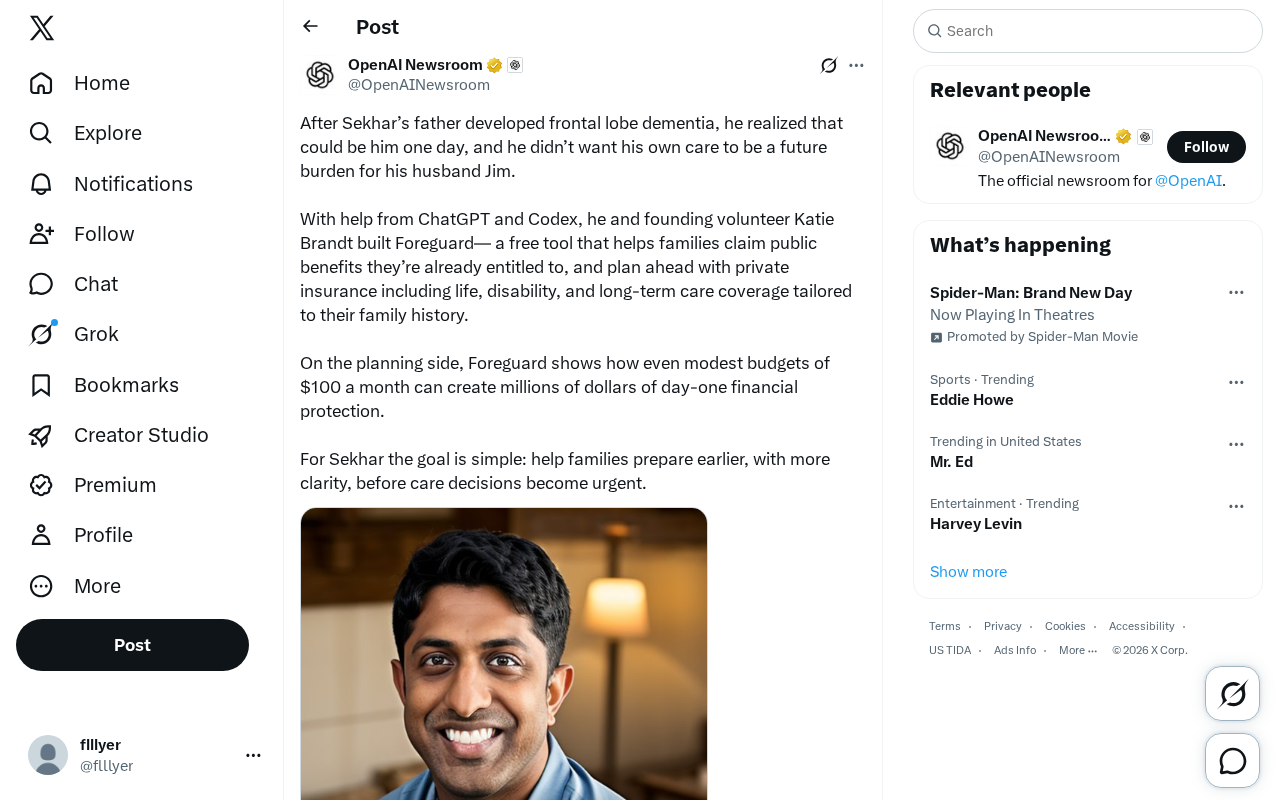
It was precisely this personal anxiety that drove Sekhar to take action—not to passively wait, but to proactively build a tool that helps families plan ahead.
Building Foreguard with ChatGPT and Codex
Sekhar didn't rely on a large engineering team to build this product. Using the AI programming capabilities of ChatGPT and Codex, together with founding volunteer Katie Brandt, he built a free family care planning tool called Foreguard.
Codex is an AI model fine-tuned by OpenAI specifically for code generation tasks, built on the GPT series foundation. It can transform natural language descriptions into executable program code, supporting dozens of programming languages including Python, JavaScript, and HTML. Codex is the underlying engine of GitHub Copilot, and its core capability lies in understanding developer intent and automatically generating functional code snippets, API call logic, and even complete application frameworks. For entrepreneurs like Sekhar who have clear product goals but may not possess deep programming expertise, Codex dramatically compresses the timeline from concept to prototype, enabling individuals or very small teams to build applications involving complex business logic.
This is a textbook case of "AI-assisted solo development." In the past, building a complex application involving public benefits data and insurance planning logic would have required a professional software team and significant funding. Now, with the programming and reasoning capabilities of generative AI, a single person with a clear goal plus a few volunteers can rapidly transform ideas into usable products.
AI-assisted solo development (sometimes called "vibe coding" or the "one-person startup" model) is a software development paradigm that has rapidly emerged between 2023-2025. With tools like ChatGPT, Claude, Cursor, and Replit, an increasing number of domain experts without traditional computer science backgrounds can independently build fully functional applications. The deeper significance of this trend is that it redefines who has the right and ability to create technology solutions. Previously, the power to develop software products was almost entirely in the hands of technical teams. Now, the people who experience problems firsthand—those who understand the pain points best—can directly become the builders of solutions. This not only shortens the path from need to product but also allows more real problems that are "too small a market" or "insufficient commercial return" to be addressed by technology tools.
This also reflects how AI programming tools are lowering the barriers to software development, enabling more "firsthand experiencers of problems" to personally solve the difficulties they encounter, without depending on third-party commercial development.
Core Features and Value of Foreguard
Foreguard's core value is primarily reflected in two areas:
Helping Families Identify and Claim Public Benefits They're Entitled To
Many families actually qualify for certain public benefits but miss out due to information asymmetry and complex processes. As a free tool, Foreguard helps families identify and claim these public benefits that already belong to them, reducing financial losses caused by lack of policy awareness.
Within the U.S. public benefits system, numerous federal and state-level programs can provide support for caregivers and care recipients, including Veterans Aid and Attendance benefits, state Medicaid waiver programs, Home and Community-Based Services (HCBS), family caregiver tax credits, and more. However, multiple studies estimate that a significant proportion of eligible families (as high as 40%-60% for some programs) have never claimed these benefits. Reasons include: obscure program names, cumbersome application processes, complex and state-varying eligibility criteria, and lack of a unified information portal. This systemic information asymmetry is the core pain point that Foreguard aims to bridge through AI tools.
Tailored Private Insurance Planning Solutions
On the planning front, Foreguard recommends suitable private insurance plans based on each family's medical history, including life insurance, disability insurance, and long-term care insurance.
Long-Term Care Insurance (LTCI) is both an important and complex market in the United States. According to the U.S. Department of Health and Human Services, approximately 70% of people over 65 will need some form of long-term care services in their lifetime, while Medicare provides extremely limited coverage for long-term care, and Medicaid requires applicants to deplete their assets to very low levels to qualify. Traditional LTCI premiums have risen year after year, and many insurance companies have exited the market. In recent years, hybrid products (combining life insurance with long-term care coverage) have gradually become an alternative. This market reality means ordinary families face extremely high information barriers and decision complexity in care financial planning, and Foreguard aims to reduce this complexity through intelligent recommendations.
A particularly compelling data point in the tool: even a modest budget of $100 per month can create millions of dollars in day-one financial protection. This comparison clearly demonstrates the enormous leverage effect of planning ahead versus responding ad hoc—early planning and investment can often yield substantial risk buffers at minimal cost. The "day-one protection" here refers to the maximum payout amount available from the moment a policy takes effect, embodying the core value of insurance products: using predictable small expenditures to hedge against uncertain large-scale risks.
The Practical Significance of Planning Long-Term Care Early
For Sekhar, Foreguard's goal is actually quite simple: helping families prepare earlier and more clearly, taking action before care decisions become urgent.
Long-term care is a classic domain where "the later you prepare, the more passive you become." When a family member is already ill and care needs have already emerged, whether it's insurance enrollment, benefits claims, or financial arrangements, the range of options narrows dramatically and costs rise significantly. Take insurance as an example: most long-term care insurance products require the applicant to pass underwriting while cognitively normal and physically healthy. Once early symptoms appear or a diagnosis is made, virtually all insurance companies will deny coverage. On the cost front, the average annual cost of U.S. care facilities already exceeds $100,000 (memory care facilities are even higher). Without advance insurance or savings arrangements, these costs will quickly deplete the savings of most middle-class families.
By planning ahead while healthy and capable, families can typically secure more composed choices and more comprehensive protection.
What Foreguard aims to do is lower the threshold for this "advance planning" to its minimum—through a free, easy-to-use tool, enabling ordinary families to conduct systematic care financial planning just like professionals.
The Humanistic Value of AI Applications: From Personal Pain Points to Public Service
The Foreguard story deserves attention not merely because it uses cutting-edge AI tools like ChatGPT and Codex, but because it demonstrates a direction for AI implementation: starting from solving the creator's own real pain points and serving ordinary people in similar circumstances.
Among the many AI products pursuing commercial scale and technical showmanship, an application like this—driven by personal experience, offered for free, and focused on family care—offers an alternative perspective: AI's value should ultimately be measured by how it tangibly reduces burdens and anxieties in people's lives. This "human-centered" AI application philosophy echoes the academic and public policy community's recent calls for "Responsible AI": technology's ultimate purpose is not to generate commercial profits or demonstrate engineering prowess, but to expand the boundaries of human well-being, especially serving groups overlooked by traditional commercial logic.
For families in similar situations, regardless of whether they ultimately use Foreguard, the philosophy it conveys is worth adopting: the earlier care preparation begins, the more choices available in the future, and the lighter the burden on family members.
Key Takeaways
Related articles

Go Microservices in Practice: Detailed Architecture for E-Commerce, AI Agent, and IM System Integration
Deep dive into integrating e-commerce, AI Agent, and IM systems under Go microservices architecture, covering unified auth, gRPC, componentized Agent engines, and group chat bots.

X Platform's Recommendation Algorithm Caught Filtering Brazilian Election Content, Reigniting Algorithm Transparency Debate
X (formerly Twitter) was found filtering Brazilian election content in its For You feed, sparking debate over algorithm transparency and free speech.

Poison-Resistant Concept Anchoring: A New Approach to Defending Against AI Data Poisoning
Deep dive into Poison-Resistant Concept Anchoring, defending against data poisoning via signed anchors and bounded updates. Experiments show 62% poison isolation with 0% false rejection rate.