Former Anthropic Researcher Resigns and Speaks Out: The AI Superintelligence Race Is 'Gambling With Our Lives'

A former Anthropic researcher's viral resignation warns AI labs are recklessly racing toward superintelligence.
Former pretraining researcher Jason Coxon's resignation post garnered 172 million views, accusing both OpenAI and Anthropic of recklessly racing toward self-improving superintelligence and gambling with human lives. Anthropic's alignment science lead publicly endorsed the post, stating he personally believes there is over a 10% chance AI could cause human extinction within a decade. Compared to Dario Amodei's own 25% risk estimate from a year prior, the diverging figures have sparked darkly humorous debate. The deeper issue is the fundamental tension between safety and speed — when insiders choose resignation to sound the alarm, the whole industry should take note.
A Resignation Statement That Rocked the Tech World
A resignation statement from an AI researcher recently set social media ablaze. The post racked up a staggering 172 million views — described by commentators as not only the most viral tweet in AI safety history, but a phenomenon-level event across all of tech Twitter.
The statement was blunt: "I resigned from Anthropic today. Over the past three years, I've done pretraining research at both OpenAI and Anthropic. Neither company has acted responsibly. They are racing straight to self-improving superintelligence, gambling with all of our lives."
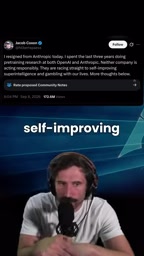
Having worked in pretraining research at both of the most cutting-edge frontier AI labs, this researcher's criticism carries unusual weight — it isn't speculation from an outside observer, but an insider voice from the very core of model development.
Who Is the Person Behind This
The figure at the center of this controversy is an AI researcher named Jason Coxon. On social media, he's been dubbed "mini Dario" and "Dario 2.0" — nicknames that clearly reference Anthropic CEO Dario Amodei, hinting at some ideological continuity between the two on AI safety.

What made this story truly take off, however, wasn't just one person's views — it was the very public endorsement from others inside the industry.
Cross-Validation from Insiders
Evan, Anthropic's alignment science lead, retweeted the post and came out in explicit support. He wrote: "Jacob is right about this. AI risk is real, and we genuinely believe AI could kill everyone. Personally, I think the probability of that happening within the next decade is above 10%."
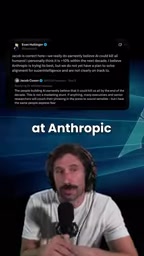
A person in a core alignment science role publicly placing the odds of human extinction within ten years above 10% hits far harder than a typical exit rant. It signals that this risk assessment isn't the fringe view of a doomsayer — it's coming from the technical leadership inside the company whose job it is to keep AI safe.
Alignment Science is a central research direction in AI safety, focused on ensuring that AI systems behave in accordance with human intentions and values. The core question it addresses is: as AI capabilities continue to scale, how do we prevent systems from exhibiting harmful, unintended, or goal-misaligned behavior? Anthropic treats alignment research as one of its core founding missions and has established a dedicated alignment science lead role. That's precisely why, when the person holding that role publicly states that AI risk is "real" and attaches a quantified probability to it, the signal carries far more weight than any individual employee's opinion — it represents deep concern from within the company's own safety-focused technical leadership, serious enough to warrant publicly endorsing a resignation statement.
How the Risk Numbers Have Shifted
The video commentary draws attention to a notable data point on the timeline. Just one year earlier, Dario Amodei himself had publicly stated that AI had "a 25% chance of leading to very, very bad outcomes."

From Dario's 25% a year ago to the alignment lead's "above 10%" today — different people, different moments, different numbers. The commentator quipped with dry humor: "So what does this mean? Things are getting better, guys." The sarcasm cuts right to the absurdity: when the industry's top experts are debating whether the probability of human extinction has dropped from 25% to 10%, "improvement" is still a deeply unsettling number.
The Real Issue Beneath the Drama
Stripped of the theatrics, this incident cuts to the most fundamental tension in AI development: safety versus speed. The phrase "racing straight to self-improving superintelligence" in the resignation statement directly indicts the industry's current competitive dynamics.
Self-improving superintelligence refers to the possibility of an AI system continuously enhancing its own capabilities. Once a model can recursively improve itself, both the speed of its capability growth and its controllability face profound uncertainty. What critics fear is this: under the pressure of commercial competition and technological arms races, companies may sacrifice necessary safety evaluations in favor of pushing capability frontiers.
A former pretraining researcher choosing the definitive act of resignation to speak out, backed by the public endorsement of an alignment lead, reflects a very real divide — even within companies that fly the banner of "safety" — over development pace and acceptable risk tolerance. Whatever the precision of those probability figures, a public debate initiated by insiders is something the entire industry should take seriously.
Recursive Self-Improvement is one of the core risk scenarios that has long been discussed in AI safety. The basic logic runs as follows: if an AI system is intelligent enough to understand and improve its own code, architecture, or training process, then each improvement produces a system even more capable of improving itself, creating a positive feedback loop. In theory, this process could advance far faster than any human oversight mechanism could keep pace with, causing AI capabilities to expand explosively in a very short time — what's known as an "Intelligence Explosion." The concept was first proposed by mathematician I.J. Good in 1965, later systematically elaborated by Nick Bostrom and others in works like Superintelligence, and has since become a theoretical foundation for modern discussions of AI existential risk. The phrase "racing straight to self-improving superintelligence" in the resignation statement directly invokes this framework, suggesting that the current pretraining race may be approaching that critical threshold.
Conclusion
The reason this 172-million-view tweet broke through into mainstream consciousness isn't just the controversy of the topic itself — it's the identity of those speaking. They are the people who best understand how these systems are actually trained. When the builders of AI begin publicly questioning the way AI is being built, perhaps the rest of us should listen a little more carefully.
Related articles

OpenAI Partners with Shield: How the Astra Agent Revolutionizes IT Troubleshooting
OpenAI and Shield launch the Astra agent, which autonomously logs into computers and legacy systems to fix IT issues in real time, 35-40% faster than traditional models, with humans involved only when judgment is needed.

iPhone Duo Battery Life Tested: One Charge a Day Is Unavoidable, and the Large Screen Is the Culprit
iPhone Duo battery test: heavy use needs at least one charge a day, and about 30% remains after 6.5 hours of screen-on time. How often the large screen is unfolded is key; a MagSafe battery pack helps, and long-term degradation is also worth watching.

Kimi K3.1 Pro Open-Sourced: 2.8 Trillion Parameters Close In on Opus
Moonshot releases the open-source MoE model Kimi K3.1 Pro, with 2.8T total parameters and 104B activated, trailing Opus 5.5 by under 1 point on Terminal Bench 4.0.