Former Plaud Executive Raises $26M to Build an AI App That Listens in the Background All Day

Former Plaud exec founded Ambi, raised $26M for a three-platform AI ambient capture app, with privacy as the biggest variable.
Ambi, founded by a former Plaud executive, raised $26 million to launch an AI app for iPhone, Mac, and Apple Watch that continuously listens in the background and automatically captures ambient information. This "ambient capture" model differs from wake-word-triggered assistants, pursuing seamless passive recording. The pure software route lowers user acquisition barriers, and the three-platform launch shows engineering depth. But privacy details remain undisclosed. With competitors like Rewind, Limitless, and Microsoft Recall, Ambi's success hinges on AI's precision in judging what's worth remembering and user trust in always being listened to.
After Leaving Plaud: A $26 Million Bet
According to an RSS tech news source, a former Plaud executive has successfully raised $26 million for a new venture called Ambi. The company's core product is an AI app that continuously listens in the background and automatically captures ambient information, initially covering three platforms: iPhone, Mac, and Apple Watch.
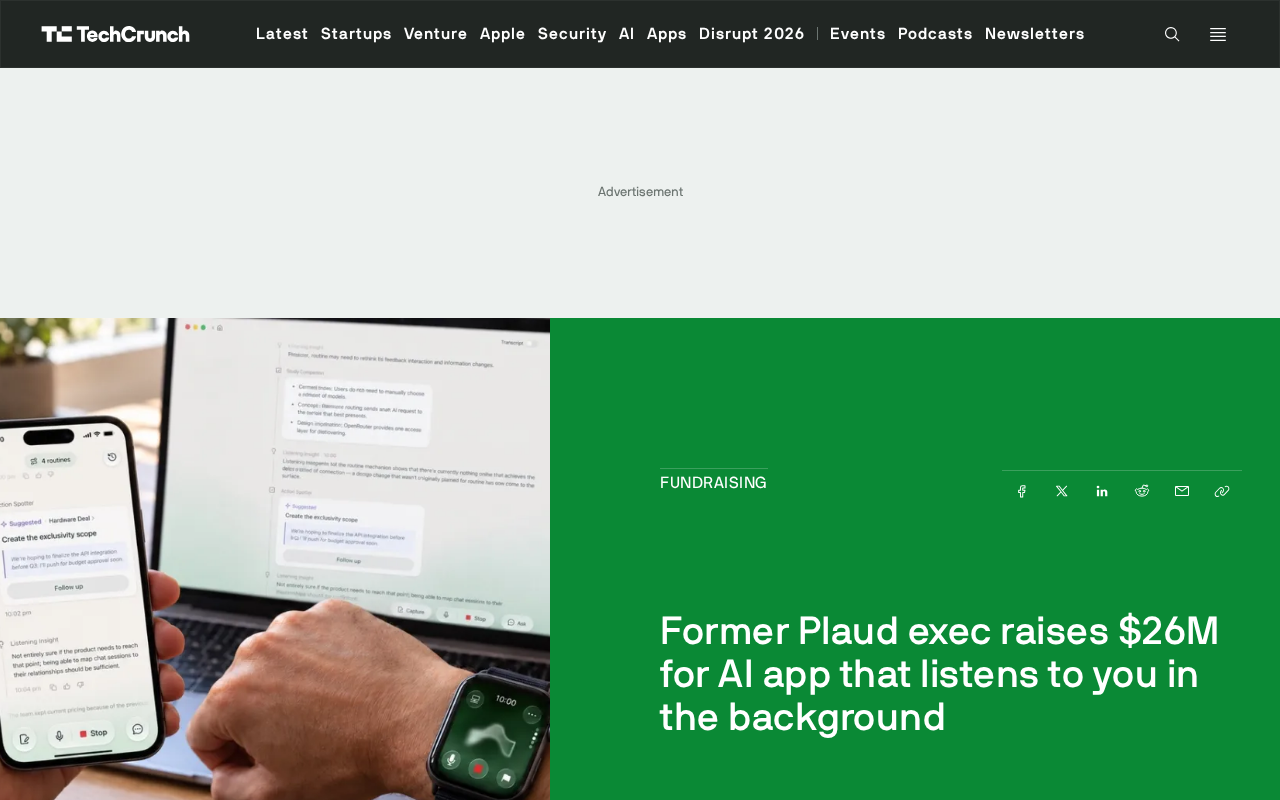
A funding round of this size is uncommon among AI application-layer startups. Especially considering Ambi's product direction — "ambient capture" — sits squarely in the crossfire of privacy controversies and technical feasibility, the fact that capital is still willing to place a heavy bet suggests the market retains strong confidence in the "always-on AI assistant" narrative.
What Is "Ambient Capture"?
Ambient capture refers to a device continuously collecting audio (and potentially visual or location data) in the background, with AI automatically identifying, organizing, and storing valuable content. Users don't need to actively press a record button — the AI decides for you what's worth remembering.
This is fundamentally different from traditional voice assistants. Siri or Alexa require a wake word to trigger, and interactions are explicit and point-to-point. Products like Ambi pursue passive, seamless information recording — you don't even need to be aware it's working.
What Problem Does Ambi Want to Solve?
In daily work and life, a massive amount of valuable information is generated in conversations and then forgotten. Decisions casually mentioned in meetings, project updates a colleague shares in the hallway, a fleeting thought spoken aloud when inspiration strikes — these moments are ephemeral. Ambi's premise is: if an AI is always listening and can intelligently filter noise and distill key points, the user's "memory bandwidth" gets an external extension.
Connection to Plaud's Products
Plaud previously gained recognition for AI recording hardware, focusing on combining voice recorders with AI transcription and summarization features. Ambi's core team members come from Plaud, meaning they have direct experience across the technical chain of audio capture, speech-to-text, and AI summarization. The difference is that Ambi has chosen a pure software route, directly leveraging the existing microphone arrays on iPhone, Mac, and Apple Watch, skipping the hardware manufacturing and sales环节.
Plaud is a company known for AI recording hardware. Its flagship product is a card-style AI voice recorder that can attach to the back of a phone or be used standalone. It captures audio through hardware microphones, then uses cloud or on-device AI for speech-to-text, speaker diarization, and summary generation. Compared to pure software solutions, the hardware route has advantages in pickup quality, standalone battery life, and cross-platform compatibility, but also brings additional purchase costs, carrying burden, and distribution channel dependence. The Ambi team chose to strip away hardware and directly call Apple devices' built-in microphone arrays — essentially trading "reduced customer acquisition friction" for "complete dependence on system permissions and background policies." This is the biggest philosophical divide between the two products.
What Does $26 Million in Funding Mean?
The funding amount itself conveys several signals.
First, investors endorse the "software-defined ambient capture" path. Plaud requires users to carry an additional hardware device, while Ambi only needs an app installed to run within the existing Apple ecosystem. The customer acquisition threshold and distribution efficiency are completely different.
Second, the inclusion of Apple Watch is noteworthy. A watch is one of the most constant devices closest to the human body, naturally suited as an entry point for environmental sensing. If Ambi can achieve low-power continuous listening on watchOS, use cases will expand from "sitting at a computer" to "moving around."
Third, the simultaneous launch across three platforms indicates the team has accumulated engineering expertise. Audio capture permissions, background operation policies, and power management differ across iPhone, Mac, and Apple Watch — cross-platform consistency is a hard nut to crack in actual implementation.
Privacy Issues Are Unavoidable
The most direct criticism of an AI app that's "always listening" is privacy.
Ambi has not yet detailed its data processing methods in public information — is audio processed locally or uploaded to the cloud? What are the data encryption and storage strategies? Can users view and delete recorded content? The answers to these questions will directly determine whether the product can earn mainstream users' trust.
From industry norms, Apple's ecosystem has strict restrictions on continuous background audio capture, and App Store review specifically scrutinizes the use of such permissions. The fact that Ambi launched on three platforms simultaneously means it has at least passed Apple's threshold at the compliance level, but there's still a gap between technical compliance and user psychological acceptance.
What Does the "Memory Extension" Users Actually Need Look Like?
The success or failure of ambient capture products isn't about whether the technology can be implemented, but whether AI can accurately judge "what's worth remembering." If it records a lot of irrelevant noise, users will quickly disable background permissions; if it misses key information, the product's value doesn't hold. This precision balance is the core issue Ambi must repeatedly debug in real-world usage scenarios.
In Apple's ecosystem, continuous background audio capture is strictly restricted. iOS and watchOS typically don't allow apps to keep the microphone active indefinitely in the background — the system constrains behavior through background task time limits, privacy indicators, and permission pop-ups. Developers often need to leverage real-time audio sessions, low-power listening, or integration with system features (such as ShazamKit or speech recognition frameworks) to achieve an approximate "always-listening" experience. Additionally, App Store Review Guidelines explicitly require apps to obtain explicit user consent before capturing audio and to explain data usage. Therefore, Ambi's simultaneous launch on three platforms at least means its permission request model and technical implementation have passed Apple's compliance review, but whether it uses on-device inference or cloud upload still depends on its architecture design.
This Track Is Heating Up
Products like Rewind AI and Limitless (formerly Rewind) are already doing similar things, and Microsoft's Recall feature has also sparked widespread discussion. Capital's continued bets in this direction show that the demand for "AI as a second brain" is being repeatedly validated.
But as of now, no ambient capture product has truly become a mainstream daily tool. Technical capability, privacy trust, and usage habits are all indispensable. Ambi enters with Plaud's industry experience and $26 million in funding. The challenge ahead isn't whether it can be built, but whether users are willing to let it keep listening.
Rewind AI initially started as a searchable memory app for macOS, using local screen and audio recording to let users revisit anything they've seen; it later transformed into Limitless, launching a wearable pendant hardware focused on all-day ambient recording and personalized AI assistance. Microsoft Recall is a system-level feature in Windows 11 that periodically takes screen snapshots and builds a local index, allowing users to search past activities using natural language. What these products have in common is attempting to build a "personal memory bank," but their privacy approaches vary: Rewind emphasizes local storage, Limitless uses wearable hardware plus cloud services, and Microsoft Recall was changed to opt-in with enhanced encryption after strong controversy over being enabled by default. Their actual adoption rates indicate that user acceptance of "being continuously recorded" remains the biggest variable.
One-line Summary
Former Plaud executive founded Ambi, raised $26M, launches three-platform AI ambient capture app, with privacy as the biggest variable.
Paragraph Summary
Ambi, founded by a former Plaud executive, successfully raised $26 million to launch an AI app covering iPhone, Mac, and Apple Watch. Its core capability is continuous background listening, automatically capturing and organizing ambient information. This "ambient capture" model differs from wake-word-triggered Siri or Alexa, pursuing seamless passive recording. The pure software route leverages existing Apple device microphones, lowering user acquisition barriers, and the three-platform simultaneous launch demonstrates engineering depth. However, privacy issues remain unclear — audio processing methods, data encryption, and user control strategies have not been disclosed. The ambient capture track already has players like Rewind, Limitless, and Microsoft Recall. Whether Ambi can break through depends on the precision of AI in judging "what's worth remembering" and user trust in "always being listened to."
Related articles

Copilot Usage Metrics Upgrade: Custom Skills and Agents Now Trackable by Name
GitHub Copilot usage metrics update: custom skills, agents, MCP servers, and plugins can now be tracked by name, with each list capacity increased from 5 to 25, helping admins precisely assess internal AI tool adoption and ROI.

Amazon Blocks AI Agents While Walmart Opens Its Doors: The Battle for the Retail Front Door
Amazon blocks AI shopping agents in court and at the firewall, while Walmart opens access via an official MCP server. We analyze both strategies and what developers should do.

Walmart Opens AI Agent Shopping While Amazon Builds Walls: The Battle for E-commerce's New Front Door
Walmart launches an official MCP server letting AI agents search and buy on its platform, with spending limits and transaction approvals; Amazon blocks AI agents in court and at the firewall. The two retail giants bet in opposite directions as agents become e-commerce's new front door.