Free Machine Learning Roadmap: A Systematic Learning Path Based on Official Microsoft Content

A student-curated free ML roadmap using Microsoft Learn content, from basics to production deployment.
A computer engineering student reorganized Microsoft's free official learning content (Microsoft Learn) into a systematic machine learning roadmap covering four stages: core ML concepts, Python + scikit-learn hands-on coding, Azure ML cloud training, and MLOps with production deployment. Based on DP-100 certification materials, it bridges the common gap between learning model training and actually deploying models to production endpoints.
Why Most Machine Learning Tutorials Lead to Dropout
Almost everyone trying to get into machine learning has encountered the same dilemma: available learning resources are either paid courses running 40+ hours, or scattered blog posts that assume you already have half the prerequisite knowledge. The result? Beginners are either deterred by high prices or lost in fragmented information.
This isn't an isolated problem. The fragmentation of machine learning education has been a long-standing issue—platforms like Coursera and Udemy host tens of thousands of ML courses, yet completion rates generally hover below 15%. The reasons are multifaceted: machine learning itself spans three major domains—mathematics (linear algebra, probability and statistics, calculus), programming (Python, data processing), and domain knowledge—creating an extremely long chain of prerequisites. Meanwhile, different courses define "beginner-level" very differently—some assume you're already familiar with NumPy and Pandas, while others start from basic Python syntax. This lack of standardization causes learners to constantly bounce between "too easy" and "can't understand."
Recently, a computer engineering student shared his solution on Reddit: he reorganized Microsoft's free learning content (Microsoft Learn) into a clear machine learning roadmap. This content is the same official material behind Microsoft's DP-100 (Azure Data Scientist certification) exam—just reorganized in the order it "should be studied."
DP-100 (full name: Designing and Implementing a Data Science Solution on Azure) is a professional-level certification in Microsoft's Azure certification system aimed at data scientists, at the Associate level. The core competencies it tests include: managing Azure Machine Learning resources, running experiments and training models, deploying and operating machine learning solutions, and implementing responsible AI. Microsoft Learn, as Microsoft's free self-study platform, offers interactive learning modules and learning paths. Each module includes text explanations, hands-on labs (sandbox), and knowledge checks—learners can even operate Azure resources directly in the browser without needing to create their own paid account.
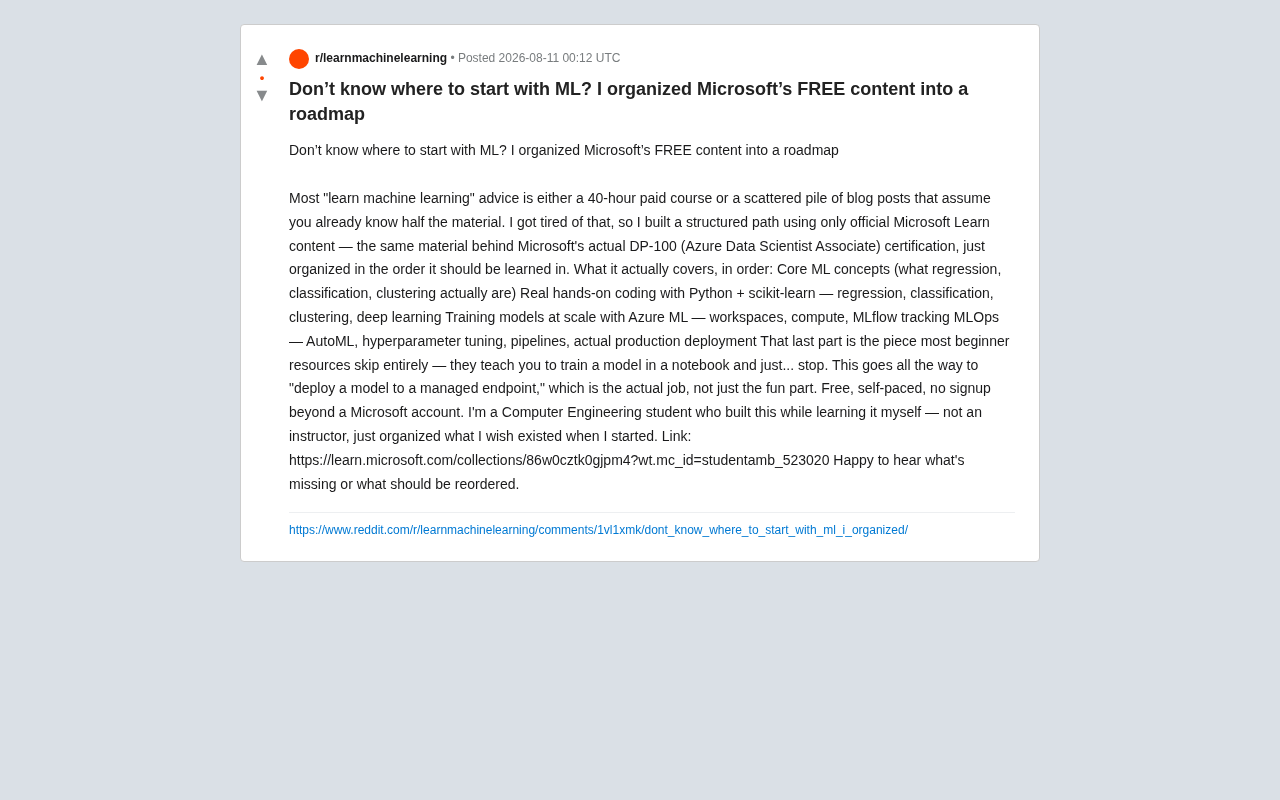
One detail worth noting: this roadmap wasn't created by a professional instructor. The author admitted he's "just a student organizing things as he learns," with the goal of creating "what I wish I had when I was starting out." This kind of organization from a learner's perspective often addresses beginners' actual pain points better than an expert's high-level curriculum design.
The Four Stages Covered by the Machine Learning Roadmap
The entire learning path is arranged in a progressive logic, divided into four escalating stages:
Stage 1: Core ML Concepts
The roadmap starts with the most fundamental concepts—what exactly are regression, classification, and clustering? This step seems simple but is exactly what many crash courses skip over. Understanding the differences between these basic task types is the foundation for all subsequent practice.
These three task types constitute the fundamental paradigms of traditional machine learning. Regression is used to predict continuous numerical values, such as house price prediction or temperature forecasting—the model outputs a number. Classification assigns inputs to discrete categories, such as whether an email is spam (binary classification) or handwritten digit recognition 0-9 (multi-class classification)—the model outputs a label. Clustering belongs to unsupervised learning, discovering natural groupings in data without labels, such as customer segmentation or news topic clustering. Understanding the differences between these three is crucial because it directly determines what algorithm you choose, how you prepare data, and what metrics you use to evaluate model performance—regression commonly uses Mean Squared Error (MSE) and coefficient of determination (R²), classification uses accuracy, precision, recall, and F1 score, while clustering uses internal evaluation metrics like the silhouette coefficient.
Stage 2: Python + scikit-learn Hands-on Programming
Immediately after concepts comes the hands-on phase. Learners use Python with scikit-learn, the classic machine learning library, to personally implement regression, classification, clustering, and even deep learning models.
scikit-learn (abbreviated as sklearn) is the most widely used traditional machine learning library in the Python ecosystem. It was started by David Cournapeau in 2007 as a Google Summer of Code project and has over 17 years of history. Its core design philosophy is "consistent API": almost all models follow the unified interface pattern of fit() (train), predict() (predict), and score() (evaluate). This means once you learn one algorithm, switching to another only requires changing one line of instantiation code. sklearn covers nearly all classic algorithms from linear regression, decision trees, and SVM to random forests and gradient boosting, while also providing a complete toolchain for data preprocessing, feature engineering, model selection, and pipeline construction. This API design friendliness makes it the best introductory tool for building intuitive understanding of the model training workflow. Note that sklearn primarily handles traditional machine learning; deep learning typically requires specialized frameworks like PyTorch or TensorFlow.
Stage 3: Azure ML Large-Scale Training
When single-machine training is no longer sufficient, the roadmap introduces the Azure Machine Learning platform, covering workspaces, compute resources, and MLflow experiment tracking. The significance of this stage is transitioning learners from "running models in a notebook" to "training and managing models at scale in the cloud."
Azure Machine Learning is Microsoft's enterprise-grade machine learning cloud platform, forming a three-way competitive landscape with AWS's SageMaker and Google Cloud's Vertex AI. Azure ML's core concepts include: Workspace as the top-level container for all ML assets, similar to a project's "home base"; Compute Instance providing cloud-based Jupyter environments for development; Compute Cluster supporting distributed training and auto-scaling, automatically releasing resources after training completes to save costs; and Datastore connecting various data sources like Blob Storage and SQL databases.
MLflow is an open-source ML lifecycle management framework (originally developed by Databricks in 2018). Azure ML natively integrates MLflow for logging experiment parameters, metrics, and model artifacts, enabling experiment traceability and reproducibility. For example, if you run 100 experiments with different parameter configurations, MLflow records what parameters were used each time, what results were obtained, and which model file was produced, allowing you to clearly compare and trace back. The core transformation from single-machine notebooks to cloud platforms is: compute resources become elastically scalable, experiments become trackable and comparable, and team collaboration becomes well-documented.
Stage 4: MLOps and Production Deployment
The final stage is the crowning touch of the entire roadmap, and the part the author particularly emphasizes: MLOps. Content includes AutoML (Automated Machine Learning), hyperparameter tuning, building pipelines, and most critically—deploying models to managed endpoints.
MLOps (Machine Learning Operations) is a methodology that applies DevOps principles and practices to machine learning systems, systematically promoted by Google starting around 2015. The core problem is: machine learning models aren't static software—they gradually degrade in production due to data drift (where production data's statistical characteristics diverge from training data) and concept drift (where the relationship between inputs and outputs changes over time). Therefore, MLOps encompasses automated training pipelines, model version management, A/B testing, continuous monitoring, and automatic retraining. According to Gartner's research, approximately 85% of AI projects fail to move from the experimental stage to production deployment—MLOps was born to solve this "last mile" problem.
Specifically regarding the technologies covered in the roadmap: AutoML dramatically lowers the barrier to model selection by automatically searching for optimal algorithm and hyperparameter combinations, enabling even non-algorithm experts to find high-performing model configurations; hyperparameter tuning (such as grid search, random search, Bayesian optimization) systematically finds optimal configurations for learning rate, regularization coefficients, and other model settings; Pipelines chain data processing, feature engineering, training, evaluation, and deployment into reproducible automated workflows that can automatically trigger the entire chain when new data arrives.
The Critical Leap from "Training Models" to "Deploying Models"
The author pinpoints the common flaw in most beginner resources:
"Most beginner resources teach you to train a model in a notebook, and then just... stop."
This is exactly the problem. In real industrial settings, training a model is often just the "fun part," while the actual core of the work is how to stably deploy the trained model to a production environment and serve it externally. This roadmap goes all the way to "deploying models to managed endpoints," bridging the enormous gap between learning and real-world practice.
Deploying a model "to a managed endpoint" means packaging the trained model as an online service callable via HTTP API. Managed Endpoints handle underlying infrastructure operations—including container orchestration, load balancing, auto-scaling, and health checks—so developers only need to focus on the model itself and inference logic. In Azure ML, deployment options include Online Endpoints (for real-time inference with millisecond-level latency requirements, suitable for scenarios requiring immediate user response) and Batch Endpoints (for large-scale offline predictions, suitable for scenarios like generating a batch of recommendation results nightly). Engineering challenges in this phase include: model serialization and loading speed, inference latency optimization, request concurrency handling, blue-green deployment of model versions (maintaining both old and new versions simultaneously for seamless switching), and inference cost control.
For job seekers looking to enter the industry, this point is particularly important. Mastering model training only qualifies as "being able to experiment," while understanding MLOps and deployment workflows proves you have the ability to deliver AI projects end-to-end—which is the skill companies truly value in hiring. In actual recruitment, the ability to take a model from a Jupyter Notebook to a production API is one of the key dividing lines between a "data scientist" and an "ML engineer."
Strengths and Limitations of This Free Machine Learning Resource
This roadmap has three major advantages:
- Completely free and self-paced: No payment or complex registration required beyond a Microsoft account. The Microsoft Learn platform even provides free sandbox environments, allowing you to operate real Azure resources directly in the browser during learning without binding a credit card.
- Official content backing: Entirely based on Microsoft Learn's formal educational materials, consistent with DP-100 certification content, ensuring quality and authority. This content is jointly maintained by Microsoft's internal technical documentation team and product engineers, and is updated in sync with platform feature releases.
- Logical sequencing: Solves the problem of official content being scattered and lacking learning path guidance. While Microsoft officially provides numerous quality modules, the order and relationships between them aren't always clear, making it easy for beginners to feel lost among dozens of modules without knowing where to start.
Of course, it also has certain limitations. The entire path is deeply tied to the Azure ecosystem, so for learners who prefer AWS (SageMaker), GCP (Vertex AI), or purely open-source toolchains (such as Kubeflow + MLflow + Docker self-hosted deployment), the Azure ML and managed endpoint deployment portions have limited transferability. However, it's worth noting that the first two stages (ML foundational concepts and scikit-learn programming) are completely platform-agnostic—this knowledge applies under any technology stack. While the third and fourth stages involve cloud platform operations with different interfaces, the underlying concepts (workspaces, experiment tracking, pipelines, endpoint deployment) are highly similar across all three major cloud platforms.
Additionally, as a community-curated resource, it's better suited as a systematic introductory framework rather than a comprehensive tutorial covering all cutting-edge theory. For example, currently hot topics like Large Language Model (LLM) fine-tuning, in-depth Transformer architecture analysis, and reinforcement learning are not within its scope.
The author also maintains an open attitude in the post, actively asking the community "what's missing and what order should be adjusted," reflecting the continuously iterative nature of learner-driven resources.
Conclusion
For those struggling with where to begin in machine learning, this free roadmap based on official Microsoft content provides a pragmatic starting point. Its value lies not only in the authority of the content itself, but more importantly in presenting the complete loop of "learning all the way to production deployment." If you're planning to get started with ML, or want to systematically fill in the knowledge chain from modeling to deployment, this path is worth trying.
Resource link: Microsoft Learn official collection (search for DP-100 related learning paths to access).
Related articles

Should U.S. College Fraternities Be Banned? A Researcher's Incisive Observations
Why not just ban U.S. college fraternities? A researcher finds the key resistance comes from decision-makers' own fraternity identities and schools' "willful ignorance."

Microsoft Discovery: Accelerating Scientific Discovery with AI Agents
Microsoft's Discovery platform runs specialized AI agents to help researchers screen and prioritize the most promising compounds and experimental paths, reducing experiments and accelerating scientific discovery.

Cambridge Heavy Industries Secretly Develops Desktop-Scale Nuclear Fusion Device
Cambridge Heavy Industries is secretly developing a desktop-scale laser-driven nuclear fusion device, targeting the equipment supply market for fusion power plants. This article analyzes its miniaturization technology path, commercialization logic, and unique positioning in the fusion startup wave.