FreeBuff: A Free Open-Source AI Coding Agent That Challenges Copilot and Cursor

FreeBuff is an ad-supported, open-source, free AI coding tool covering five forms.
FreeBuff is an Apache-licensed open-source AI coding agent offering desktop, terminal, web, cloud, and chatbot forms at zero cost with one account. It integrates third-party models like DeepSeq v4, MIMO, and GLM 5.3, requires no credit card or API key, and is funded by ads. Free access has limits: five hours daily, four requiring a VPN, and some models may use input for training. Compared with Cloud Code and Cursor ($20/month) and Copilot ($10/month), it suits budget-conscious individual developers and students, though heavy or commercial use needs careful evaluation of time limits, privacy terms, and stability.
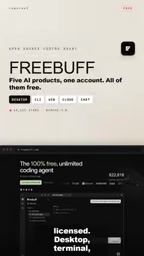
If you're still paying $20 a month for an AI coding tool, you might want to check out an open-source project called FreeBuff. It claims to handle similar coding tasks at zero cost, and it covers five forms: desktop, terminal, web, cloud, and chat.
One Account, Five Products
What makes FreeBuff most appealing is its product matrix. According to a YouTube channel, it simultaneously offers a desktop app, a terminal tool, a web interface, a cloud service, and a chatbot — all with just one account. That means you can switch seamlessly across different scenarios without paying for or registering on each platform separately.
This "five-in-one" design approach is rare among AI coding tools. Most competitors either focus on IDE plugins or only build terminal assistants, while FreeBuff attempts to cover every entry point a developer might touch.
Built-In Multiple Models, Paid for by Ads
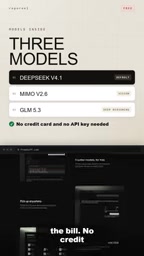
FreeBuff doesn't develop its own models; instead, it integrates third-party models such as DeepSeq v4, MIMO, and GLM 5.3. Users don't need to provide a credit card or API key, because the project's operating costs are covered by ad revenue.
This "ads for free access" model is common in consumer software but relatively rare in the developer tools space. It lowers the barrier to trying the product, but it also means the user experience may involve some kind of trade-off with ad display.
A Note on Model Names: The DeepSeq v4, MIMO, and GLM 5.3 mentioned in the original source don't have exact official counterparts in public materials — they are very likely transcriptions or version aliases of Chinese models such as DeepSeekAd, MiMo, and GLM. DeepSeek and Zhipu GLM are both mainstream open-source large model series in China, often called through API aggregation by third-party agent tools; MIMO may refer to Xiaomi's open-source multimodal model series. So-called "integration of third-party models" usually means FreeBuff doesn't train models itself but acts as a client that routes requests to these models' servers. Therefore its capability ceiling, response speed, and availability are all constrained by upstream services — if an upstream provider changes pricing or API policy, the free model could be affected.
Free, But With Clear Limits
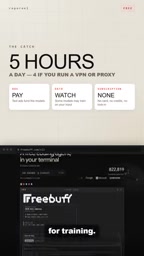
FreeBuff's free tier isn't without constraints. According to the original material, users can use it five hours per day, four of which require a VPN connection. In addition, some models may use user input for training.
These limitations are worth noting for potential users. A five-hour daily quota may not be enough for heavy developers, and the data-training clause involves privacy considerations. If you're working with sensitive code or commercial projects, you need to weigh whether to accept this condition.
On VPN and Data Training: Requiring a VPN to get most of the quota usually indicates that the server has access restrictions or rate limiting for certain regions, and it may also relate to the regional availability of upstream models; this means actual network latency and stability will be affected by the connection route. As for "input used for training," the risk is especially high in AI coding scenarios — code often contains internal interfaces, key fragments, business logic, and unpublished architecture designs. If you plan to use it for company projects, it's advisable to first check the data processing details in the terms of service, avoid pasting sensitive credentials, and switch to a paid plan that can be self-hosted or explicitly promises no training when necessary.
Price Comparison: What You Save Is What You Earn
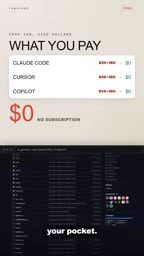
The video directly compares the prices of several mainstream tools: Cloud Code at $20 per month, Cursor at $20 per month, Copilot at $10 per month, and FreeBuff at $0.
For budget-conscious individual developers or students, this price difference is indeed attractive. Of course, whether a free tool can match paid products in feature completeness, response speed, and stability still needs to be verified through actual use.
Installation and Community Popularity
FreeBuff uses the Apache License, and installation requires only a single command. The original material mentions that the project has received 14,000 stars, indicating that it has already gained some attention in the open-source community.
The Apache License means you can freely use, modify, and distribute the code, even for commercial purposes. For teams looking to self-host or build on top of it, this is a plus.
What the Apache License Actually Means: Apache 2.0 is a permissive open-source license that allows users to freely use, modify, and redistribute the code, including for closed-source commercial use, and it includes a patent grant clause that adds a layer of patent protection beyond MIT. However, it only governs the project's own code and does not cover the third-party models it calls — model weights and APIs often have separate licenses or commercial restrictions. Therefore, "Apache licensed" does not mean "the entire chain can be freely used commercially." If a team plans to build on it and offer services externally, they need to separately verify the code license and the model service terms.
Worth Trying, But Keep a Rational Perspective
FreeBuff's arrival provides a free alternative in the AI coding tools market. Its multi-form coverage, open-source license, and zero-cost entry do lower the barrier to use. But the daily time limit, VPN requirement, and data-training clause are all factors that need serious consideration before choosing it.
If you're price-sensitive, or want to experience multi-model AI coding without spending money, FreeBuff is worth a try. But if you rely on stable, unrestricted productivity tools, paid products may still be the safer choice.
One-line Summary
FreeBuff is an ad-supported, open-source, free AI coding tool covering five forms.
Paragraph Summary
FreeBuff is an Apache-licensed open-source AI coding agent that offers five product forms — desktop, terminal, web, cloud, and chatbot — at zero cost, all accessible with one account. It doesn't train models itself but integrates third-party models such as DeepSeq v4, MIMO, and GLM 5.3. Users don't need a credit card or API key, and operating costs are covered by ad revenue. Free doesn't mean unrestricted: it's available five hours per day, four of which require a VPN, and some models may use user input for training. The article compares it with Cloud Code and Cursor ($20/month each) and Copilot ($10/month), concluding that it suits budget-conscious individual developers and students, but heavy or commercial use still requires careful evaluation of time limits, privacy terms, and stability.
Related articles

Nothing CMF Buds 2A Drops to $17.89 on Black Friday: A New Low for ANC Earbuds
Nothing CMF Buds 2A wireless earbuds Black Friday deal: just $17.89 on Amazon, about $11 off retail and a record low. ANC earbuds at an entry-level price.

When AI Creation Gets Accused of "Spitting": Hacker News Heats Up Over the Glaude Controversy
A Hacker News post, "Spitting in the Face of Glaude," sparks debate on AI creation transparency and attribution ethics. This analysis examines the blurred creator identity behind the controversy and offers practical advice for AI content production.

Akai Embraces Custom Firmware: MPC Sample 1.4 Lets Users AI-Program Their Sampler
Akai embraces the modding community with MPC Sample 1.4 firmware, supporting vibe-coded custom firmware and effects. We analyze the impact of this open strategy on music hardware and AI-assisted programming.