FreeLLMAPI: One Free Endpoint Unifies 34 LLMs and Connects Directly to Claude Code

FreeLLMAPI aggregates 34 free LLM tiers into a single OpenAI-compatible endpoint, lowering the barrier to trial but constrained by free-tier limits.
FreeLLMAPI wraps 34 free LLM tiers behind an OpenAI-compatible endpoint, letting coding assistants like Claude Code and Codex call multiple free models by simply changing the base URL, with the core value of reducing model comparison and experimentation costs. It aggregates free quotas and routes behind a unified interface, keeping protocol and auth details on the server. But the docs admit that free-tier rate limits, incomplete features, and extra aggregation latency remain, and quota exhaustion directly affects the experience. It suits prototyping, learning, and lightweight coding help—not production or high-stability tasks; since requests pass through third parties, sensitive code data needs extra evaluation.
Why Do We Need a Unified Endpoint?
When developers want to use AI coding assistants like Claude Code or Codex, they often struggle with API keys, quotas, and the differing interface formats of various vendors. FreeLLMAPI takes a straightforward approach: it packages 34 free LLM tiers behind a single OpenAI-compatible endpoint, so all you need to do is point Claude Code or Codex requests at that endpoint.
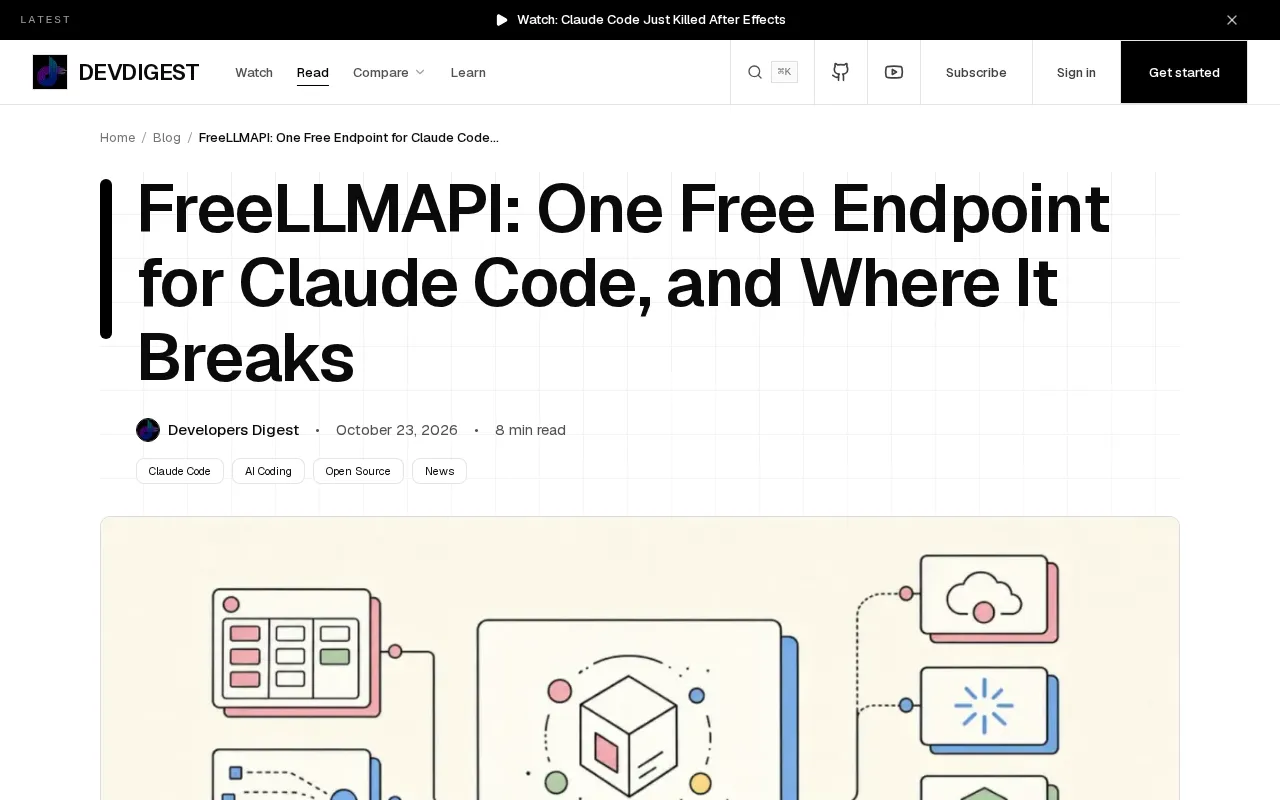
The core value of this project lies in lowering the cost of experimentation. There's no need to register separately for each model, configure environment variables, or write adapter layers—one endpoint covers multiple free models. For anyone who wants to quickly compare how different models perform on coding tasks, this saves a great deal of repetitive work.
An OpenAI-compatible endpoint refers to an HTTP interface that follows the OpenAI Chat Completions API specification, including the request path (such as /v1/chat/completions), the JSON field structure (messages, model, temperature, etc.), and the SSE format for streaming responses. Since a large number of client tools (including Claude Code's compatibility mode and many open-source coding assistants) have built-in support for this specification, as long as the server exposes the same interface, the client requires no code changes—simply swapping the base URL and key is enough to switch backends. This is also the fundamental reason FreeLLMAPI chose this form: it uniformly translates the differing authentication methods, request parameters, and response structures of various vendors into a single standard contract, thereby making "one endpoint for multiple models" engineering-feasible.
Two Key Commands
FreeLLMAPI's documentation emphasizes two commands, which form the backbone of the usage workflow. The first is used to start the local service and load all configured free tiers, and the second is used to proxy Claude Code or Codex requests to this service.
The exact commands are not given verbatim, but from the project's positioning one can infer: one handles endpoint initialization, and the other handles pointing the client. This design keeps complexity on the server side—the client only needs to change a base URL. For developers familiar with OpenAI-compatible interfaces, the barrier to entry is very low.
How It Chains Together 34 Free Tiers
FreeLLMAPI does not provide models itself; instead, it aggregates the existing free quotas from various vendors. Each LLM vendor's free tier typically has rate limits, context length limits, or feature restrictions, and FreeLLMAPI encapsulates these differences behind a unified interface.
This means the same request you send from Claude Code may be routed to different backend models. The project documentation acknowledges the boundaries of this approach: the limitations of the free tiers themselves do not disappear—they are merely hidden behind a unified entry point. When a backend triggers rate limiting or exhausts its quota, the experience is affected.
Rate limiting is the core constraint of free tiers, commonly expressed as RPM (requests per minute), TPM (tokens per minute), and RPD (requests per day); when triggered, it usually returns HTTP 429. Different vendors' window algorithms and counting conventions are inconsistent—some count per account, some per key, and some count input and output tokens separately. The aggregation layer needs to perform routing and failure retries across multiple backends, which is effectively a simplified form of load balancing and rate-limit circumvention: when one tier's quota is exhausted, the request is redirected to the next available backend. Understanding this is crucial—the aggregation layer cannot break through any single vendor's limits; it merely combines multiple independent limits into a larger pool, and the pool's total capacity is strongly correlated with each backend's policies.
Limitations the Documentation Itself Acknowledges
FreeLLMAPI's documentation does not shy away from the issues. It explicitly lists several categories of limitations: call frequency caps on free tiers, incomplete support for long contexts or specific features in some models, and additional latency that the aggregation layer itself may introduce.
These limitations determine what scenarios it suits. Prototype validation, learning experiments, and lightweight coding assistance are reasonable uses; production environments or tasks with stability requirements still need paid APIs or self-hosted inference. Treating a free aggregation endpoint as formal infrastructure will cost you when quotas run out or rate limiting kicks in.
The additional latency introduced by the aggregation layer comes mainly from three sources: requests must first pass through a local or remote proxy process for protocol conversion and routing decisions; cross-vendor calls mean longer network paths, especially when backends are distributed across different cloud regions; and the failure-retry mechanism adds one or even multiple round trips when a backend is rate-limited. For interactive scenarios like coding assistants, time to first token (TTFT) especially affects the experience, because users are very sensitive to lag when waiting for completions. In addition, if buffering policies are inappropriate when streaming responses are forwarded through the proxy, output that should be emitted character by character may be accumulated into a single block, further amplifying perceived latency. When evaluating such aggregation tools, beyond looking at how many models are supported, you should measure their latency distribution under real network conditions.
Significance for the AI Coding Tool Ecosystem
The value of tools like Claude Code and Codex lies in embedding model capabilities into the development workflow, but they are bound to specific vendors by default. FreeLLMAPI represents a counter-trend: decoupling the client from the model and returning choice to the developer through a compatibility layer.
This decoupling has practical benefits. Teams can switch backend models without changing their workflow, and individual developers can experiment at zero cost. The trade-off is that reliability and feature completeness must be weighed by yourself. The project documentation's candor actually increases its credibility—it does not promise that free aggregation can replace paid services.
Usage Recommendations
If you plan to try FreeLLMAPI, first clarify your purpose. For model comparisons or learning experiments, it is an efficient entry point; for daily development tasks, watch out for rate limiting and quota consumption; for team collaboration or production workflows, it is advisable to keep a paid API as a fallback.
In addition, aggregating multiple free tiers means your requests pass through third-party services, so the handling of sensitive code or data requires extra evaluation. The sustainability of free quotas is also outside your control—a policy change at one tier may directly affect availability.
FreeLLMAPI is positioned as a tool for lowering barriers, not as an infrastructure replacement. Understanding where it breaks is more important than remembering how many models it supports.
The risks brought by requests passing through third-party services need to be made concrete: code snippets, file paths, business logic in comments, and even keys may appear in the request body sent to the aggregation endpoint, while the log retention and data usage policies of the aggregator and its upstream vendors are not under your control. For services using free tiers, some vendors explicitly reserve the right to use request data to improve their models. Therefore, before integrating, you should confirm: whether the aggregation service itself records request content, whether the upstream it forwards to enables training use, and whether there are options for local deployment or self-hosted proxying. In scenarios involving proprietary algorithms or customer data, the safer approach is to use such tools only on desensitized code or sample projects.
One-line Summary
FreeLLMAPI aggregates 34 free LLM tiers into a single OpenAI-compatible endpoint, lowering the barrier to trial but constrained by free-tier limitations.
Paragraph Summary
FreeLLMAPI wraps 34 free LLM tiers behind an OpenAI-compatible endpoint, allowing coding assistants like Claude Code and Codex to call multiple free models simply by changing the base URL; its core value is reducing the cost of model comparison and experimentation. The project aggregates each vendor's free quota and routes behind a unified interface, keeping protocol differences and authentication details on the server side. But the documentation candidly admits that the inherent rate limits, incomplete features, and extra latency of the aggregation layer do not disappear, and quota exhaustion or rate limiting directly affects the experience. It is therefore suitable for prototype validation, learning experiments, and lightweight coding assistance, but not for production environments or tasks with high stability requirements; since requests pass through third-party services, data handling for sensitive code also requires extra evaluation.
Related articles

Tencent WorkBuddy Hands-On: How AI Agents Crush Traditional Chat Assistants
WorkBuddy vs Doubao tested: how AI Agents directly operate computers to convert PPT to PDF, archive files and more. Analysis of WorkBuddy's low barrier, domestic ecosystem, pricing and plugin marketplace, plus AI Agent selection advice.

Azure Cross-Tenant Attack Chain: Root Cause Analysis of Five Paths
Binary Security analyzes five full cross-tenant compromise paths in Azure, trending 271 points on HN. This article interprets their shared root cause perspective and offers defense recommendations for cloud tenant isolation and reflections on responsibility boundaries.

Recreating a Real Bubble Tea Station in Isaac Sim: Script-Driven Unitree G1 Brews Tea
Developers recreated a real self-service tea station in NVIDIA Isaac Sim, using scripts to drive a Unitree G1 through a five-step tea-brewing process, exploring whether physics simulation can be a source of synthetic robot demonstration data and discussing contact stability and imitation learning.