Frevana Multiplayer: Turning AI Agents into Shared Team Assets
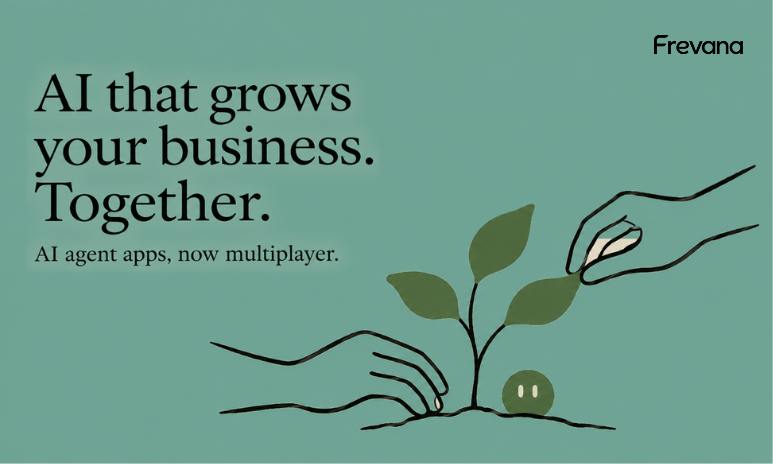
Frevana launches Multiplayer, letting teams share AI agents and skills, evolving personal productivity tools into team collaboration platforms.
Frevana launched Multiplayer on Product Hunt, enabling users to share AI agents and skills via invite links and turning a single-user AI application into a team collaboration platform. Its core value is turning individually discovered workflows into team assets that new members can reuse and build upon, ensuring business continuity. The product targets non-technical business teams across Productivity, AI, and No-Code categories. It received 101 votes and 14 comments on launch day, ranking #3—showing early interest, though votes don't equal long-term retention. The sharing mechanism presupposes existing agent configurations, limiting value for teams starting from zero. Overall, it reflects the trend of AI applications evolving from personal productivity tools toward team collaboration platforms.
Frevana has launched its Multiplayer feature on Product Hunt, transforming what was originally a solo AI agent application into a team collaboration platform. The tagline is refreshingly direct: "AI that grows your business alongside your team"—AI is no longer just a personal productivity tool, but a business partner that grows with your team.
From Solo Tool to Team Collaboration: What Problem Is Frevana Solving?
Frevana's positioning is to run AI agent applications that help users find customers, create content, and automate tedious tasks. Previously, this capability felt more like a personal assistant—you configure an agent, and it does the work for you. The launch of Multiplayer changes the boundary of usage: with a single link, you can invite team members, share agents and skills, and continue building on each other's work.
This design addresses a common pain point: someone on the team figures out an efficient workflow, but others often don't know about it—or if they do, they have to recreate it from scratch. Frevana's proposed solution is "your best workflow becomes everyone's."
AI Agent is one of the core concepts in current AI applications. Unlike traditional chatbots, agents can not only understand instructions but also autonomously plan steps, call tools, and execute multi-turn tasks. For example, an agent responsible for customer acquisition can automatically search for potential customers, write personalized emails, track replies, and update CRM records. Frevana runs exactly this kind of application: once users configure the agent's goals, data sources, and operational permissions, it can continuously work in the background. The Multiplayer feature extends this capability from a single-user environment to a team environment, meaning multiple members can share the same agent instance and its accumulated contextual data, thereby avoiding redundant configuration and knowledge silos.
Shared Agents and Skills: How Collaboration Changes
Multiplayer's core mechanism is invite links + shared agents + shared skills. From a product logic perspective, this brings at least three layers of change:
- Knowledge retention has changed: Good agent configurations and skill combinations are no longer personal collections but team assets that new members can directly reuse upon joining.
- Collaboration granularity has changed: Team members can iterate on agents built by others rather than starting from scratch every time.
- Business continuity has changed: When agents handle customer acquisition and content production, team sharing means business processes won't be disrupted by personnel changes.
Frevana categorizes this capability under Productivity, Artificial Intelligence, and No-Code, indicating that it aims to serve non-technical business teams rather than developers.
No-Code development is key to understanding Frevana's positioning. Through visual interfaces and pre-built modules, it enables users without programming skills to build automated workflows. In the AI agent context, No-Code means business users can define an agent's trigger conditions, execution actions, and output formats through drag-and-drop and form configuration—without writing API calls or handling authentication logic. Frevana categorizing itself as No-Code indicates that its target users are operations, marketing, and sales teams, not engineers. This also explains the design philosophy behind Multiplayer's sharing mechanism: what's shared isn't just the agent itself but also reusable skill modules, which are combined in a No-Code manner, lowering the barrier for internal propagation and secondary development.
Impressive Numbers and Real Barriers
On Product Hunt, Frevana Multiplayer received 101 votes and 14 comments, ranking #3 for the day. This result shows that the product concept has gained early attention—but that's about it. Vote counts reflect launch-day visibility, not long-term retention or actual results.
The sobering caveat: sharing agents and skills presupposes that someone on the team is already seriously configuring agents. For teams that haven't yet established AI workflows, Multiplayer's value may be limited for now. In other words, it's more of a "amplify existing capabilities" feature than a "teach your team AI from scratch" tool.
Product Hunt's ranking and voting mechanism deserves a brief explanation to more accurately interpret Frevana's results. Product Hunt ranks each day's product launches by user votes, and the top three typically gain significant homepage exposure. However, voting mostly occurs within 24 hours of launch, and participants are primarily early adopters, creators, and tech enthusiasts—so vote counts reflect launch-day marketing reach rather than long-term retention or paid conversion. A score of 101 votes and #3 ranking is above average for a feature update debut, but insufficient on its own to prove product-market fit. Teams should evaluate it alongside subsequent comment quality, user feedback, and actual usage data.
Signals Worth Watching
Frevana was launched by three makers including Jason Chen. Choosing Multiplayer as a feature update rather than a brand-new product suggests the team believes collaboration is a core demand among existing users. Pushing personal productivity tools toward team collaboration platforms is also a clear trend in current AI applications: no matter how powerful a single agent is, it's hard to sustainably generate value if it doesn't integrate into team workflows.
For teams evaluating AI workflow tools, Frevana Multiplayer is worth adding to the watchlist—especially for those who already have someone using AI for customer acquisition and content but struggle to spread that expertise. Whether it can convert launch-day buzz into long-term usage will depend on how well the sharing mechanism holds up in real team collaboration.
One-line Summary
Frevana launches Multiplayer, enabling teams to share AI agents and skills and pushing personal productivity tools toward team collaboration platforms.
Paragraph Summary
Frevana launched Multiplayer on Product Hunt, allowing users to share AI agents and skills via invite links and transforming a single-user AI application into a team collaboration platform. Its core value lies in turning individually discovered efficient workflows into team assets—new members can reuse them directly and iterate on others' work, ensuring business continuity. The product targets non-technical business teams, spanning Productivity, AI, and No-Code categories. It received 101 votes and 14 comments on launch day, ranking #3, indicating early interest—but votes don't equal long-term retention. The sharing mechanism presupposes that teams already have agent configurations in place, limiting its value for teams starting from zero. Overall, it reflects the trend of AI applications evolving from personal productivity tools toward team collaboration platforms.
Related articles

Gemini 4 Neon Leak: A Potential Strong Contender Against Opus 5.5
A Hacker News thread suggests Gemini 4 Neon looks like an Opus 5.5 competitor. This article unpacks the product positioning behind this community signal, shifts in the top-model competitive landscape, and what it means for developers' model selection strategy.

Claude Fable 5.2's Self-Authored Short Film 'Fable' Sparks Discussion
A short film 'Fable,' credited to Claude Fable 5.2 for script, visuals, and directing, appears on Hacker News. This article analyzes the significance of full-pipeline AI creation, community reactions, and what it means for content creators.

Anthropic IPO Pricing: A Signal of AI Giants Going Public
Anthropic's IPO pricing draws attention. This article analyzes its potential impact on AI industry valuation, commercialization paths, and the competitive landscape, and highlights public-market expectations and challenges for AI companies.