From AI to Large Language Models: A Beginner's Guide to the AI Technology Landscape

A clear map of AI's evolution from rule-based systems to large language models, and how beginners can enter the field.
This article traces the layered progression from AI to machine learning, deep learning, large language models, and generative AI. Traditional AI relied on human-defined rules; machine learning shifted to data-driven pattern discovery; deep learning tackled complex perceptual tasks through neural networks. Google's 2017 Transformer architecture and attention mechanism solved the language context problem and became the shared foundation of modern LLMs. Generative AI's key leap was moving from classification to open-ended creation. For beginners, the practical entry point is building knowledge bases and Agents on top of existing models — using AI as a powerful assistant rather than recreating it from scratch.
Many people new to AI share the same confusion: what exactly is the relationship between artificial intelligence, machine learning, deep learning, large language models, and generative AI? Some think AI is just ChatGPT; others treat machine learning, deep learning, and LLMs as completely separate technologies. In reality, there's a clear line of development connecting all of them. Bilibili creator Jinze mapped out this technology evolution in an accessible way as part of his introductory LLM course series. Understanding these foundational concepts is essential before diving into large model application development.
What Does Artificial Intelligence Actually Study?
Artificial intelligence is the study of enabling computers and machines to acquire human-like abilities — learning, understanding, reasoning, and acting. Two keywords matter here: machine (AI focuses on computer programs, software systems, and robots, not humans themselves) and intelligence.
By science-fiction standards, machines would need autonomous consciousness, human-like thinking, or even superhuman intellect — and we're not there yet. But from a more practical angle, if a machine can perform tasks that previously required human effort, it can be considered intelligent to some degree. The voice assistant on your phone understanding spoken commands, or a maps app planning a route based on your needs — these are all AI applications.
AI isn't a specific product or piece of software; it's an entire field touching computer science, mathematics, statistics, linguistics, and even neuroscience. The reason people hold such wildly different views on AI comes down to differing expectations for what "intelligence" means. From an engineering and practical standpoint, the right question is: can AI help me solve real problems?
From Deep Blue to AlphaGo: The Rule-Based Era of Traditional AI
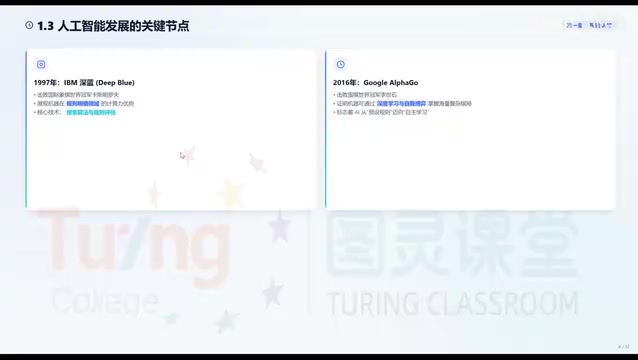
Two milestones mark AI's early development. In 1997, IBM's Deep Blue defeated chess world champion Garry Kasparov. In 2016, AlphaGo defeated Go world champion Lee Sedol.
Deep Blue proved that in domains with clearly defined rules, machines can surpass humans through sheer computational power. But its underlying approach is nothing like today's large models — it relied primarily on search algorithms. In simple terms, the computer analyzed vast numbers of possible moves in advance, then used pre-defined evaluation rules to select the highest-probability play.
This approach worked for chess because every rule — how pieces move, what each move does — could be pre-programmed. The core logic of traditional AI: humans tell the machine the rules; the machine calculates from there. But real-world problems grew increasingly complex. Many tasks (writing articles, analyzing nuanced information) simply can't be solved by predefined rules — and that pressure pushed AI into a new phase.
Machine Learning: Letting Machines Find Patterns in Data
Determining whether an image contains a cat, or detecting the sentiment of an article — these tasks are nearly impossible to solve by writing rules in advance. Machine learning takes a different approach: instead of telling the machine all the answers, let it discover hidden patterns by processing large amounts of data.
Machine learning has three classic paradigms:
Supervised Learning
Provide the machine with labeled answers — the most common approach. Think of a student learning math by studying worked examples before tackling new problems. To train a cat-vs-dog classifier, you label each image (image A = cat, image B = dog) and the model continuously learns the relationship between images and labels until it can correctly predict on new images. Spam detection and financial risk systems both use supervised learning.
Unsupervised Learning
The data has no labels and no pre-defined answers — the machine finds structure on its own. Given a large dataset of user information (age, browsing habits, purchase history) with no predefined categories, the model figures out which users behave similarly. Large model training uses similar ideas extensively: feed the model massive amounts of text without telling it what anything means, and let it learn language patterns by predicting missing content from context.
Reinforcement Learning
The core is adjusting behavior through trial, error, and feedback — similar to how a child learns to walk: fall down, adjust, succeed, receive positive reinforcement. After completing basic training, ChatGPT still requires further quality optimization. This is where RLHF (Reinforcement Learning from Human Feedback) comes in. Simply put: it teaches the model not just what the answer is, but how to answer better.
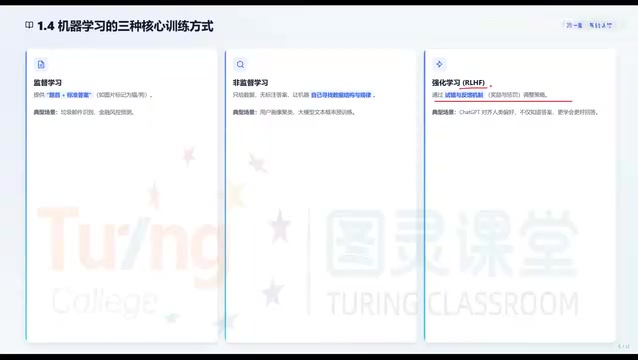
RLHF (Reinforcement Learning from Human Feedback) is the critical link connecting machine learning theory to ChatGPT's real-world performance. The process has roughly three steps: first, use supervised learning to teach the model basic question-answering capabilities; then collect human annotators' preference rankings of multiple model responses to train a "reward model" that simulates human judgment; finally, use reinforcement learning (PPO algorithm) to fine-tune the language model to maximize reward scores. This process teaches the model not just to "know the answer" but to express it in ways that align with human expectations — safer, more helpful, and more honest. RLHF was the core technique systematically described in OpenAI's InstructGPT paper (2022), and the main reason ChatGPT was so dramatically more practical than the earlier GPT-3.
Deep Learning and Transformer: The Technical Foundations of Large Models
As tasks grew more complex (image recognition, speech understanding, natural language processing), traditional machine learning hit its ceiling. Deep learning emerged as a critical branch, with neural networks at its core.
Neural networks are inspired by how neurons connect in the human brain — large numbers of computational nodes linked together, with information processed through multiple layers. In image recognition, for example: the first layer learns edges and colors, the second learns shapes and structures, the third learns object composition. The "deep" in deep learning refers to the number of layers — more layers means richer, more abstract representations. Early deep learning struggled with information loss across many layers, but innovations like residual connections — which allow information to bypass layers and flow directly — became a cornerstone of modern deep learning.
In 2017, eight researchers at Google published a paper titled Attention is All You Need, introducing the Transformer architecture. The fundamental challenge of human language is that the same word can mean different things in different contexts. "This project is really hard" might mean it's technically complex, operationally difficult, or simply an emotional expression. A machine that can't understand context can't truly understand language.
Transformer solved this with the attention mechanism. When processing "Apple launched a new phone, and it was warmly received by users," the model can correctly identify that "it" refers to the new phone. More importantly, the attention mechanism lets the model analyze multiple parts of a text simultaneously, enabling it to handle massive, longer, and more complex text data. This is the shared architectural foundation of ChatGPT, Claude, and Chinese domestic large models alike.
The intuition behind the attention mechanism can be understood through reading: when you read a passage, you naturally allocate more attention to key words rather than treating every character equally. Transformer's self-attention mechanism does something similar — for each word in a sequence, it computes a relevance weight between that word and every other word, then aggregates information through weighted summation. This means no matter how far apart two related words are in a sentence, the model can directly connect them without relying on sequential propagation through recurrent structures (RNN/LSTM). This parallel computing capability allows Transformer to efficiently leverage GPUs to process large amounts of data simultaneously, laying the engineering groundwork for the massive pre-trained models that followed (GPT, BERT, etc.). Residual connections came from ResNet, proposed by Microsoft Research in 2015 — the core idea is that each layer's output equals "the change this layer learned" plus "the original input," mitigating the vanishing gradient problem in deep networks and allowing information and gradients to flow smoothly across dozens or even hundreds of layers.
Generative AI: From Judgment to Creation
Looking back at AI's development arc — rules → machine learning → deep learning → Transformer — one shift stands out. Earlier AI primarily performed classification and judgment (is this email spam? is this image a cat?). Generative AI's defining breakthrough is the ability to create from scratch.
Old AI answered "what is this thing?" Modern large models can "create something new" on demand — generating articles, code, images, and more. Three factors drove the explosive arrival of ChatGPT 3.5: accumulated data scale, a leap in compute (GPU clusters, training method optimization), and the architectural breakthrough of the 2017 Transformer paper. The result was a phase transition from quantitative accumulation to qualitative capability.

How Should Ordinary People Enter the Large Model Space?
Do regular learners need to study LLM fundamentals in depth? It depends. If your goal is to become an AI researcher or develop new model architectures, you'll need deep grounding in mathematics, statistics, and deep learning algorithms — a high bar. But if you simply want to work in AI applications, the focus isn't recreating large models — it's learning how to build practical applications on top of existing ones.
Think of it like the automobile: after cars were invented, most people didn't need to understand how an engine works. They just needed to learn how to drive.
Here's a quick overview of major models worth knowing: OpenAI's GPT series has the broadest influence, covering text generation, code assistance, and knowledge Q&A; Claude emphasizes long-document analysis and logical reasoning, making it a favorite among developers; Google's Gemini is a multimodal model handling text, images, audio, and video. On the Chinese side, Alibaba's Qwen (open-source), Baidu's ERNIE series, and DeepSeekAd are prominent options.
Choosing a model isn't about finding the "best" one in absolute terms — it depends on the task and environment. Enterprise deployments also need to weigh data security, private deployment support, cost control, and integration with existing systems.
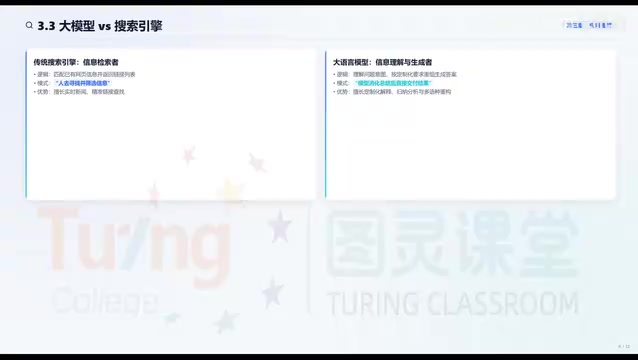
The most realistic positioning for large models today isn't fully replacing roles — it's acting as a highly efficient assistant, taking on large volumes of repetitive work and freeing human energy for goal-setting, decision-making, and creative tasks. For most people, the practical path forward is to leverage the general capabilities of existing large models and combine them with specific business scenarios — building internal enterprise knowledge bases, or developing Agents to handle repetitive workflows.
The direction ahead is becoming clear: continuously improving model capabilities (reasoning, coding, multimodal); increasing industry specialization (domain-specific models for finance, law, healthcare); and Agents emerging as a major application paradigm. Agents don't just answer questions — they understand goals, formulate plans, invoke tools, and complete tasks in an end-to-end loop. Ask one to analyze your company's sales performance, and it can automatically pull data, analyze trends, generate a report, and offer recommendations. That's the trajectory of intelligent agents.
The core architecture of an Agent typically includes four modules: Perception (receiving user input or external data), Planning (decomposing goals into subtasks, often leveraging the LLM's reasoning), Memory (short-term conversational context plus long-term knowledge storage), and Action (calling external tools — search engines, databases, code execution environments, APIs, etc.). Leading Agent frameworks today include LangChain, AutoGen, and CrewAI, which encapsulate common patterns for tool use, multi-step reasoning, and multi-agent collaboration, so developers don't have to build everything from scratch. Enterprise knowledge bases using RAG (Retrieval-Augmented Generation) are another high-frequency deployment: company documents are vectorized and stored, then when a user asks a question, relevant passages are retrieved and fed to the LLM to generate an answer — combining the model's language capabilities with grounding in real private data, effectively reducing hallucinations.
Related articles

Should U.S. College Fraternities Be Banned? A Researcher's Incisive Observations
Why not just ban U.S. college fraternities? A researcher finds the key resistance comes from decision-makers' own fraternity identities and schools' "willful ignorance."

Microsoft Discovery: Accelerating Scientific Discovery with AI Agents
Microsoft's Discovery platform runs specialized AI agents to help researchers screen and prioritize the most promising compounds and experimental paths, reducing experiments and accelerating scientific discovery.

Cambridge Heavy Industries Secretly Develops Desktop-Scale Nuclear Fusion Device
Cambridge Heavy Industries is secretly developing a desktop-scale laser-driven nuclear fusion device, targeting the equipment supply market for fusion power plants. This article analyzes its miniaturization technology path, commercialization logic, and unique positioning in the fusion startup wave.