From Beginner to Advanced AI Agent Development: A Deep Dive into One Essential Hands-On Book

A comprehensive hands-on book that takes developers from zero to production-ready AI Agent systems.
This article reviews a highly practical AI Agent development book recommended by Bilibili creator Future. The book stands out for its complete coverage — from foundational LLM concepts and Prompt Engineering, through memory management, RAG, multi-agent collaboration with AutoGen and CrewAI, and Function Calling, all the way to production concerns like observability with AgentOps and cost control strategies.
As large model applications evolve from simple chatbots toward autonomous AI Agents, many developers are struggling to find a systematic path to mastering Agent development. Most tutorials on the market either pile up concepts or showcase trivial demos — rarely taking you through the full journey from zero to production. Bilibili creator Future recently shared a book he just finished reading on Agent development, calling it a genuinely practical guide that teaches developers how to actually build intelligent systems. This article summarizes his key recommendations and the book's core value.
Build the Big Picture First, Then Dive Into Components
One of the book's most commendable qualities is that it doesn't immediately bombard you with frameworks. Instead, it first helps readers develop a holistic understanding of Agents. What are the building blocks of an Agent? The book breaks them down into core modules: Profile (role definition), Actions, Memory, Reasoning, and Planning — sketching the complete skeleton before going deep on each.
These module distinctions are grounded in both cognitive science and engineering: Profile is essentially about using a System Prompt to give the model a specific behavioral boundary and identity; Memory is split into two layers — short-term memory (conversation history within the context window) and long-term memory (persistent storage in a vector database); Reasoning typically leverages techniques like Chain-of-Thought to enable multi-step thinking; Planning decomposes complex goals into sequences of executable subtasks, with common paradigms including ReAct (Reasoning + Acting) and Tree of Thoughts. Understanding the underlying logic of these modules is what allows you to combine them flexibly in engineering practice.

This "forest before trees" approach is extremely beginner-friendly. The reason many people feel lost when learning Agent development is precisely because they dive into the API details of some framework without ever grasping the full picture of what an Agent system looks like. By framing Agents as a system of cooperating components, the book smooths out the learning curve considerably.
A Linear, Progressive Learning Path
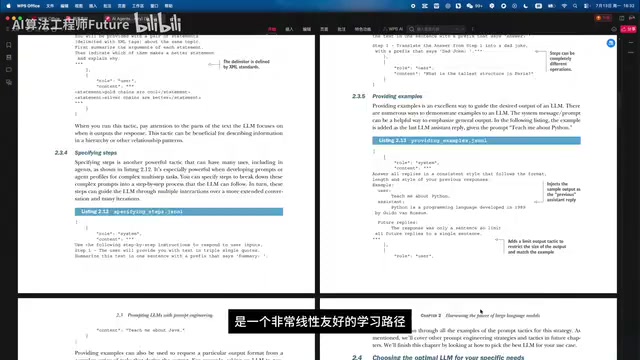
The second highlight is the book's carefully staged knowledge progression. The author starts from foundational LLM capabilities — covering the OpenAI API, how large models work, and Prompt Engineering — before transitioning to GPT Assistants, and finally to full Agent development. The path is linear and sequential, so readers never need to jump back and forth between chapters to fill in gaps.
For engineers new to AI development, this design significantly lowers the barrier to entry. You start with basic API calls, gradually understand how prompt engineering constrains model behavior, and then naturally progress to building Agents capable of autonomous decision-making. This hand-holding transition effectively avoids the knowledge gaps that plague so many tutorials.
Memory Management and RAG: A Dedicated Deep Dive into a Core Challenge
The place where Agent development most often gets stuck is handling knowledge and memory. A model that can only handle single-turn conversations isn't a real Agent — Agents need to remember context, retrieve external knowledge, and maintain long-term state.
Rather than treating memory and RAG as an afterthought, the book dedicates full chapters to both. RAG (Retrieval-Augmented Generation) was introduced by Meta AI in 2020 to address two fundamental shortcomings of large language models: knowledge cutoff limitations and hallucinations. The core workflow is: external documents are chunked and converted into vectors via an Embedding model, then stored in a vector database (e.g., Pinecone, Chroma, Weaviate); when a user asks a question, the system first retrieves the most semantically relevant document chunks, then injects them into the prompt as context, guiding the model to generate answers grounded in real source material. In practice, the quality bottlenecks in RAG usually come down to retrieval accuracy (balancing Recall and Precision), document chunking strategy (choosing the right Chunk Size), and Reranking algorithm optimization. This editorial choice reflects the author's accurate read on where things get hard — the quality of memory management and knowledge injection often determines the ceiling of an Agent product's usability.
Multi-Agent Collaboration: Hands-On, Not Just Theory
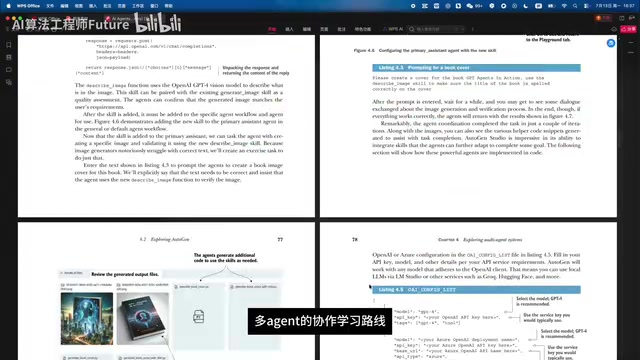
Multi-Agent systems are a hot topic right now, but most resources stay at the conceptual level. This book takes a different approach: it goes directly hands-on with two mainstream frameworks, AutoGen and CrewAI, laying out a complete learning roadmap for multi-Agent collaboration.
AutoGen, developed by Microsoft Research, is built around the idea of programmable conversation patterns that allow multiple Agents to communicate and collaborate, with support for Human-in-the-loop design — making it well-suited for complex workflows requiring human supervision. CrewAI uses role-playing as its central metaphor, treating a multi-Agent system like a professional team where each Agent is given a clear Role, Goal, and Backstory, and collaboration happens through a task delegation mechanism. The two frameworks have different strengths: AutoGen is more flexible and low-level, better suited for research-oriented scenarios; CrewAI offers higher-level abstractions and is better for rapidly building business process automation. The core challenges of multi-Agent systems lie in task allocation strategy, designing inter-Agent communication protocols, and preventing information loss and decision conflicts during collaboration.
Readers not only understand the design philosophy behind multi-Agent systems but also get to actually build task-delegation mechanisms across multiple Agents by following the book's projects. For developers looking to build complex task-processing systems, this section provides directly applicable engineering practice.
Engineering-Grade Tool Use and Function Calling
The reason Agents have real practical value is that they can invoke external tools to accomplish actual tasks — not just generate text. The book's coverage of tool use and Function Calling is genuinely engineering-focused.
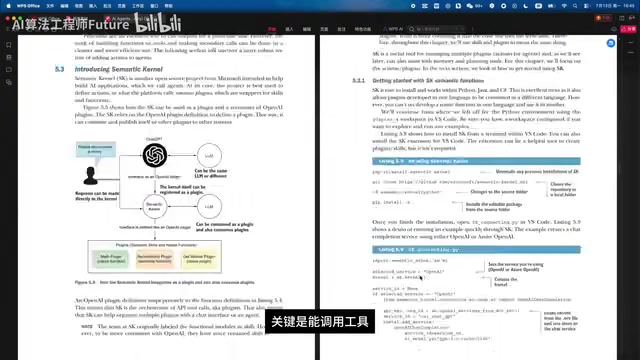
The book dedicates specific coverage to OpenAI Function Calling (now renamed Tool Use) and Microsoft's Semantic Kernel framework. Function Calling, launched in June 2023, allows developers to declare function interfaces in JSON Schema format; the model then determines at inference time whether to invoke a function and outputs a structured function-call request rather than natural language — fundamentally solving the engineering headache of unpredictable LLM outputs. Semantic Kernel is Microsoft's open-source AI orchestration SDK, supporting Python, C#, and Java; its design philosophy abstracts AI capabilities as "Plugins," with a Kernel managing LLM calls, memory, planners, and function registration in a unified way. When used together, Semantic Kernel can automatically discover and register functions as tools, and combined with a Planner, enables goal-directed automated task chains. Mastering both means you can make Agents genuinely "do things" rather than just have conversations.
Production Perspective: Observability and Cost Control
What impressed Future most was the author's inclusion of real-world concerns like observability and cost management — going beyond just showcasing a polished demo.
Agent system Observability draws from the three pillars of traditional distributed systems: Logs, Metrics, and Traces. In an Agent context, this means tracking the inputs and outputs of every LLM call, tool invocation parameters and results, intermediate states in multi-step reasoning, and the complete decision path of an entire task chain. AgentOps is a monitoring platform purpose-built for AI Agents, offering features like Session replay, token consumption statistics, latency analysis, and error attribution. On the cost control side, the core challenge for complex Agent systems is the token accumulation effect across the call chain — each step's context stacks and carries forward, causing token consumption per task to far exceed that of a single-turn conversation. Common optimization strategies include context compression, selective memory injection, tiered model calls, and Semantic Caching. The book compares CrewAI and AgentOps across dimensions like performance, interaction efficiency, and cost management — this production-oriented perspective is invaluable, because in a live environment, an Agent system's observability and cost predictability often matter more than its features when it comes to actually shipping.
Advanced Topics and Platform Vision: What Does an Agent Product Look Like?
The latter half of the book focuses on advanced topics, including Evaluation, Reasoning, Planning, and Feedback — the key elements of building reliable Agent systems. The author even uses a project called Nexus to demonstrate a complete prototype of an Agent platform.
If you want to understand what an Agent system looks like when it matures into a product or platform, this chapter is well worth reading carefully. It ties together all the components covered earlier into a coherent system, showing the full picture from individual features to a productized platform.
Conclusion
Overall, this book's value lies in combining completeness with engineering rigor: it offers a linear learning path from fundamentals to advanced topics, digs deep into practical challenges like memory management, RAG, multi-agent systems, and tool use, and — unusually — also covers production concerns like observability, cost control, and platform architecture. For developers who want to actually build reliable Agents, this is a book worth adding to your reading list.
Related articles

The Truth Behind Codex 'Build a Website in 5 Minutes': AI Isn't Creating Sites—It's Helping You Copy Them
Exposing the truth behind viral Codex 5-minute website videos: creators aren't building original sites with AI—they're copying shared prompts or scraping others' work. Learn AI coding tools' real limits.

Getting Started with AI Agent Development: A Complete Guide from Concept to Practice
A comprehensive guide to AI Agent architecture and development, covering automated marketing, intelligent customer service, and investment analysis scenarios with single and multi-agent collaboration.

The Truth Behind Codex 'Build a Website in 5 Minutes': AI Isn't Creating Sites — It's Helping You Copy Them
Exposing the truth behind viral Codex 5-minute website videos: creators aren't building original sites with AI — they're copying shared prompts or scraping others' work.