From Chat to Agent Platform: A Practical Guide to Engineering AI Applications

How to evolve a simple chat tool into a production-grade, maintainable AI Agent platform.
This article dissects the complete engineering path for AI applications: evolving from a simple chat page into a six-layer Agent platform. It covers the ReAct paradigm, Model Provider abstraction, RAG knowledge bases, Workflow and Orchestrator scheduling, explicit Agent modeling, hybrid local/cloud deployment, and using AI tools to build complex systems.
Why a Chat Page Can't Support Real AI Applications
Many people still understand AI applications at the level of "connect a large model + build a chat page." But if that's all it is, how is it any different from a simple model wrapper? A Bilibili creator, drawing on their open-source project OpenVitamin, offers a more fundamental insight: In truly complex AI applications, what the user submits is often not a chat message, but a task.
This difference seems subtle, yet it actually determines the entire architectural direction of the system. A typical task might be "analyze this project document for me and generate a system architecture diagram." This is no longer something that a single call to a large model can reliably accomplish—the system needs to first determine which Agent should handle it, then retrieve materials from the knowledge base, invoke tools to execute multiple steps, and finally tell the user which materials were used, which tools were called, and how the entire task was executed.
The AI Agent referred to here means an AI system capable of perceiving its environment, autonomously planning, and executing multi-step tasks. Unlike a single call to a large model, an Agent possesses capabilities for tool invocation, memory management, self-reflection, and multi-turn reasoning. Its core architecture typically includes a perception module (processing input), a planning module (decomposing tasks), a memory module (short-term/long-term storage), and an action module (invoking external tools or APIs). The key breakthrough of Agents lies in the ReAct (Reasoning + Acting) paradigm—jointly proposed by Google and Princeton University in 2022—which enables models to iterate in a loop of "Thought → Action → Observation" until the task is complete.
Before ReAct was proposed, the industry mainly relied on Chain-of-Thought (CoT) prompting to make models reason step by step, but CoT's reasoning process is closed—the model cannot call external tools, obtain real-time data, or perceive execution results mid-reasoning, causing the quality of completing complex tasks to depend heavily on the model's own internalized knowledge. The iterative loop mechanism of ReAct essentially introduces a "perception-action" external environmental feedback loop for language models: after each action, the model observes the real results returned by external tools and adjusts the direction of its next reasoning step accordingly, rather than continuing to write a potentially distorted reasoning chain out of thin air. This design solves the dual shortcomings of pure reasoning models being unable to perceive external state and pure tool-calling models lacking a reasoning chain, enabling Agents to truly complete complex tasks that require multi-step, multi-tool collaboration. This is the fundamental architectural difference between Agents and ordinary LLM calls.
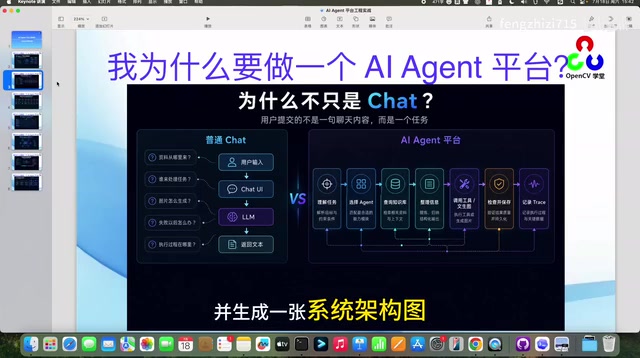
In other words, the Chat page is merely the entry point that "catches" the task; what actually completes the task is the AI Agent platform behind it. This is also the core of what this series aims to dissect: how to progressively design a Chat tool into a task execution system.
Why Simple Architectures Fail
The vast majority of AI projects start with an extremely simple architecture: the user inputs a sentence, the backend makes one call to the large model, and the result is streamed back to the frontend. This architecture is perfectly adequate for a Demo, but as soon as you start building a real project, the problems quickly surface.
Taking the earlier example of "analyze the document and generate an architecture diagram," the system needs to go through a series of stages:
- Intent understanding: determining whether this is an ordinary conversation or should be handed off to a specialized Agent;
- Knowledge retrieval: finding relevant materials from the knowledge base—these materials might be text, images, tables, or PDF pages;
- Content organization: the Agent needs to sort out modules and their invocation relationships;
- Capability invocation: calling text-to-image capabilities to generate the architecture diagram, and if the result doesn't meet requirements, reorganizing or regenerating;
- Result persistence: saving the generated result and recording which steps this task went through.
By this point, it becomes clear that Chat is only the entry point for submitting the task; what actually completes the task are the Agent, knowledge base, tools, and execution flow behind it. This is precisely the fundamental reason why "as AI applications grow complex, they will inevitably evolve from chat pages toward task execution systems."
The Evolution of OpenVitamin: Every Step Driven by an Engineering Problem
OpenVitamin was originally called the "Local AI Inference Platform," and the problem it initially solved was straightforward: how to run different large models in a unified way locally. Therefore, the early focus was on model configuration, Provider management, streaming output, and run logs—essentially, "model management."
But after integrating multiple models, the first engineering problem immediately arose: if each model has its own invocation method, the business code is bound to become increasingly messy. So the platform needed a unified layer of Model Provider to unify the invocation methods, streaming output, and run logs of different models.
The Model Provider is a classic application of the Adapter Pattern in AI engineering. Different large model providers (OpenAI, Anthropic, local Ollama, etc.) have distinct API interfaces, authentication methods, and streaming output protocols. The unified Provider layer encapsulates these differences internally by defining a standard interface, allowing upper-layer business code to program against a unified protocol—this design borrows from the philosophy of database ORMs, where the business layer doesn't care whether the underlying model is GPT-4o or a local Qwen model.
Worth noting is that the OpenAI-compatible protocol (/v1/chat/completions) has become the de facto industry standard: mainstream local inference frameworks such as Ollama, vLLM, and LM Studio all support this interface, giving the Provider's unified abstraction a more solid protocol foundation in practice—developers only need to switch base_url and api_key to seamlessly migrate between local and cloud models. There are profound industry drivers behind this standardization trend: around 2023, a large number of enterprises and individual developers simultaneously faced the parallel competitive landscape of multiple model providers, and the risk of Vendor Lock-in became a real engineering concern. The proliferation of the OpenAI-compatible protocol was essentially a collective vote by the entire ecosystem for "replaceability"—it lowered the cost of model migration and forced providers to converge at the protocol level, ultimately shaping today's mainstream engineering paradigm of "multiple models, unified interface."
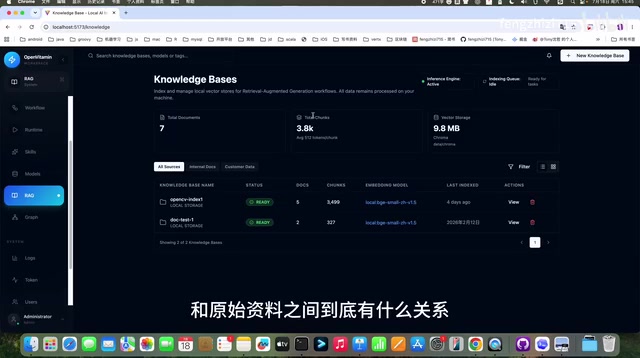
Subsequently, a knowledge base (RAG) was added: documents go through parsing, chunking, and Embedding before entering a vector database, so Chat can combine materials to answer questions. RAG (Retrieval-Augmented Generation) is a core engineering solution to the large model "hallucination" problem—documents are split into text chunks (Chunks), which are transformed into vectors via an Embedding model and stored in a vector database; when a user asks a question, the system also vectorizes the question for similarity retrieval, extracts the most relevant Chunks as context, and then has the large model generate an answer combining this context.
The concept of RAG was first formally proposed by Meta AI in 2020 in the paper "Retrieval-Augmented Generation for Knowledge-Intensive NLP Tasks," with the core motivation of solving the fundamental shortcomings that parametric knowledge (knowledge frozen in model weights) cannot be updated in real time and is difficult to precisely cite sources for. Compared with model Fine-tuning, RAG's advantage lies in that knowledge updates require no model retraining—only the vector database needs updating; its disadvantage is that retrieval quality directly determines generation quality, forming the engineering challenge of "retrieval as bottleneck." The difficulty of RAG lies not in the process itself, but concentrates on the following engineering details: Chunk splitting strategy (fixed-length splitting vs. semantic paragraph splitting, directly affecting retrieval granularity), Embedding model selection (general-purpose model vs. domain-fine-tuned model, affecting the semantic alignment quality of the vector space), retrieval precision tuning (hybrid strategies of dense retrieval + sparse retrieval, and the introduction of a Rerank model), and multimodal content parsing (OCR and structured extraction of charts and scanned PDFs). The gaps in these details are often the fundamental reason why RAG systems perform excellently in Demos but frequently err in production.
But soon the second problem arose—being able to answer doesn't mean answering accurately. If an answer is wrong, you need to know which Chunks it retrieved, the relevance score of each result, and whether it cited image text or a table. Thus came RAG Trace and Evidence Trace, used to track the entire process of text retrieval and image-text retrieval, making this "black box" process observable and debuggable.
Further on, the system began to support Agents: different Agents can be bound to different knowledge bases, tools, and models, and Chat can automatically find the appropriate Agent through semantic discovery. When a task changes from a single-turn answer to multi-step execution, Workflow is needed to manage the execution process; when multiple Agents need to collaborate on a division of labor, an Orchestrator is needed to handle planning, scheduling, and checking.
Workflow in an AI system refers to breaking down complex tasks into execution steps structured as a Directed Acyclic Graph (DAG), where each node can be a model call, tool execution, or conditional judgment. This design gives tasks recoverability—after a step fails, it can be retried from the breakpoint rather than restarted from scratch; it also grants tasks the ability to be visualized and audited, so operations personnel can intuitively see which step a task is stuck on and why it failed. Another important engineering value of the DAG structure is parallel execution: nodes without dependencies can be triggered simultaneously, significantly reducing the overall waiting time for multi-step tasks—this is completely consistent with the design philosophy of classic workflow engines in the data engineering domain such as Apache Airflow and Prefect, except that the execution nodes have changed from data processing scripts to LLM calls or Agent tasks.
The Orchestrator is the brain of multi-Agent collaboration, responsible for task distribution, progress tracking, and result aggregation, similar to the microservice orchestration layer in software engineering. In practice, the Orchestrator needs to handle result dependencies between Agents, scheduling strategies for parallel execution and serial waiting, and degradation and retry logic when a particular Agent fails. The combination of the two solves the core pain point of a single Agent easily "going off track" or "getting lost" in long-horizon tasks, and is the key engineering infrastructure for AI systems to move from Demo to production.
This evolutionary logic is worth learning from for everyone doing AI engineering: the system doesn't pile in all features from the start; rather, each step forward encounters a new engineering problem, which is then solved through new capabilities.
Six-Layer Architecture: How a Single Request Traverses the Entire System
Viewed as a whole, the platform can be understood as a six-layer structure:
- Interaction Layer: the part visible to users, including Chat, knowledge base, Agent management, Workflow canvas, Trace pages, and text-to-image;
- Application Service Layer: responsible for overall scheduling;
- Agent Core Layer: understanding tasks, assembling context, and selecting agents;
- Knowledge System Layer: managing knowledge bases, invoking tools, and controlling the execution flow;
- Model and Tool Layer: large models, vision models, text-to-image models, and various tools;
- Data Layer: storing business data, vector data, file resources, and complete run records.
What the user sees may be just a Chat page, but when a real request executes, it may traverse the entire architecture. This is also key to understanding modern AI Agent platforms—behind the surface simplicity lies a complete layered pipeline.
This six-layer design is highly consistent with the Separation of Concerns principle in classic software architecture. Each layer only handles problems within its own scope of responsibility: the interaction layer doesn't care how the model is called, the data layer doesn't care about business logic, and the Agent core layer doesn't care about the implementation details of vector retrieval. The direct benefit of this layering is: when the technical solution of a particular layer needs to be replaced (for example, migrating the vector database from Chroma to Qdrant), the scope of changes is strictly confined within that layer and does not trigger a systemic chain of refactoring—this is precisely the engineering foundation that allows complex AI systems to evolve over the long term without collapsing.
From the perspective of architectural evolution history, the idea of separation of concerns was first proposed by Edsger Dijkstra in a 1974 paper, and has since undergone several generations of evolution—from class encapsulation in object-oriented programming, to the view/logic separation of the MVC framework, to service boundary delineation in microservices. The six-layer architecture of the AI Agent platform is the latest expression of this principle in the LLM era—it adds two AI-specific concerns, a "model layer" and a "knowledge layer," on top of traditional software layering, reflecting the additional complexity that AI systems have over traditional software in knowledge management and model scheduling: the layered concerns of a traditional web application are data flow and interface rendering, whereas an AI Agent platform must additionally manage semantic retrieval in vector spaces and the non-deterministic output of model inference—two dimensions that classic software architecture never needed to explicitly handle.
An Agent Is Not a Wrapper With an Avatar, but a Capability Unit
Within this architecture, an Agent is not just an added ordinary feature; it is more like the task scheduling center of the entire platform. But note: the Agent is not meant to replace the knowledge base, tools, and Workflow, but to organize these capabilities according to the task—the knowledge base provides evidence, the tools execute actions, the Workflow manages steps, and the Agent understands the task and decides which capabilities to use.
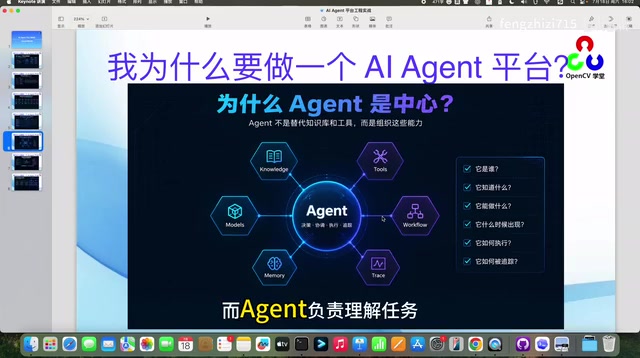
A Truly Usable Agent Needs to Answer Six Questions
- Who is it: name, description, system prompt, and capability boundaries;
- What does it know: which knowledge bases, knowledge graphs, conversation history, and run context it is bound to;
- What can it do: which tools it can invoke, whether it can launch a Workflow, whether it can use generative capabilities like text-to-image;
- When does it appear: whether automatic routing is allowed, and whether its capability description can be semantically retrieved by the system;
- How does it execute: directly call the model, or first retrieve knowledge then invoke tools, or enter a multi-step Workflow;
- How is it tracked after execution: recording the selection process, context assembly, knowledge retrieval, tool invocation, model requests, and final results.
This "six-question framework" clearly defines that an Agent should be a capability unit with knowledge boundaries, tool permissions, execution flows, and run records—not just writing a Prompt and adding an avatar.
From an engineering perspective, these six dimensions essentially correspond to the Agent's data model design: "who is it" corresponds to the base metadata table, "what does it know" corresponds to the knowledge base association table, "what can it do" corresponds to the tool permission table, "when does it appear" corresponds to routing strategy configuration, "how does it execute" corresponds to an execution strategy enumeration, and "how is it tracked after execution" corresponds to the Agent Run log table. Explicitly modeling these six dimensions, rather than implicitly writing them into the Prompt, is the key step for an Agent to move from a personal toy toward a team-maintainable system.
The value of this explicit modeling is reflected not only in maintainability, but even more in auditability and access control: in enterprise-grade deployment scenarios, regulatory compliance requirements often demand precise records of "which Agent, at what time, based on what knowledge, invoked what tools, and produced what results"—if this information exists only in Prompt strings, it is nearly impossible to programmatically retrieve, audit, and control; but once explicitly modeled as structured data, it can be directly integrated with permission systems, audit logs, and monitoring alerts. This is precisely the key engineering leap from a prototype system to an enterprise-grade system: not just making the system usable, but making every action of the system traceable, explainable, and controllable.
Local Is Not a Boundary, but a Foundation
The project's renaming from "Local AI Inference Platform" to "AI Agent Platform"—does that mean local deployment is no longer emphasized? The author gives a clear answer: it's not about abandoning local, but about making the positioning more accurate.
The platform still supports local large models, local Embedding, local vision models, and local file storage, but local should be a deployment method and capability choice, not the boundary of the entire platform. The same Agent can use both local models and cloud models. To sum it up in one sentence: Local is the foundation, Agents are the direction, and engineering is the real problem to be solved.
Behind this positioning shift lies a deeper industry context: as open-source models such as Llama 3, Qwen 2.5, and Gemma 3 continue to approach closed-source commercial models in reasoning capability, the core obstacle of "local models aren't capable enough" is rapidly dissolving. The core value of local deployment has also evolved from the early "cost savings" to today's more diverse needs: data privacy compliance (healthcare, finance, government scenarios), offline availability, low-latency response, and avoiding the instability of API calls. Treating local as a "foundation" rather than a "boundary" means the system architecture provides equal first-class citizen support for both local and cloud, allowing users to flexibly combine them based on the sensitivity, cost budget, and performance requirements of specific tasks.
This "hybrid deployment" approach often lands in practice in the form of sensitivity-tiered routing: highly sensitive personal identity information and financial data are routed by default to local models for processing, while general low-sensitivity tasks such as summary generation and format conversion can flexibly call cloud models to obtain stronger capabilities. This tiered routing strategy requires explicit strategy configuration support at the Provider layer—essentially transforming "compliance requirements" into "routing rules" written into the system, rather than relying on developers' manual judgment. This is also a typical engineering solution for enterprises seeking a balance between "capability vs. compliance," and the concrete manifestation of the aforementioned Model Provider unified abstraction layer delivering maximum value in enterprise scenarios.
Developing an AI Platform With AI Programming Tools
This series also has a hidden but important practical thread: how the author leverages AI programming tools to develop this complex project. Their approach carries considerable methodological value:
- Frontend pages first explore design directions with Stitch, then let Codex or Cursor complete the engineering implementation according to the existing component system;
- In the code repository, project rules and module boundaries are defined through
AGENTSfiles in the root directory and in each module; - Repetitive development processes are solidified through Skill;
- A checking mechanism reviews whether the AI's modifications break the existing system;
- Complex tasks don't have a single Agent do everything from start to finish; instead, planning, implementation, testing, and review are progressively separated.

The core challenge that AI programming tools like Cursor and Codex face in complex projects is the contradiction of "limited context window but infinitely large project." The AGENTS file (similar to .cursorrules or Cursor's Memory feature) is precisely the key engineering practice to solve this problem: by explicitly defining architectural constraints, coding conventions, module boundaries, and prohibited operations in the project root directory and each module, AI programming assistants have a more accurate "project map" to reference when generating code, thereby avoiding the typical problem of "AI modified module A but quietly broke module B."
Understood from the perspective of software engineering evolution, the AGENTS file plays a role highly similar to Architecture Decision Records (ADR) in traditional projects: ADRs record "why this architectural decision was made" for human developers to consult, while AGENTS files transform architectural constraints into real-time context that AI can proactively reference during each code generation—this is a fusion of AI-native software engineering practices with classic engineering culture. The common essence behind both is: transforming implicit team consensus into explicit, continuously referenceable structured constraints. Even without AI programming tools, this kind of documented architectural constraint is equally valuable for collaboration among human developers; and in AI-assisted development scenarios, it additionally takes on the key role of "delineating work boundaries for the AI," serving as an engineering guardrail that prevents the AI from "improvising too freely" in large projects.
The division of labor where Stitch is used for rapid prototype exploration and Cursor handles engineering implementation essentially decouples the two phases of "creative divergence" and "engineering convergence"—this is in line with the classic software engineering principle of designing first and implementing later, except that the toolchain has undergone an AI-native upgrade.
The significance of this practical thread lies in that it doesn't just show how to write a certain piece of code, but answers a more universal question—how a complex AI system can be progressively implemented with the help of AI programming tools, while avoiding the project becoming increasingly chaotic.
Series Planning and Core Proposition
The entire series is tentatively divided into five phases:
- Platform Foundation: overall architecture, frontend/backend boundaries, ORM, Service, Provider, and the AI programming workflow;
- Models and Multimodality: local models, cloud models, and text-to-image capability integration;
- Knowledge System: knowledge base Pipeline, retrieval layer, RAG Trace, Tool, and knowledge graphs;
- Agent System (the largest in scope): data model, semantic discovery, Routing, tool invocation, Agent Run Trace, and workbench;
- Workflow and Orchestrator: multi-Agent collaboration, and how complex tasks are composed into executable, recoverable, and traceable task flows.
The question this series truly wants to answer is not "how to integrate a large model," but "how to organize models, tools, knowledge, Agents, and Workflows into a truly maintainable engineering system." For any developer looking to move from Demo to production-grade AI applications, this evolutionary approach provides an engineering blueprint of tremendous reference value.
Key Takeaways
Related articles

Network Doctor: An Open-Source Terminal Tool for Network Fault Diagnosis
Network Doctor is an open-source terminal network diagnostic tool that integrates ping, dig, curl, and traceroute, automatically detecting connectivity in stages and outputting fault conclusions in natural language.

LangChain Guardrails Explained: Building Safe and Controllable AI Agents
A detailed guide to LangChain Guardrails covering layered ecosystem architecture, middleware implementation, deterministic and model-driven protection for building production-grade secure AI Agents.

Deep Dive into Microsoft's AI Security Tools: Does Performance Really Surpass the Competition?
Microsoft launches enterprise AI security tools claiming superior performance. This deep analysis examines core capabilities, ecosystem advantages, and risks to guide enterprise security decisions.