From CNN to Transformer: How AI Evolved to Understand Human Language

Tracing AI's evolution from CNN to RNN to Transformer to understand how machines learned human language.
This article follows the CNN → RNN → Transformer thread to explain how AI learned to understand language. It covers CNN's feature extraction, RNN's memory and its limits, the Transformer's attention mechanism, and the essential difference between BERT and GPT—giving you the core technical intuition behind today's large models.
Many technical professionals preparing for large model job interviews have had a similar experience: calling APIs and running demos comes easy in daily work, but the moment an interviewer asks about the Transformer's attention mechanism or the difference between BERT and GPT, they freeze up. This is precisely the dividing line between an "API caller" and an "algorithm engineer"—tools and APIs change every day, but the underlying logical architecture remains relatively stable. Once you truly understand this evolutionary path, those seemingly complex formulas no longer need to be memorized by rote.
This article follows the main thread of CNN → RNN → Transformer to weave together the complete story of how AI learned to "understand humans." You'll find that the logic behind the evolution of this technical path is remarkably similar to the human learning process.
CNN: The Starting Point for AI Understanding the World
Why did AI learn to "see images" (facial recognition, autonomous driving) so early, yet struggle for so long to break through the bottleneck in natural language processing? The answer lies in the fundamental difference between images and text.
In a computer's eyes, a picture of a cat is just an arrangement of pixel numbers. The key to recognizing a cat lies in capturing features—pointy ears, round eyes, whiskers—not in whether it's on the left or right side of the frame, or whether it's lying down or sitting. For images, what matters is the features, not the absolute position.
Text is completely different. "I eat the apple" and "The apple eats me" use the same words, but swap the order and the meaning is completely reversed. In language, order determines meaning. It's not a simple pile of features, but a flowing chain of information carrying contextual causality.
Convolution and Pooling: Scanning Like a Hunter
The way CNNs (Convolutional Neural Networks) work is much like a hunter holding a magnifying glass. It uses a small window (the convolution kernel) to slide and scan across the image—one window looks specifically for eyes, another for the mouth—capturing local features one by one.
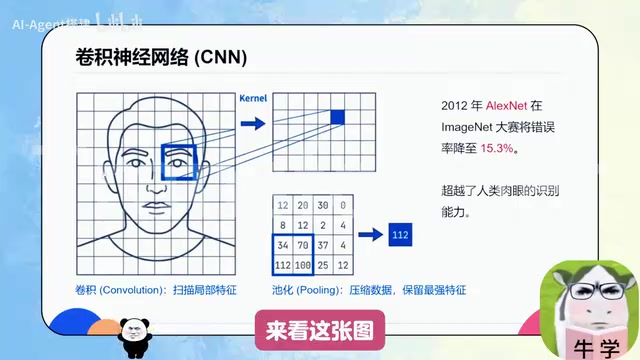
Next comes the "pooling" operation, which is essentially compression: among four cells of numbers, only the largest is kept. Like taking notes and highlighting the key points, it discards redundant information and keeps only the strongest features.
With this "scan + compress" combination, the classic AlexNet of 2012 reduced the image recognition error rate to 15.3%—an accuracy that even surpassed the human eye. In that moment, people truly felt that "AI had risen."
Background: AlexNet and the Singularity Moment of Deep Learning
The 2012 ImageNet competition was a true turning point in the history of deep learning. AlexNet, submitted by Alex Krizhevsky, Ilya Sutskever, and Geoffrey Hinton (the "godfather of deep learning"), slashed the image recognition error rate from 26% to 15.3%—nearly 11 percentage points lower than second place. This gap stunned the entire academic community. Behind this achievement was the first large-scale application of GPU parallel computing power to neural network training, establishing the industry consensus of the following decade that "computing power equals competitiveness." It's worth noting that AlexNet's core author Ilya Sutskever later became co-founder and Chief Scientist of OpenAI, directly participating in the birth of the GPT series—this technical lineage also forms a complete historical continuity at the personnel level.
CNN's Fatal Flaw: It Can't Read Order
But when people tried to transplant this image-processing approach to text, the problem was exposed. CNNs are essentially "bag-of-words models"—they only look at local features, regardless of where words appear. In a CNN's eyes, "I eat the apple" and "The apple eats me" are the same three words shaken out of a bag; it simply can't tell which is the subject and which is the object.
This is CNN's fatal flaw: it can't understand causal logic. A language model built with it is like a forgetful parrot—it can blurt out a few words but can't string together a coherent sentence.
RNN: Giving AI "Memory"
Since the problem was about order, the RNN (Recurrent Neural Network), designed specifically for sequences, stepped onto the stage. Here, "recurrent" means it doesn't process things in a straight line—it has memory.
The core idea of RNN is much like a person taking notes in their head while reading a book. When it reads "I," it stores the information; when it reads "eat," it not only looks at the current word but also looks back at the previously stored "I," thereby generating a new understanding—"Ah, it's I who is eating." Finally, when it reads "apple," it combines everything before to arrive at the complete meaning.

This "little notebook for taking notes" is technically called the hidden state. With it, the RNN can finally distinguish the difference between "I eat the apple" and "The apple eats me." Early machine translation and sentiment analysis relied primarily on RNNs.
RNN's Two Major Weaknesses
However, the RNN has two major weaknesses that severely limit its ceiling:
First, it can't parallelize, so it's extremely slow. An RNN is like waiting in line to pass airport security—to compute the second word, you must first finish computing the first; to compute the 1000th word, you have to wait for the previous 999 to finish queuing. It can't perform parallel computation on all inputs at once the way a CNN can, making it simply unable to run at scale against massive amounts of data.
Second, long-distance dependency (amnesia). Information gradually decays as it's passed layer by layer. Short sentences are fine, but if a long article opens with "Alice holds the key" and thousands of words pass in between, by the time the model reaches the final "he," it has long forgotten who the protagonist is. So RNNs can handle short sentences, but they start talking nonsense once you ask them to write long texts.
Background: LSTM and GRU—Patch Solutions for RNN
To alleviate the RNN's "amnesia," researchers proposed LSTM (Long Short-Term Memory) in 1997, and later simplified it into GRU (Gated Recurrent Unit) in 2014. LSTM introduced a set of gate mechanisms—the "forget gate," "input gate," and "output gate"—allowing the model to learn on its own "which information is worth retaining long-term and which can be discarded." Essentially, it equips the hidden state with a selective filter. LSTM was once the standard configuration in the NLP field; Google Translate saw a dramatic improvement in translation quality after switching to an LSTM architecture at scale in 2016. But even so, LSTM still couldn't fundamentally solve the problem of slow serial computation, which is the core reason Transformer eventually replaced it.
Slow and forgetful—AI's natural language processing capability was thus stuck at a bottleneck.
Transformer: Attention is All You Need
In 2017, Google dropped a history-changing paper—"Attention is All You Need"—proposing a brand-new architecture: Transformer. It threw out the complex recurrence and convolution entirely, keeping only one core weapon: the Attention Mechanism. This paper essentially declared that natural language processing had entered a new era, and it became the common "ancestor" of all of today's large models (ChatGPT, DeepSeek, and more).
Background: How One Paper Changed the Entire Tech Industry
"Attention is All You Need" was co-authored by eight researchers from Google Brain and Google Research, and published at the 2017 NeurIPS conference. The title itself was a rather provocative declaration—asserting that the attention mechanism alone was enough to replace all the complex recurrent and convolutional structures that came before. As of 2024, this paper has been cited over 100,000 times, making it one of the most-cited papers in the history of artificial intelligence. Even more noteworthy is that Transformer's influence has long spilled beyond the NLP field: the Vision Transformer (ViT) for image processing, AlphaFold2 for protein structure prediction, and even music and video generation models all use this attention mechanism at their core—truly validating the assertion that "attention is all you need."
Attention Mechanism: Highlighting Key Points Like a Human
The attention mechanism actually mimics human reading habits. When we see "I love China," our brains don't rigidly read one character at a time; instead, we instantly grasp the key points and build connections.
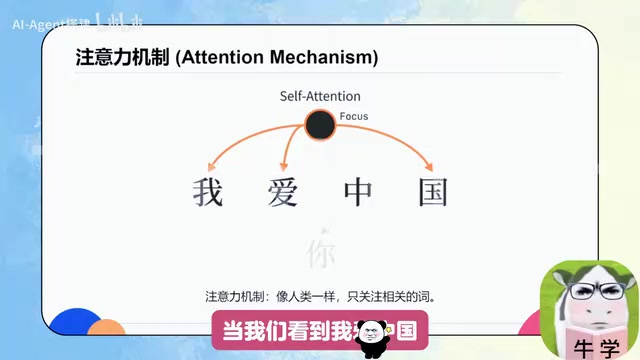
Seeing "love," the brain automatically asks: Who loves? — "I love" is closely related, high score; loves whom? — "China" is strongly associated, high score. The machine thus learns, like a human, to focus only on relevant words rather than treating everything indiscriminately.
Deep Dive: The Mathematical Intuition of the Q-K-V Triplet
The core computation of the attention mechanism involves three vectors: Query, Key, and Value. This design derives from the database query logic of information retrieval systems. Intuitively, you can understand it this way: for each word in a sentence, the model poses a question (Query), then scans the "labels" (Keys) of all words, computes the degree of match, and then weights and extracts the corresponding "content" (Value). The match is computed using the dot product, then divided by the square root of the dimension for scaling to prevent excessively large values, and finally normalized via softmax to obtain the attention weights. This "Q-K-V" triplet design is extremely general; nearly all subsequent large models (BERT, GPT, LLaMA) evolved on top of it rather than starting from scratch.
Parallel Computation + Positional Encoding: A Two-Pronged Approach
The attention mechanism also conveniently solved RNN's speed problem. It computes the degree of association between words, requiring no serial waiting. It can throw all four words of "I love China" in at once and compute them simultaneously—turning "a single service window" into "multiple service windows working at once," boosting computation speed by several orders of magnitude. This is precisely the foundation that allows large models to devour massive amounts of data for training.
But parallel computation brings a new problem: if all words are computed together, wouldn't the order get scrambled? Transformer's designers came up with Positional Encoding. Each word entering the model is handed a "seat number": "I" is No. 1, "love" is No. 2, "China" is No. 3. The data fed into the model packages "word meaning + position" together, giving it both the speed of parallelism and, through these number tags, the memory of what comes before and after.
Attention for highlighting key points, parallelism for speed, positional encoding for preserving order—this combination finally took AI from ignorance to mastery of language.
BERT and GPT: The Two Schools of Transformer
Transformer later split into two major schools. BERT used only the Transformer's Encoder, specializing in understanding; the famous GPT used only the Decoder, specializing in generation (creation). Understanding the difference between BERT and GPT is one of the core checkpoints in learning about large models.
BERT: The Bidirectional Reader
BERT's biggest feature is bidirectional attention. For example, to fill in the blank "He eats lunch at the ___," BERT can look both at "He eats lunch at" on the left and "the" on the right, as if it read through the whole text before inferring, determining that it might be "company/home/restaurant."
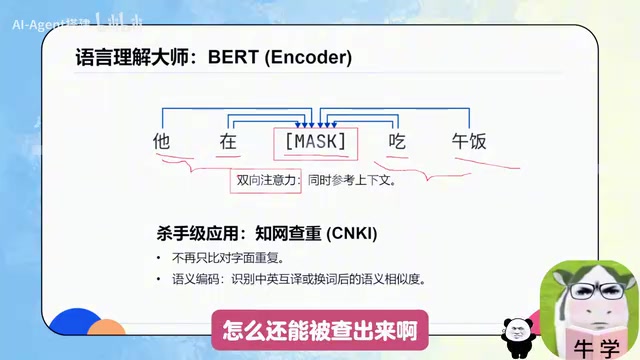
This technology is very close to our daily lives. Anyone who has written a graduation thesis is familiar with plagiarism checkers—after the systems were upgraded, changing "as the economy develops" to "along with economic takeoff" can still be caught. The reason is that the system now uses BERT to understand the meaning of sentences—swap a word but keep the meaning unchanged, and it still recognizes it. Simple content-spinning no longer works.
GPT: The Unidirectional Creator
GPT's approach is the exact opposite. When writing an article, you can't look at the ending all at once, so it has only unidirectional attention. When writing "I'm going to the ___ today," it can only look at what comes before, not after. To prevent it from "peeking at the answer," engineers added a Mask mechanism that blocks out the future words, forcing it to guess the next word based only on the words it already has—maybe company, mall, or movie theater—guessing one and then the next. This is precisely why GPT's output is so fluent: it simulates the human logic of writing one character at a time.
Pre-training + Fine-tuning + Scaling Miracles
GPT relies on the combination of "pre-training + fine-tuning." The Pre-training phase feeds it almost all the books, web pages, and papers on the internet, teaching it general grammar and common sense—equivalent to completing nine years of compulsory education plus a general university curriculum. The Fine-tuning phase feeds it specialized material targeting specific tasks—feed it legal documents if you want it to review contracts, feed it GitHub code if you want it to write code—equivalent to pre-job professional training.
Background: The Industrial Economics of "Pre-training + Fine-tuning"
This paradigm is not just a technical solution but also a business logic that reshaped the AI industry landscape. The cost of pre-training a large model is extremely high—GPT-3's single training run is estimated to have cost over $4.6 million, meaning only a handful of tech giants or well-funded startups can complete it independently. But the barrier to fine-tuning is far lower: a company only needs to prepare hundreds to thousands of high-quality domain-specific data samples and can complete fine-tuning on a cloud platform for tens of dollars, obtaining a specialized model that "knows the field." This ecosystem stratification—"infrastructure built by big companies, application layers developed by small and medium players"—gave rise to today's vast application development market around foundation models like GPT, Claude, and LLaMA, and is the underlying logic of the AI entrepreneurship boom.
With the methodology set, what remained was a matter of scale. Early GPT had just over a hundred million parameters and could only write simple short sentences. By GPT-3, it soared to 175 billion parameters, and scientists were astonished to discover: when the parameter count grows large enough, the model suddenly "gets it." Not only could it write poetry and code, it even acquired logical reasoning ability—this is called "Emergence." By GPT-4, the scale grew even larger, and it could even understand images.
Background: The Controversy and Significance of "Emergence"
"Emergence" remains controversial in academia to this day. A 2022 Google research paper first systematically described this phenomenon: when a model's parameter count is below a certain threshold, it barely possesses a given capability, but once it exceeds the threshold, that capability suddenly appears and rapidly improves—just as water is liquid at 99°C but suddenly boils at 100°C. However, a 2023 paper from Stanford University raised doubts: "emergence" might be an illusion of the measurement method, and switching to a smooth evaluation metric shows that capability improvement is actually continuous rather than abrupt. This debate remains unresolved, but whether or not emergence is real, the significant advantage of large-parameter models in complex reasoning tasks is an objective fact—and this is the fundamental driving force behind the continued investment of major tech companies in the "scaling race."
Conclusion: A Technical Relay Spanning More Than a Decade
Looking back over this entire path, AI didn't become smart overnight: it first learned to "see features" with CNNs, then learned to "remember order" with RNNs, and finally truly learned to "understand and express" through the Transformer's attention mechanism.
So when you open your computer and ask AI to help you write a weekly report, draft a plan, or generate an image, take a moment to consider—behind that screen is a technical relay spanning more than a decade, the result of countless engineers meticulously refining model structures bit by bit, all to give you this one fluent answer today. This may just be the coolest technological romance of our era.
Key Takeaways
Related articles

The Truth Behind Codex 'Build a Website in 5 Minutes': AI Isn't Creating Sites—It's Helping You Copy Them
Exposing the truth behind viral Codex 5-minute website videos: creators aren't building original sites with AI—they're copying shared prompts or scraping others' work. Learn AI coding tools' real limits.

Getting Started with AI Agent Development: A Complete Guide from Concept to Practice
A comprehensive guide to AI Agent architecture and development, covering automated marketing, intelligent customer service, and investment analysis scenarios with single and multi-agent collaboration.

The Truth Behind Codex 'Build a Website in 5 Minutes': AI Isn't Creating Sites — It's Helping You Copy Them
Exposing the truth behind viral Codex 5-minute website videos: creators aren't building original sites with AI — they're copying shared prompts or scraping others' work.