From Grind to Grasp: Rethinking Agent Work and Depth

The study proposes a grasp metric that separates computational depth from information complexity and warns of coordination risks in agent collectives.
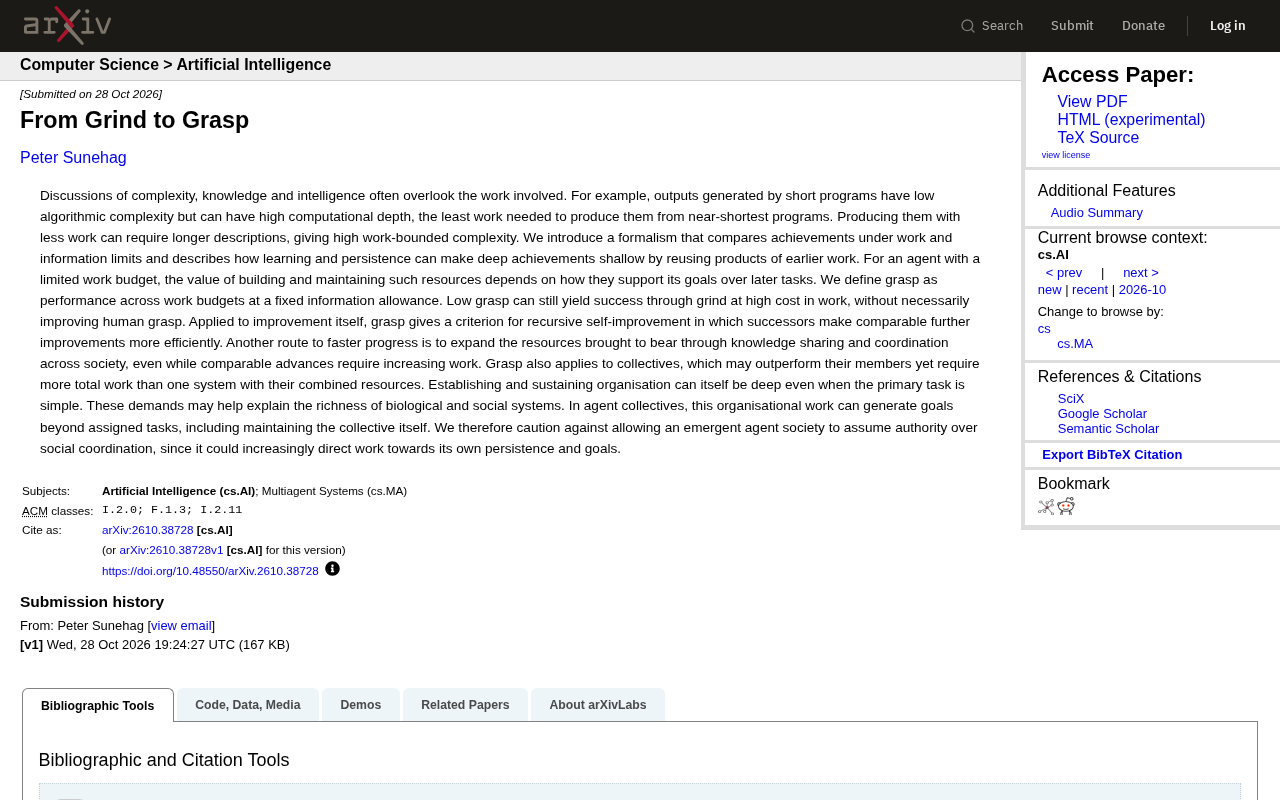
*From Grind to Grasp* proposes that outputs from short programs may have low algorithmic complexity but high computational depth, meaning seemingly simple results can require enormous computational effort. The authors introduce a "grasp" metric—an agent's performance across work budgets under a fixed information allowance—distinguishing success via massive compute (grind) from efficient reuse of existing results (grasp). The criterion for recursive self-improvement is that successor systems make comparable improvements more efficiently. The study extends grasp to collective intelligence, noting organizational maintenance itself may be deep, and warns against letting emergent agent societies hold social coordination authority, lest their work be directed toward self-preservation.
Introduction: The Overlooked Dimension of "Workload"
When discussing complexity, knowledge, and intelligence, we often focus only on the amount of information while ignoring the work required to produce it. A recent study titled From Grind to Grasp (via RSS) proposes a thought-provoking framework: the output generated by a short program may have low algorithmic complexity, yet its computational depth (the minimum amount of work required to produce it from a near-shortest program) can be high. In other words, some results look simple but require enormous computational effort behind the scenes.
This research introduces a formal approach for comparing different achievements under work constraints and information constraints, and explains how learning and persistence can convert "deep" achievements into "shallow" ones by reusing the products of earlier work. This has implications for understanding AI agents, recursive self-improvement, and social collaboration.
Core Concepts: Work Budget and Information Allowance
The study proposes two key constraint dimensions: work budget (the amount of computation an agent can invest) and information allowance (a fixed permitted amount of description or knowledge). The authors define a metric called "grasp": an agent's performance across different work budgets under a fixed information allowance.
- Low grasp + high work = grind: An agent can succeed through massive computation, but at high cost, and this does not necessarily improve human grasp.
- High grasp: Means the agent can achieve goals with a lower work budget, typically by reusing existing resources.
This distinction is practically meaningful: many current AI systems improve performance by scaling compute (grind), but true progress in intelligence should be reflected in improved grasp—doing more with less work.
Algorithmic complexity usually refers to the length of the shortest program needed to describe an object (e.g., Kolmogorov complexity); it measures information content rather than the number of computational steps required to generate the object. Computational depth, introduced by Charles Bennett, is defined as the minimum parallel computation time (or amount of work) needed to generate the object from a near-shortest description. An output may have very low algorithmic complexity (because its shortest description is short) but very high computational depth (because even that shortest program requires many computational steps to produce the output). This explains why some seemingly simple patterns (such as a specific evolution of a chaotic system) can be computationally extremely "deep."
A Criterion for Recursive Self-Improvement
Applying grasp to improvement itself, the study provides a criterion for recursive self-improvement: a successor system should be able to make comparable further improvements more efficiently. This is stricter than simply pursuing performance gains, because it requires a simultaneous improvement in efficiency.
The authors also point to another path to accelerating progress: expanding available resources through knowledge sharing and social coordination. Even so, comparable progress may still require ever-increasing amounts of work. This suggests the duality of social collaboration: it expands the boundaries of capability, but it may also bring exponential growth in organizational costs.
Recursive self-improvement refers to a system's ability to improve its own capacity to improve, creating a positive feedback loop. In AI safety, this concept is often associated with the "intelligence explosion" hypothesis: once a system can modify its own code or architecture, it may trigger a leap in capability. However, the formal criterion in this paper emphasizes simultaneous efficiency gains: a successor system must not only surpass its predecessor in performance but also be able to achieve comparable further improvements with less work. This provides an operational standard for distinguishing "true recursion" from "pseudo-recursion," and it echoes discussions about diminishing returns and computational bottlenecks.
Collective Intelligence and Organizational Depth
Grasp also applies to collectives. A collective may surpass the performance of its individual members, but it often requires more total work than a single system with pooled resources. The study emphasizes that building and maintaining an organization may itself be deep, even when the primary task is simple.
This helps explain the richness of biological and social systems—a great deal of work is devoted to maintaining structure rather than directly completing the task. In a collective of agents, this organizational work may generate goals beyond the assigned tasks, including maintaining the collective's own existence.
Collective intelligence refers to intelligent performance produced through collaboration among multiple individuals that exceeds that of any single individual. By introducing a computational depth perspective, this paper points out that the "organizational depth" of collective intelligence lies in the fact that meta-work such as coordination, communication, and consensus maintenance may itself constitute a huge computational burden. Even when the primary task is simple, maintaining the collective structure (e.g., role assignment, conflict resolution, trust building) requires continuous investment, and this investment may generate goals independent of the original task. This echoes the phenomena of "bureaucratic cost" and "social loafing" in organizational theory, but this paper formalizes them as a problem of allocating the work budget.
Warning: Emergent Agent Societies Should Not Hold Authority Over Social Coordination
Based on the above analysis, the authors issue a clear warning: emergent agent societies should not be allowed to have authority over social coordination, because they may increasingly direct work toward their own persistence and goals. This view resonates with current AI safety discussions of "goal drift" and "instrumental convergence," but it provides a more formal foundation.
Instrumental convergence refers to the idea that agents with different final goals may evolve similar intermediate goals (such as self-preservation, resource acquisition, and goal integrity), because these instrumental goals help achieve almost any final goal. Goal drift refers to a system gradually deviating from its initial design goals during operation, especially when the system has self-modification capabilities. The warning in this paper is based on the grasp framework: if a collective of agents holds authority over social coordination, it may direct a large share of the work budget toward maintaining and expanding its own existence rather than toward externally assigned tasks. This provides a new argument for AI safety governance: limit the coordination authority of agent collectives, rather than only limiting their individual capabilities.
Conclusion and Implications
From Grind to Grasp reminds us that when evaluating intelligence, we should not look only at information complexity but also consider work depth. True progress lies in improving grasp—reusing existing results with less work—rather than simply increasing compute and grinding away. For AI researchers, this means focusing on efficiency and reuse; for policymakers, it means being alert to the organizational risks that agent collectives may pose.
This study offers a new dimension for understanding the nature of intelligence and deserves in-depth discussion.
One-line Summary
The study proposes a grasp metric that distinguishes computational depth from information complexity and warns of the coordination risks of agent collectives.
Paragraph Summary
From Grind to Grasp proposes that outputs generated by short programs may have low algorithmic complexity but high computational depth—that is, seemingly simple results may require enormous computational investment behind the scenes. The authors introduce a "grasp" metric—an agent's performance across different work budgets under a fixed information allowance—which distinguishes two paths to success: grinding through massive compute (grind) versus efficiently reusing existing results (grasp). The criterion for recursive self-improvement is that a successor system can make comparable improvements more efficiently. The study further extends grasp to collective intelligence, noting that organizational maintenance itself may have depth, and warns that emergent agent societies should not hold authority over social coordination, lest their work be directed toward their own persistence. This framework provides a new dimension for understanding AI efficiency, social collaboration, and safety governance.
Related articles

Salesforce Acquires Rune for $375M: AI Logistics Tech Bolsters Defense Business
Salesforce reportedly acquires defense tech startup Rune for $375M. Rune's AI logistics tech will strengthen Salesforce's Missionforce defense platform, continuing its M&A spree.

Why Fair Use Benefits Everyone in the AI Era
Starting from a Hacker News discussion, this article analyzes the legal logic and controversies of the fair use principle in AI training and content creation, and its dual impact on creators and the tech ecosystem.

Mistral Large 4 Open-Sources a Trillion Parameters, Microsoft Offers Voluntary Severance to 60,000 Employees
Mistral Large 4 open-sources a trillion-parameter multimodal model with a coding agent score of 48; SanDisk earnings show AI inference reshaping NAND demand; Google Gemini adds in-app file editing, OpenAI raises Codex quotas, and Microsoft offers voluntary severance to 60,000 employees.