From Leaving Google to KDD 2026: The Industry Signals Behind an AI Scientist's Career Pivot
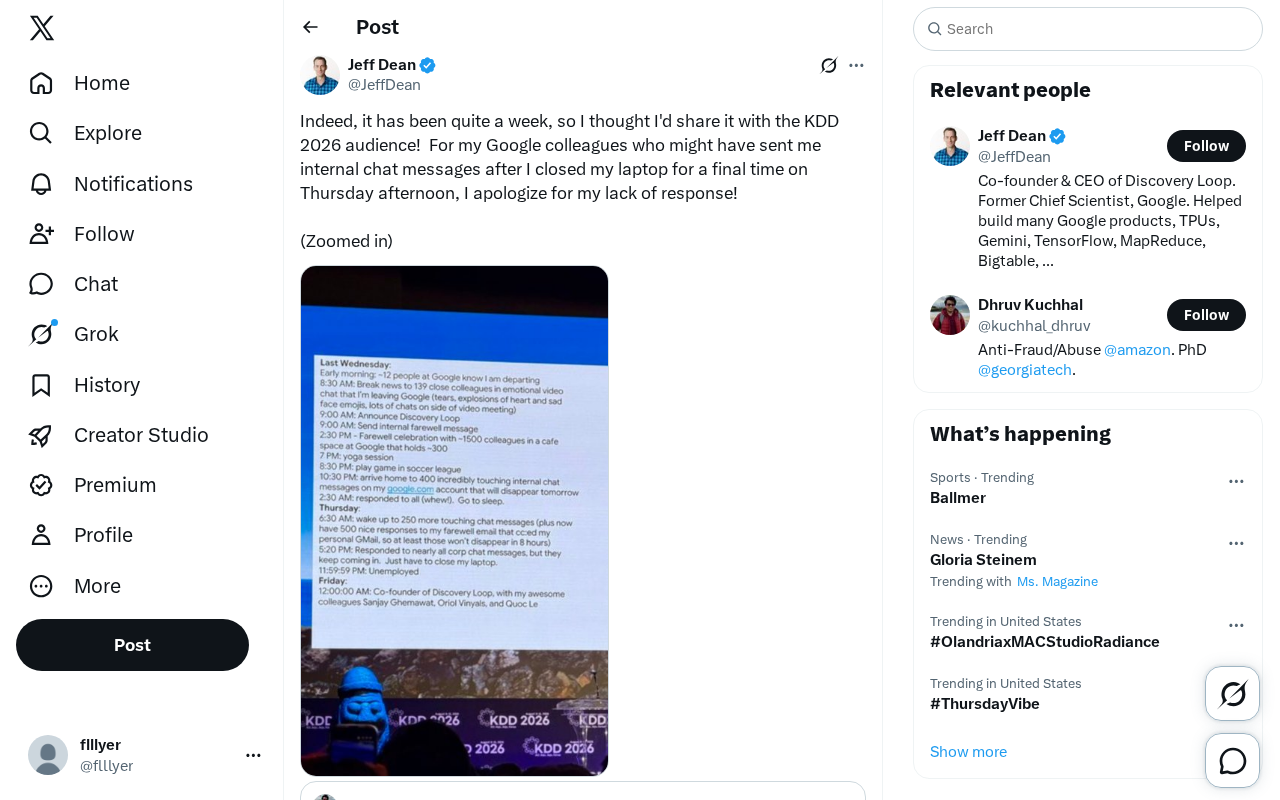
A Google departure aimed at the KDD 2026 audience reveals deeper trends in AI talent mobility and research shifts.
A senior data scientist's departure from Google, shared with the KDD 2026 audience, signals accelerating AI talent mobility. This article examines the structural forces driving researchers from big tech to startups and academia, KDD's unique role as a bridge between industry and research, and how the generative AI wave is reshaping data mining careers and research directions.
An Industry Signal Hidden in a Farewell Note
Recently, a senior data scientist shared a major career turning point on X (formerly Twitter) — officially leaving Google — and directed the message toward the audience of the upcoming KDD 2026 (ACM SIGKDD Conference on Knowledge Discovery and Data Mining).
In this somewhat sentimental post, the author mentioned "closing the laptop for the last time" on a Thursday afternoon, and apologized to Google colleagues who may have sent internal chat messages afterward without receiving a reply. While brief and personal, this expression reflects a broader snapshot of the accelerating talent movement in AI and data science.
Why This Tweet Deserves Attention
On the surface, it might seem like just another tech professional's routine update. But considering the context — addressed to the academic audience of KDD 2026 — it carries several layers of meaning worth unpacking.
Accelerating Mobility of Top AI Talent
Google has long been a powerhouse of AI and data mining research. Its teams have led the way in recommendation systems, large-scale machine learning, graph algorithms, and more. When a senior member departs, it's rarely an isolated event — it's a direct reflection of the vitality of the broader talent ecosystem. With the explosion of generative AI, the movement of top researchers between big tech, startups, and academia has noticeably accelerated, becoming an industry norm.
To understand the deeper context behind this trend, it's important to recognize that Google's AI capabilities extend far beyond its products. Internally, Google Research and Google DeepMind (formed in 2023 from the merger of Google Brain and DeepMind) have long served as two of the world's most powerful AI research engines. From the groundbreaking 2017 paper Attention Is All You Need that introduced the Transformer architecture, to milestone projects like AlphaGo and AlphaFold, Google's research teams have sat at the pinnacle of both academic output and engineering impact. However, this extremely high density of talent also means that when industry winds shift — such as the rise of the generative AI startup wave — the momentum of talent outflow is equally massive. In recent years, several core researchers, including multiple co-authors of the Transformer paper, have left Google to found companies (such as Character.AI, Cohere, Adept, and others), forming what the industry has dubbed the "Google alumni startup wave."
Academic Conferences as Career Hubs
The author's choice to tie this announcement to the KDD 2026 audience itself speaks to the pivotal role top academic conferences play in professional networks. As one of the oldest and most influential conferences in data mining, KDD is not just a venue for paper presentations — it's a core nexus where industry and academia connect, and where ideas collide. For many researchers, a career identity shift often comes hand-in-hand with a "re-debut" at conferences like this.
KDD 2026: A Bellwether for the Data Mining Field
For those less familiar, KDD (Knowledge Discovery and Data Mining) is the flagship conference organized by ACM SIGKDD, covering cutting-edge areas such as data mining, machine learning, and big data analytics. Every year, researchers from tech giants like Google, Microsoft, Meta, and Amazon, along with top universities worldwide, converge here to showcase their latest work.
The full name is the ACM SIGKDD International Conference on Knowledge Discovery and Data Mining. First held in 1995, it has nearly 30 years of history. It operates under ACM's (Association for Computing Machinery) SIGKDD Special Interest Group and is a universally recognized top-tier conference in data mining, ranked alongside ICML, NeurIPS, and AAAI as an A-class conference in the AI/ML space. What makes KDD unique is that it features both a Research Track and an Applied Data Science Track — the latter dedicated to industry practice outcomes. This makes KDD one of the top conferences with the closest intersection between academia and industry. Over the years, many core technologies from companies like Google, Microsoft, and Alibaba — such as ad click-through rate prediction models and large-scale graph computation frameworks — were first published at KDD.
In the era of generative AI, KDD's topics continue to evolve:
- Traditional tracks: Recommendation systems, anomaly detection, time series analysis
- Emerging frontiers: Integration of large language models (LLMs) with data mining, graph neural networks, trustworthy AI
- Industry practice: Large-scale data systems engineering, model deployment and governance
The convergence of LLMs and traditional data mining methods is one of the most closely watched frontiers at KDD in recent years. Specifically, this fusion manifests on multiple levels: first, using LLMs as feature extractors, leveraging their powerful semantic understanding to generate high-quality embeddings for unstructured data (such as user reviews and product descriptions), thereby improving downstream tasks like classification and recommendation; second, using LLMs' reasoning capabilities for data augmentation and synthetic data generation to address data scarcity in few-shot learning; and additionally, combining knowledge graphs with LLMs to reduce hallucination problems is another hot research area. On the graph neural network (GNN) front, architectures like GraphSAGE and GAT have demonstrated powerful capabilities in social network analysis and molecular property prediction, while injecting graph-structural information into large language models to enhance relational reasoning is emerging as a new research frontier.
A researcher leaving the industry frontlines who chooses to share their journey on this platform may, in some sense, be signaling that their future direction will lean more toward cutting-edge research or independent exploration.
The Industry Logic Behind AI Talent Mobility
From "Doing Research at Big Tech" to "Redefining Research Directions"
Over the past decade, tech giants leveraged their advantages in massive datasets, compute power, and compensation to nearly monopolize top AI talent. But the situation is subtly shifting:
- Startups and open-source communities offer greater autonomy and technical influence
- Academia's independent value in foundational research is being re-appreciated
- Personal brands allow researchers to build influence that transcends institutional boundaries
Behind these changes are deep structural driving forces. The release of ChatGPT in late 2022 marked generative AI's entry into the public consciousness, but its impact on data science career paths runs far deeper than what meets the eye. Traditional data scientists' core skills center on feature engineering, statistical modeling, and domain knowledge, while the rise of LLMs is redefining the boundaries of this role. On one hand, LLMs enable automation of much traditional data cleaning and exploratory analysis work; on the other hand, how to combine LLMs with structured data mining methods — such as using large models for knowledge graph completion or improving recommendation systems with retrieval-augmented generation (RAG) — has become a new frontier. This paradigm shift directly triggered a reshuffling of the talent market: researchers with LLM experience have become highly sought-after, while some seasoned experts who specialized in traditional directions face a choice of repositioning themselves.
Meanwhile, the rise of open-source AI communities has fundamentally changed the distribution of research resources. Platforms like Hugging Face have made model sharing and collaboration unprecedentedly convenient, and Meta's release of the LLaMA series of open-source models has broken down the compute barriers to large model research, enabling small teams and even individual researchers to produce impactful work on cutting-edge topics. AI venture capital continued to heat up from 2023 to 2025, with the soaring valuations of companies like OpenAI and Anthropic inspiring a wave of big-tech researchers to leave and start their own ventures. The core driver of this trend is that startups can offer higher equity incentives, faster decision-making, and more focused research directions — precisely the things that are difficult to fully satisfy within the bureaucratic management structures of large companies.
The expression "closing the laptop for the last time" in this tweet carries a clear sense of ritual, suggesting a carefully considered choice rather than a simple job hop.
The Communication Value of Personal Narratives in the Tech Industry
Here's a notable detail: more and more researchers are proactively telling their career stories on social platforms. This is not only an effective personal branding strategy but also gives outsiders a glimpse into the real rhythms inside tech companies. An apology for unreturned messages to colleagues may seem trivial, but it authentically captures a slice of the high-intensity work culture and interpersonal networks within big tech.
In fact, social media — especially X (formerly Twitter) — has taken on a role in the AI research community that far exceeds a simple information-sharing tool. It effectively constitutes a reputation system that runs parallel to the traditional academic publishing ecosystem. Many important research findings generate discussion on social platforms through tweets, blogs, or preprints (arXiv) before formal papers are published. Prominent researchers like Andrej Karpathy, Yann LeCun, and François Chollet have all built personal influence that transcends their affiliated institutions through consistent social media output. For researchers undergoing career transitions, social platforms provide a low-cost signal emitter: a carefully worded departure tweet serves as both a farewell to the past and an implicit recruitment signal to future collaborators and potential employers. This "public narrative" strategy has already become an established communication pattern in Silicon Valley tech circles.
Conclusion: One Person's Pivot, a Footnote of an Era
This tweet itself carries limited information, but set against the backdrop of rapid transformation in AI and data science, it serves as a representative sample. The mobility of top talent, the hub function of academic conferences, the communicative power of personal narratives within the industry — these elements together paint an authentic picture of today's tech talent ecosystem.
For readers following industry trends, rather than fixating on where exactly this scientist is headed next, it's more valuable to see this as a reminder: in an era of breakneck AI advancement, the relationships between talent, platforms, and research directions are being continuously reshaped. And stages like KDD 2026 may well be one of the best windows through which to observe these changes.
Related articles
AI Agent Cost Optimization in Practice: Engineering Wisdom That Saved $1 Million in One Hour
Databricks eliminated $1M/year in wasted AI Agent spend in just one hour. Learn the root causes of Agent cost overruns and key strategies like model tiering, context pruning, and caching.
How the FDA Is Building an AI-Ready Data Foundation on Databricks
Explore how the FDA leverages Databricks for Government to build a unified Lakehouse architecture and AI-ready data foundation while meeting federal security and compliance standards.
The Power of Security Collaboration: Why Vulnerability Discovery Cannot Do Without Human Intelligence
Explore how security collaboration outperforms tool dependency, the value of vulnerability stories, cross-team knowledge sharing practices, and building stronger defenses by investing in people and collaboration.