From Nextcloud to Immich: A Real-World Photo Management Experience

A user ditched Nextcloud for Immich after finding its album UI unusable, revealing why purpose-built media tools win for photo management.
A long-time Nextcloud user switched to Immich after discovering that Nextcloud's album UI only allows selecting photos one at a time — making a simple vacation album a two-hour ordeal. The same task in Immich took 30 seconds. The article uses this real-world case to examine the core difference between the two platforms: Nextcloud is a general-purpose file collaboration suite where photos are just one module, while Immich is purpose-built for media management, mirroring the Google Photos experience. Immich also outperforms on duplicate detection and out-of-the-box facial recognition. The takeaway: use Nextcloud for broad collaboration needs, but choose Immich if photo and video management is your primary goal.
The best way to evaluate a self-hosted photo management solution is to put it through real-world use. A Reddit user recently shared their experience of switching entirely from Nextcloud to Immich — triggered by a frustrating attempt to create an album from over a thousand vacation photos. This firsthand account highlights the fundamental differences in how these two popular self-hosted platforms approach photo and video management.
One Album Operation That Ended the Relationship
This user had actually tried deploying Immich a few years earlier, but wasn't satisfied at the time and ended up using Nextcloud long-term. Despite frequent frustrations with Nextcloud, the lack of a suitable alternative kept them sticking with it.
The turning point came after a California vacation. The user and their spouse returned with roughly 1,000 photos and videos and wanted to create a vacation album — the first time they'd seriously used Nextcloud's album feature. What they discovered was that Nextcloud's album UI only allowed selecting one image at a time: no click-and-drag batch selection, and on Android, only about 4 images were visible before scrolling.
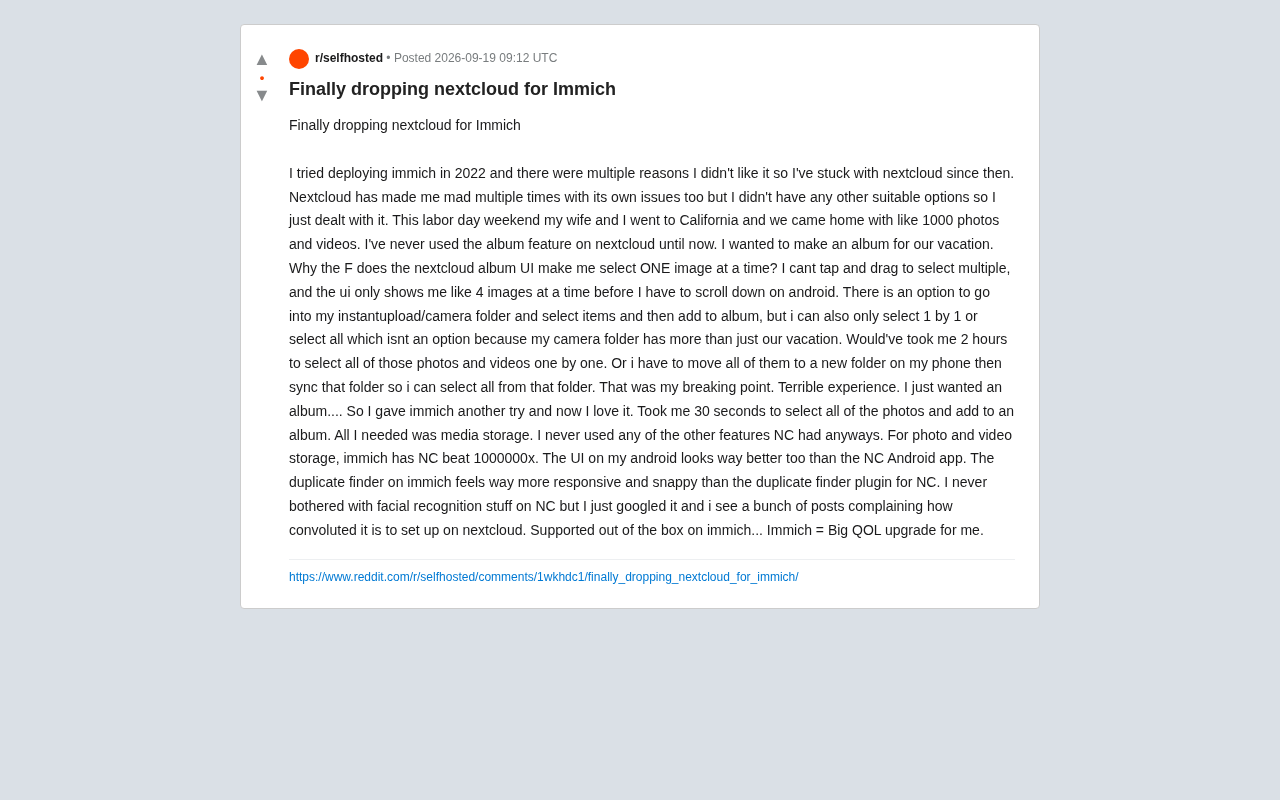
While it was technically possible to navigate into the auto-upload/camera folder to select items and add them to an album, the same limitation applied — select one at a time, or select all. Selecting all wasn't practical since the camera folder contained far more than just vacation content. At that pace, going through each photo and video individually would take two hours. The alternative was to first move the files into a new folder on the phone, sync that folder, then select all from there. For what should be a simple, everyday task like "making an album," the experience was simply unacceptable.
Immich's Core Strength: Built for Media
After giving Immich another shot, the same task took 30 seconds — select all photos, add to album, done. This dramatic gap in efficiency comes down to a fundamental difference in product philosophy.
Nextcloud is a full-featured file collaboration and cloud storage platform; photo management is just one of many modules. Immich, by contrast, was designed from the ground up for photo and video storage and management, positioning itself as a self-hosted alternative to Google Photos. When a user's actual need is simply "a place to store and manage media," Immich's focused approach translates directly into a better experience.
The user was candid about this: they had never really used any of Nextcloud's other features — all they needed was a reliable photo and video repository. Their verdict was blunt: for photo and video storage, Immich beats Nextcloud by a million miles. The Android client is also far more polished than Nextcloud's Android app.
Immich is an open-source self-hosted photo and video management solution that emerged around 2022, positioning itself as a Google Photos alternative. It supports Docker-based deployment and offers mobile auto-backup, timeline browsing, map view, album management, and an overall interaction model closely mirroring Google Photos — with virtually no learning curve for users accustomed to consumer apps. Nextcloud, by contrast, is a more established open-source cloud platform that evolved from the ownCloud project. Its design philosophy centers on the file system as a foundation, with functionality extended through a plugin ecosystem. Nextcloud Photos is essentially a media view layered on top of a general-purpose file management framework — which is why batch selection, album creation, and other media-specific operations are inherently constrained by the underlying architecture. This architectural difference explains why two platforms doing "the same thing" can feel worlds apart.
Across-the-Board Wins in the Details
Beyond batch selection and visual polish, several specific features further widened the gap.
Duplicate file detection: Immich's built-in duplicate finder is noticeably faster and more responsive, while Nextcloud requires a plugin and feels comparatively sluggish.
Facial recognition: A high-demand feature in consumer photo apps. The user had never bothered setting it up in Nextcloud, and a quick search turned up countless complaints about the complicated configuration process. Immich, on the other hand, supports this out of the box with no complex setup required.
These individually small wins add up to what the user described as a massive quality-of-life (QOL) upgrade. For self-hosters whose primary goal is photo management, how well a tool handles frequent, everyday operations is often what makes or breaks the experience.
Immich's facial recognition is powered by machine learning models (using open-source models like InsightFace by default), with inference running entirely on the local server — keeping all data within your own infrastructure while maintaining convenience. On first indexing, it batch-processes existing photos in your library; new uploads trigger recognition automatically without any manual intervention. Nextcloud's facial recognition, by contrast, depends on third-party apps like Recognize or Face Recognition. After installation, users still need to manually configure cron jobs or background queues to get it running properly — and on low-spec servers or shared hosting, recognition tasks frequently get stuck in queue backlogs. For non-technical home users, the gap between "works out of the box" and "requires tinkering" is often the line between continued use and abandoning the project entirely.
Lessons for Self-Hosters
This story isn't a wholesale condemnation of Nextcloud. As an all-in-one collaboration and file management platform, its value lies in breadth and ecosystem. The issue is about using the right tool for the right job. If you need document collaboration, calendar sync, contact management, and a suite of productivity features, Nextcloud still has a clear place.
But if your sole requirement is centralized photo and video management, album organization, deduplication, and facial recognition, then Immich — purpose-built for exactly that — is the more appropriate choice. Before choosing, ask yourself: what core problem am I actually trying to solve? Reaching for a general-purpose platform to handle a vertical need will likely mean friction at every turn in the most critical daily workflows.
For anyone exploring self-hosted solutions for family photos, this real-world account is worth keeping in mind: rather than making do with the photo module of a general-purpose platform, consider trying a tool that was built specifically for media.
Related articles

Building Your Own OpenAI-Compatible Gateway to 6 Chinese LLM Providers: Five Pitfalls Beyond the Happy Path
A developer built the He-API gateway to unify DeepSeek, Kimi, Qwen, Doubao, ERNIE, and GLM behind one OpenAI-compatible endpoint. Five real pitfalls: streaming compatibility, token billing precision, hot reload, two-dimensional rate limiting, and base_url config.

In the AI Era, a Developer's Core Value Is No Longer Writing Code
AI coding assistants make code generation easier than ever, but a developer's core value is shifting from writing code to understanding requirements and making the right trade-offs. This article explores how developers can stay irreplaceable in the AI era.

Hands-On with PhotoCraft: An Open-Source Photo Editor You Can Actually Tinker With
Hands-on review of PhotoCraft, an open-source photo editor with 58K GitHub stars: self-hosting, local inference, zero API costs, plus installation steps and use cases.