From Perception to Simulation: A New Benchmark for MLLM Spatial Reasoning and the SpatialWalker Breakthrough
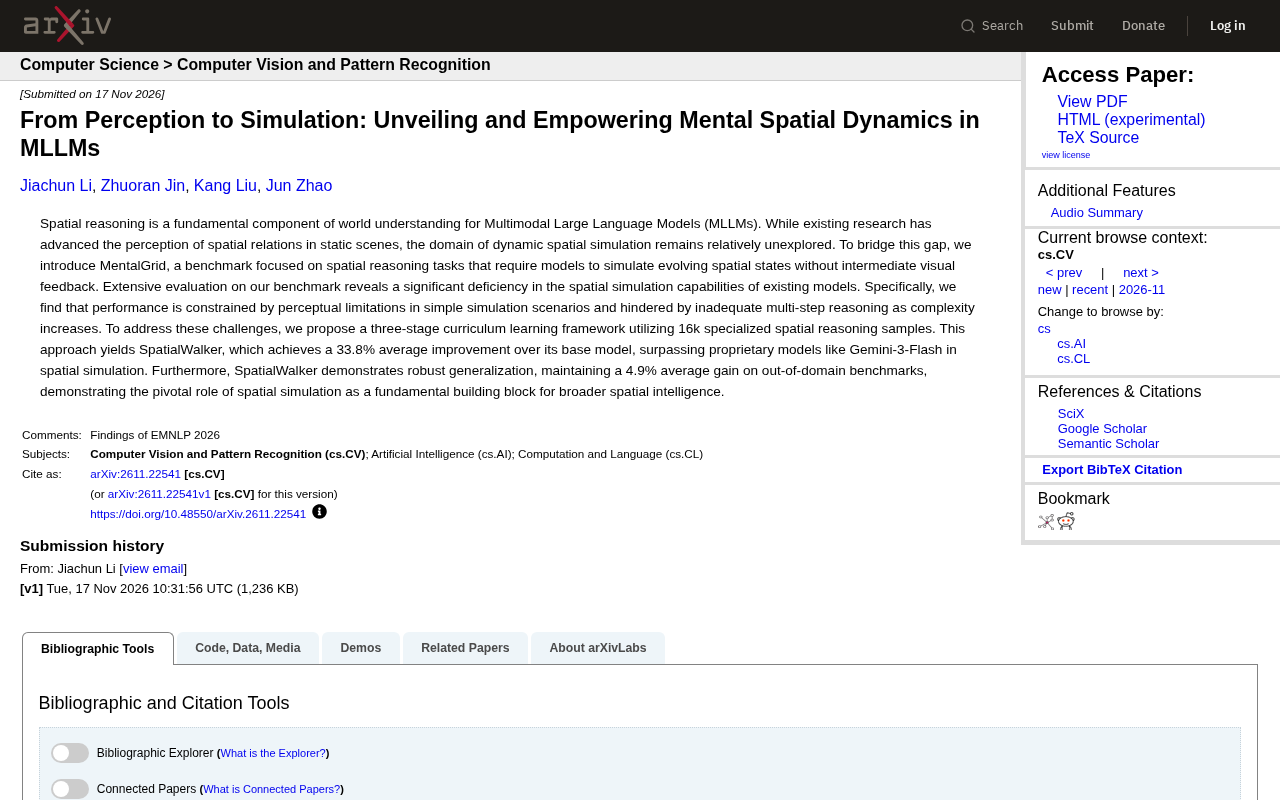
The paper proposes the MentalGrid benchmark to reveal MLLM shortcomings in dynamic spatial simulation, and uses three-stage curriculum learning to train SpatialWalker for a 33.8% improvement.
The article points out that multimodal large language models have made progress in static spatial relationship perception but are significantly lacking in dynamic spatial simulation requiring "in-head reasoning." The authors propose the concept of Mental Spatial Dynamics and the MentalGrid benchmark, finding that simple tasks are limited by initial perception errors while complex tasks are trapped by error accumulation in multi-step reasoning. To address this, they design a three-stage curriculum learning framework and train SpatialWalker on about 16k samples, achieving an average improvement of 33.8%, surpassing Gemini-3-Flash on spatial simulation tasks, and maintaining a 4.9% gain on out-of-domain benchmarks, indicating that spatial simulation is a foundational building block for broader spatial intelligence.
Multimodal large language models (MLLMs) are moving from perceiving static relationships to simulating dynamic processes in their understanding of the world. A recent paper points out that current models have significant shortcomings on spatial simulation tasks that require "in-head reasoning," and proposes a targeted solution.
Static perception has improved, but dynamic simulation remains a gap
Spatial reasoning is a foundational capability for MLLMs to understand the world. Most existing research focuses on perceiving spatial relationships in static scenes—for example, judging the relative positions of objects or identifying occlusion relationships—and has made considerable progress. However, when a task requires the model to simulate how spatial states evolve over time or through operations without intermediate visual feedback, the model's performance reveals clear deficiencies.
The paper calls this capability "Mental Spatial Dynamics" and introduces a dedicated benchmark, MentalGrid. This benchmark requires models to infer the intermediate states and final outcomes of a series of spatial transformations given only text or an initial visual input, rather than merely answering "what is currently visible."
Multimodal large language models (MLLMs) refer to large language models that process multiple modalities such as text and images simultaneously, with typical examples including GPT-4V and Gemini. Their core architecture usually maps images into feature sequences via a visual encoder, which are then fed together with text tokens into the language model for joint reasoning.
Mental Spatial Dynamics draws on the concepts of "mental rotation" and "mental simulation" from cognitive science. It refers to the internal representational process in which an individual infers, in their mind, how object positions and orientations change over time or through operations without external visual feedback. In the context of MLLMs, it requires the model to progressively generate intermediate spatial states based solely on initial observations or textual descriptions, rather than outputting a one-shot judgment of static relationships, thereby placing higher demands on working memory and the coherence of the reasoning chain.
The MentalGrid benchmark reveals two major bottlenecks
Extensive evaluations on MentalGrid show that existing models generally lack spatial simulation ability, and the source of errors varies with task complexity.
- Simple scenarios are limited by perception: In simulation tasks with fewer steps, the model's main obstacle comes from inaccurate perception of the initial spatial layout, causing subsequent reasoning to be built on incorrect premises.
- Complex scenarios are trapped by multi-step reasoning: When a simulation requires passing through multiple intermediate states, even if the initial perception is correct, the model tends to accumulate errors during step-by-step reasoning and ultimately deviate from the correct result.
This finding indicates that improving spatial simulation ability cannot rely solely on enhancing the visual encoder; specialized training targeting the multi-step reasoning process is also needed.
The key difference between spatial relationship perception and spatial simulation lies in whether state transitions are involved. The former is a single-frame judgment, such as "A is to the left of B"; the latter requires the model to maintain an internal world state that updates with each step and to apply transformations (translation, rotation, occlusion changes, etc.) at every step. Error accumulation in multi-step simulation is similar to the problem of compounding errors in sequential decision-making: even if single-step accuracy is high, the success rate decays exponentially after multiple steps. This explains why the bottleneck in complex scenarios shifts from perception to the stability of the reasoning chain.
Three-stage curriculum learning and 16k samples
To address the above challenges, the authors designed a three-stage curriculum learning framework and trained it on approximately 16,000 specially constructed spatial reasoning samples. The curriculum follows an easy-to-hard logic, gradually guiding the model from basic spatial perception to complex multi-step simulation.
The model trained under this framework is named SpatialWalker. Experimental results show that SpatialWalker achieves an average improvement of 33.8% over its base model, and even surpasses closed-source models such as Gemini-3-Flash on spatial simulation tasks.
Curriculum learning is a training strategy that organizes samples in increasing order of difficulty, enabling the model to first master simple patterns and then gradually adapt to complex tasks; it is often used to alleviate training instability in multi-step reasoning. A base model refers to a large-scale pretrained model that has not undergone task-specific fine-tuning; SpatialWalker is built on top of it via supervised fine-tuning with curriculum-organized samples rather than training from scratch. Out-of-domain benchmarks refer to evaluation sets constructed outside the training data distribution, used to test whether the model has truly acquired transferable capabilities rather than memorized task formats.
Generalization ability and the foundational significance of spatial intelligence
In addition to significant progress on in-domain benchmarks, SpatialWalker also demonstrates robust generalization: it maintains an average gain of 4.9% on out-of-domain benchmarks. This indicates that the improvement in spatial simulation ability is not overfitting to a specific task format, but rather provides foundational support for broader spatial intelligence.
The authors argue that spatial simulation is a key cornerstone for building broader spatial intelligence. The leap from perception to simulation means that MLLMs are beginning to acquire the ability to internally model the dynamic processes of the physical world, which has potential value for their application in scenarios such as robotics, navigation, and interactive planning.
Limitations and outlook
The paper does not disclose in detail the task distribution and difficulty grading of the training data, and the specific criteria for dividing the three-stage curriculum also need further clarification. In addition, the scale and diversity of the MentalGrid benchmark itself are not yet reflected in the abstract; future research could examine whether the benchmark can cover more complex real-world spatial transformations.
Overall, this work advances the research focus of MLLM spatial reasoning from static perception to dynamic simulation, and provides a reproducible training scheme along with quantitative evidence of improvement, offering a new benchmark and starting point for the development of spatial intelligence.
Related articles
When AI Starts Blogging: Scott Aaronso…
When AI Starts Blogging: Scott Aaronson's Kitchen Wine Experiment
Scott Aaronson shares a kitchen wine AI writing experiment on his blog, sparking Hacker News debate. This analysis explores the authenticity gap in AI-generated blog content, transparency disputes, and implications for content creators.

Amazon Loses Recall Case: Liability for 400,000 Dangerous Products Established
A U.S. court ruled Amazon is a distributor, not a logistics provider, and must recall over 400,000 dangerous products. This analysis examines the ruling's impact on platform liability boundaries and e-commerce compliance.

Google Familiar Faces Comes to Walmart's Budget Cameras
Google Familiar Faces facial recognition now supports Walmart's Onn outdoor and floodlight cameras at $35 and $77, but requires a Google Home Premium subscription.