From the Kodak Button to AI Generation: Every Panic in the Art World

Kodak's button camera and generative AI both lowered creative barriers; history shows professional value is not destroyed but redefined.
Starting with Kodak's 1888 button camera preloaded with film, the article reviews the art world's hostility toward "button pressers" and uses Stieglitz's 1897 misjudgment of photography as a passing fad to show that technological democratization did not eliminate photography but re-established professional standards through movements like Pictorialism and Straight Photography. The author draws a parallel with today's generative AI wave: prompt input is like pressing Kodak's shutter button, and creators' resistance to AI closely resembles the art world's reaction back then. The article notes that what remains truly scarce after tools become widespread is composition, narrative, aesthetic judgment, and depth of thought—lowering barriers does not mean standards disappear. It also emphasizes that current resistance includes legitimate demands regarding copyright, attribution, training data sources, and livelihoods, requiring institutional responses rather than simple taking of sides.
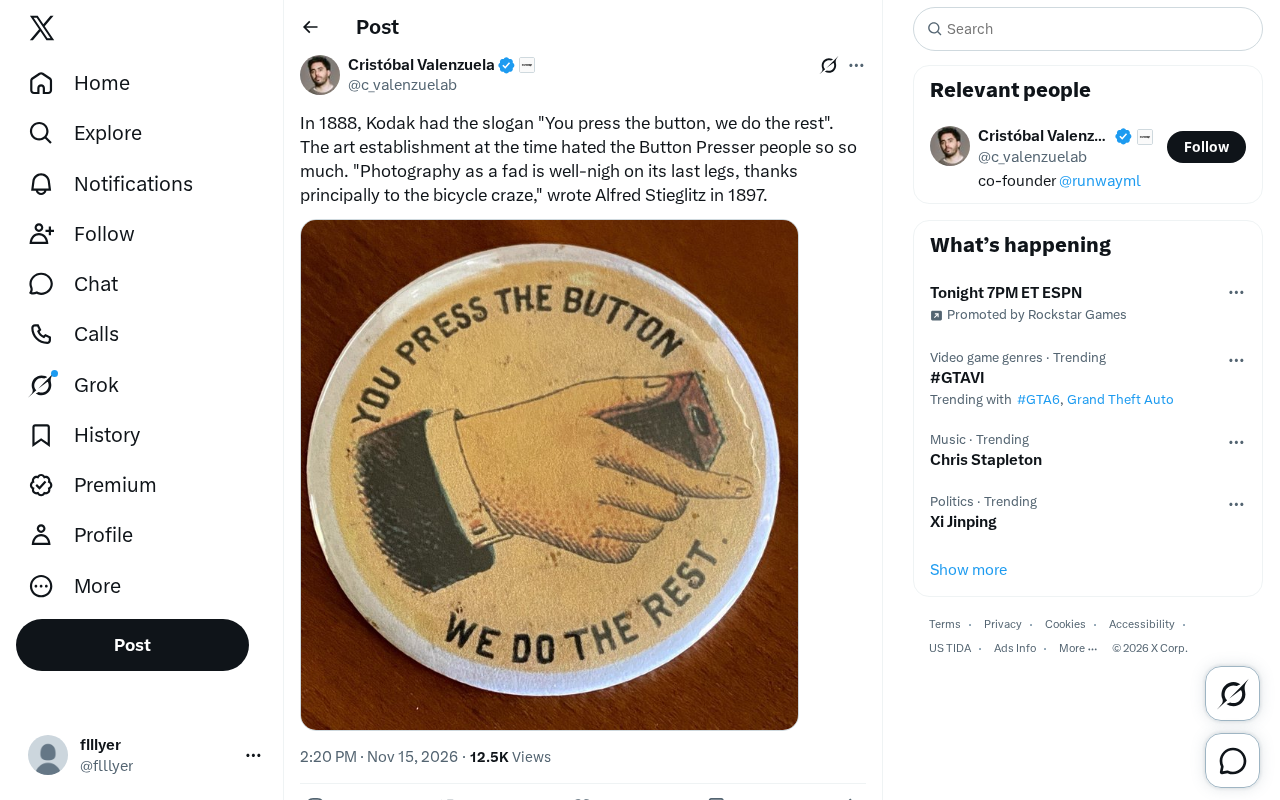
In 1888, Kodak launched a portable camera preloaded with film and coined the famous slogan: "You press the button, we do the rest." This seemingly simple phrase completely changed the trajectory of photography—it transformed taking pictures from a skill requiring specialized knowledge and cumbersome chemical processes into an everyday operation available to anyone.
According to historical snippets shared by a Twitter user, the art world of the time was filled with hostility toward these "Button Pressers." This hostility was not directed at the technology itself, but at the democratization it brought: as more and more people could easily produce clear images, the professional barriers that traditional art practitioners relied on for their livelihoods began to loosen.
Resistance from the Art World: A War Over "Barriers to Entry"
This resistance left clear traces in the commentary of the time. In 1897, Alfred Stieglitz—who would later become an important champion of photography as art—wrote: "Photography as a fad is about played out, thanks chiefly to the bicycle craze." This statement reveals a widespread condescension of the era: photography was seen as a passing trend, like the bicycle, that would fizzle out after a brief burst of excitement.
But history proved Stieglitz's prediction wrong. Photography did not die; instead, over the following century and more, it became one of the most widespread visual media. What actually happened was this: the convenience of technology did not eliminate art—it redefined who was qualified to participate in visual creation.
The Loosening and Reconstruction of Professional Barriers
Kodak's button camera did not put professional photographers out of work. Instead, it split photography into two tiers: a popular level of casual documentation and a professional level pursuing expression and craft. Professional photography continuously re-established its artistic legitimacy through movements such as Pictorialism and Straight Photography. In other words, the shock brought structural adjustment, not simple replacement.
Alfred Stieglitz (1864–1946) was a key figure in the history of American photography. In his later years, the magazine Camera Work and the New York "291" gallery he founded played a decisive role in securing artistic status for photography. But early in his career, he was influenced by the Pictorialism movement and favored soft-focus, handcrafted printing processes that imitated painterly effects, and thus held an elitist disdain for popular snapshot photography. When he wrote in 1897 that "photography as a fad is about played out," it was precisely at a time when Kodak's button camera was becoming widespread and amateur snapshots were proliferating. Notably, Stieglitz later shifted his position and promoted the Straight Photography movement, arguing that photography should leverage its own mechanical precision rather than imitate painting—this turn itself demonstrates that professional photography responded to technological democratization by redefining aesthetic standards.
Pictorialism flourished from the late 19th to the early 20th century, advocating that photography should pursue soft focus, aesthetic composition, and handcrafted printing textures like painting, in order to prove that photography had artistic qualifications. Straight Photography emerged in the early 20th century, represented by Paul Strand, Edward Weston, and later Ansel Adams. It opposed imitating painting and emphasized sharp focus, precise exposure, and faithful depiction of real details, arguing that photography's value lies precisely in its mechanical recording capability. These two movements constituted two key attempts by photography to establish artistic legitimacy: the former sought recognition by aligning with painting, while the latter established independent status by emphasizing the medium's uniqueness. For the analogy of understanding the AI era, this process shows that when a professional field faces the popularization of a tool, it often does not resist the technology itself but redefines the meaning and standards of "professionalism."
Generative AI: A New "Button Moment"
Looking at this history in today's context, the parallels are almost one-to-one. Generative AI tools are playing the role of the Kodak camera: users only need to input a prompt, press the generate button, and leave the rest to the model. The barriers to creating images, text, and code have been dramatically lowered, and both speed and quality are improving at a visible pace.
And so, the same anxiety has resurfaced. The resistance of illustrators, photographers, and designers to AI-generated content mirrors the art world's hostility toward "button pressers" back then. The core concern is highly similar: when creative tools are no longer scarce, where is the value anchor of professional identity?
What History Offers as a Reference
From the history of photography, what becomes clearer after tools become widespread is precisely what is truly scarce. When everyone can take clear photos, composition, narrative, aesthetic judgment, and depth of thought become more important—these are exactly the parts that tools themselves cannot replace.
For current AI creation, the logic is the same. Prompts can generate images, but deciding what to generate, why to generate it, and how to select and edit still depends on human judgment. Lowering the barrier does not mean the disappearance of standards; rather, it pushes competition to a higher dimension.
Generative AI refers to model systems that can automatically generate images, text, code, audio, and other content based on user-input prompts. Representative technologies include diffusion-model-based image generation tools (such as Midjourney and Stable Diffusion) and large-language-model-based text generation systems (such as the GPT series). Their core mechanism is to learn statistical patterns from massive training data and then synthesize new content according to instructions. Similar to how the Kodak camera "encapsulated chemical processes into film," generative AI encapsulates complex creative workflows into a single prompt input. But there is an important difference: AI's training data comes from the existing works of a vast number of human creators, which directly raises disputes over copyright ownership, attribution rights, and training data licensing—and this is precisely the key difference between current resistance and that of 1888.
The Real Demands Behind the Resistance
To note a detail: resistance from the art world has never been merely emotional conservatism. The photographers of that era sought recognition of photography as an art form, not a rejection of camera technology. Today's creators' resistance to AI includes legitimate concerns about copyright, attribution, training data sources, and livelihood impacts. These issues require institutional responses and cannot be dismissed simply by saying "embrace change."
From the Kodak button to the AI generate button, technology has consistently encapsulated complex processes into a single action. Each encapsulation triggers industry upheaval and also gives rise to new divisions of labor and new professional standards. History does not repeat itself, but it rhymes—understanding this is more valuable than taking sides.
The training data source controversy is one of the core institutional issues in current resistance to AI creation. Most image generation models are trained on massive quantities of images scraped from the internet, including large amounts of copyrighted works, while creators are typically neither informed nor compensated. This has given rise to several types of demands: first, requiring model developers to disclose the composition of training data; second, asserting that works used for training should be licensed and compensated; third, calling for source labeling and clear attribution rules on AI-generated content. These issues have already entered legislative and litigation processes in multiple jurisdictions, such as class-action lawsuits against image generation platforms and legislative discussions in various countries regarding AI transparency and copyright exceptions. Together they point to a reality: how the costs and benefits of the efficiency gains brought by technological encapsulation are distributed among creators, platforms, and the public requires institutional design rather than spontaneous market adjustment.
Related articles

Jensen Huang Returns to Nvidia: The Power Game Behind an "Aggro Reset"
Nvidia's board reappointed Jensen Huang as CEO less than two weeks after his scandal-driven resignation. This analysis explores the board's decision-making, Trump's political intervention, media power failure, and market reaction behind the dramatic return.

Why Voice AI Can't Understand Kenyans' Everyday Conversations
Swahili speech recognition hits 3.24% error on read text, but everyday Kenyan speech mixes English, Sheng slang, and accents—leaving mainstream voice AI struggling.

Data Centers Build Their Own Natural Gas Plants: AI Compute's Breakout Around a Decade-Long Grid Wait
Grid interconnection approvals can take a decade, so xAI and others are building off-grid natural gas plants to power AI clusters. This article analyzes the drivers, costs, and impact of behind-the-meter generation on AI infrastructure.