From Vibe Coding to AI-Automated Research: How Agents Are Reshaping the Research Workflow

AI programming evolves from Vibe Coding to Coding Agent to multi-agent research automation, with humans retaining judgment.
Using Bilibili creator Qian Yun's sharing as a thread, the article outlines three layers of AI programming entering research: Vibe Coding turns writing code into stating requirements, lowering the programming barrier from "writing" to "reading"; Coding Agents differ from chatbots by taking over the computer, executing steps, and delivering results; multi-agent collaboration points toward research workflow automation. The article notes that Agents target repetitive work like literature retrieval, code writing, data preprocessing, and repeated experiment runs, with prompts becoming the new infrastructure for structuring research intent. But the core conclusion is clear: AI cannot replace researchers — judgments about problem value, innovation validity, experimental design, and result trustworthiness remain with humans. The stronger the tools, the more valuable judgment becomes.
AI programming is moving from "assisting with code writing" toward "taking over the experimental workflow." In a sharing session, Bilibili creator Qian Yun broke this evolutionary path into three levels: Vibe Coding, Coding Agent, and multi-agent collaborative research automation. This framework deserves serious attention because it answers a question many people care about — how far AI can actually go in scientific research, and which positions humans should hold on to.
Starting from Vibe Coding: Describe the Need, Let AI Handle the Code
The core of Vibe Coding is turning "writing code" into "stating requirements." In the past, to build a deep learning project, you had to first learn a programming language, then write model code, training scripts, and data preprocessing logic line by line; now you just need to describe the requirements clearly, and AI can generate the corresponding code. The creator emphasized in the video that this does not mean you don't need to learn programming — the barrier to understanding remains, it's just been lowered from "being able to write" to "being able to read": knowing what the code does and what the algorithmic logic is is enough.
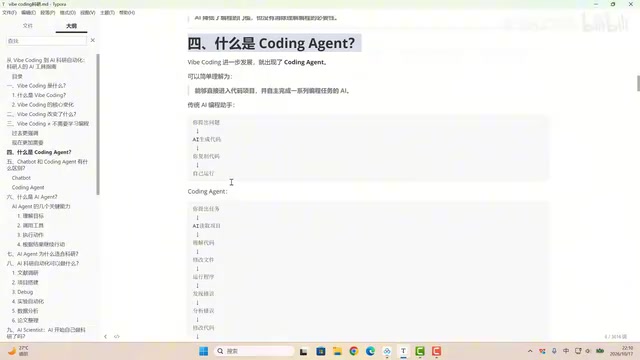
There's an easily overlooked distinction here: chatbots and Coding Agents are not the same thing. ChatGPT, Claude, DeepSeekAd and the like are chatbots — you ask, they answer; while Agent tools like Codex and Claude Code can take over your computer, analyze data, generate project code, and execute specific steps. In other words, chatbots give suggestions, Agents deliver results. This difference determines how far research automation can go.
The technical difference between Coding Agents and ordinary chatbots lies in tool use and execution environment. Chatbots can only output text; Agents are granted access to the local file system, terminal, browser, and APIs, and can iterate in a "perceive—plan—act—observe" loop: reading data files, running Python scripts, checking error messages, modifying code and re-running. The industry often calls this architecture ReAct (Reasoning + Acting) or the Plan-and-Execute pattern. Tools like Codex and Claude Code bind the reasoning capability of large models with sandboxed execution capability — that's why they can "deliver results" rather than just "give suggestions." Understanding this makes it clear why Agent reliability depends heavily on sandbox isolation, permission control, and traceable logs — these are also engineering prerequisites that must be considered when using Agents in research scenarios.
Why Agents Suit Research: Repetitive Work Is the Real Pain Point
The traditional research workflow is a long chain: posing questions, searching literature, setting direction, finding data, preprocessing, modeling and training, analyzing results, writing papers. The creator pointed out that many of these steps are repetitive — information retrieval, code writing, data preprocessing, repeated experiment runs. These are exactly what Agents are good at.
Specifically, the steps Agents can intervene in include: literature research and summarization, data analysis and training script construction, running complete experiments, generating result tables and comparison charts, and data organization and checking. Note that the positioning here is "assistance" rather than "replacement" — Agents take over repetitive work, freeing up researchers' time for judgment.

Multi-Agent Collaboration and Early Evidence of Research Automation
The video mentioned the idea of multi-agent division of labor: one Agent searches literature, one proposes hypotheses, one finds evidence, one runs experiments, jointly completing research tasks. This direction is not fantasy — the creator cited a study published in March as support (the original mentioned a "Later"-related article; for specific sources, refer to the materials in the creator's comment section).
At the tool level, a rough classification can be made: literature search tools, general conversation tools, dedicated Coding Agents (such as Codex and Claude Code), and research automation Agents. There's also the concept of "Skill" — feeding specific skills to an Agent so it can produce precise output for a particular domain.
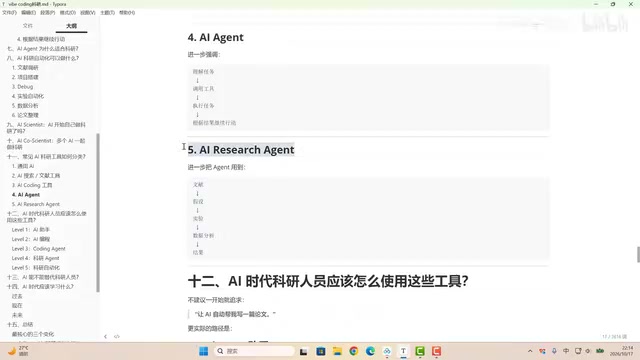
There are three common organizational approaches for multi-agent collaboration: pipeline-style (the output of one Agent becomes the input of the next, e.g., retrieval→hypothesis→experiment→writing), debate/review-style (multiple Agents propose solutions, then challenge each other and converge through voting), and planner-executor-style (an Orchestrator breaks down tasks and dispatches them to specialized Agents). The theoretical intuition behind such designs is that "role specialization reduces the context burden on any single point," but it also brings new problems: errors cascade and amplify across Agents, token costs multiply, and it becomes difficult to locate the point of failure. Therefore, multi-agent systems usually need to introduce verification Agents or human checkpoints. The so-called Skill can be understood as an encapsulated, reusable domain capability module (a combination of prompt templates, tool functions, and checklists) that lets Agents perform more stably on specific tasks without having to reason from scratch each time.
Prompts Are the New Research Infrastructure
The creator compiled a set of prompts for deep learning, covering building a project from scratch, data analysis, model training, optimization and hyperparameter tuning, paper reproduction, and writing. The core point is: reasonable prompts enable Agents to complete projects more thoroughly while saving tokens. This isn't mysticism — prompts are essentially about conveying research intent to Agents in a structured way; the clearer the intent, the less rework.

Effective prompt engineering in research scenarios typically includes several elements: clarifying role and goal (you are a research assistant helping to reproduce a paper), specifying input specifications and output format (require runnable scripts, specify directory structure, present comparison results in table form), setting constraints and acceptance criteria (must not use a certain dataset, must report random seeds and runtime environment), and step-by-step decomposition (propose a plan first, then write code, confirming at each step). This is highly isomorphic to "requirements specifications" in software engineering — writing good prompts is essentially translating vague research intent into executable, verifiable specifications. In addition, providing Agents with project-level context files (such as documents explaining experimental conventions, directory structure, and common commands) often saves more tokens than repeatedly explaining in a single conversation, and is more conducive to consistency across sessions.
Human-Machine Division of Labor: AI Does the Repetition, Humans Do the Judgment
One judgment in the video is very direct: AI cannot replace researchers. The division of labor logic is — AI is good at repetitive work (writing code, summarizing literature, simple data analysis), while humans are responsible for the irreplaceable parts: whether the research question is valuable, whether the innovation holds, how to design experiments, and most critically, judging whether the results AI provides are trustworthy.
This also answers "what to learn in the AI era": the focus shifts to using AI and Agent tools to solve problems, while retaining the ability to understand the output. From chatbots telling you "how to do it" to Agents helping you "get it done," the role has changed, but the power of judgment always remains in human hands.
Final Thoughts
The essence of this evolutionary line is the further separation of "execution" and "decision-making" in research work. Vibe Coding lowers the execution barrier, Agents take over the execution process, but problem definition, experimental design, and result verification remain the core work of researchers. The stronger the tools, the more valuable judgment becomes.
One-line Summary
AI programming evolves from Vibe Coding to Coding Agent to multi-agent research automation, with humans retaining the power of judgment.
Paragraph Summary
Drawing on a sharing session by Bilibili creator Qian Yun, the article traces the three-layer evolution of AI programming entering research: Vibe Coding turns writing code into stating requirements, lowering the programming barrier from "being able to write" to "being able to read"; Coding Agents differ from chatbots in that they can take over the computer, execute steps, and deliver results; multi-agent division of labor points toward automation of the research workflow. The article notes that Agents' entry points are precisely repetitive work such as literature retrieval, code writing, data preprocessing, and repeated experiment runs, while prompts become the new infrastructure for structuring research intent. But the core conclusion is clear: AI cannot replace researchers — whether a question is valuable, whether the innovation holds, how to design experiments, and whether results are trustworthy — these judgments still belong to humans. The stronger the tools, the more valuable judgment becomes.
Related articles

Why Does the Tesla Roadster Need to Fly? A Deep Dive into Musk's Wild Demo
Tesla's Roadster launch showed wall-climbing, upside-down driving, and flying stunts—but The Vergecast notes the demo car may lack a battery, the Rocket version is invite-only and not street-legal, and the website terms don't guarantee delivery. After nine years of delays, why does this car still need to exist?

AI Is Not a Replacement: Human-AI Collaboration Through the Lens of Factory Root Cause Analysis
Starting from factory root cause analysis, this article explains how AI accelerates evidence chain construction rather than replacing human experts, exploring the pragmatic implementation logic and business value of 'AI supporting people rather than replacing them.'

AI Agent Decision Auditing: Building an Evidence Chain in Regulated Workflows
Starting from a Reddit discussion, this article analyzes three core issues in AI agent decision auditing within regulated workflows: what fields audit records should contain, how to handle feedback latency for erroneous decisions, and how to continuously calibrate LLM judge consistency with human judgment.