From Vibe Coding to Spec Coding: A Practical Engineering Methodology for AI Full-Stack Development

How to evolve from chat-based AI coding to spec-driven engineering methodology for full-stack development.
This article analyzes the evolution from Vibe Coding to Spec Coding in AI-assisted development. It covers why chat-based programming fails at team scale, presents a business-first architecture selection strategy spanning frontend (React/Vue, Vite, Tailwind), backend (NestJS, FastAPI, Spring Boot), and DevOps (Docker), and demonstrates how layered feature implementation with AI agents creates an engineering closed loop that dramatically boosts individual productivity.
Why Vibe Coding Is No Longer Enough
In an era where AI programming tools are everywhere, many developers have fallen into a trap: having one prompt after another in conversation with AI, relying on chat to gradually generate code. This approach, known as Vibe Coding, is easy to pick up and feels great, but its ceiling is actually very low.
The original material for this article comes from a live AI full-stack development session on Bilibili. The instructor explicitly stated: Vibe Coding is only suitable for solo developers and open-source projects with very few contributors. Once you enter real team collaboration, this approach falls apart. The reason is simple—individual chat-based development lacks reusable methodology, domain model accumulation, and team-level skill assets.
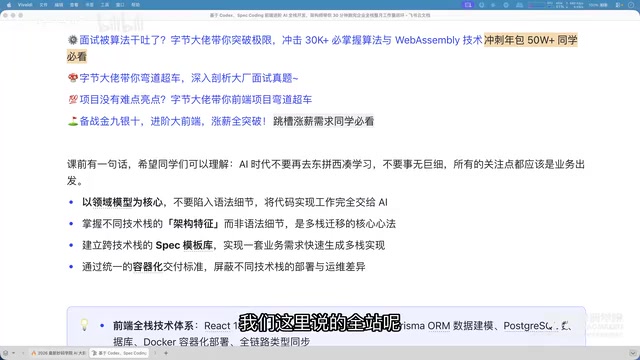
The instructor highlighted a concerning phenomenon: many developers are using AI blindly yet confidently, but when interviewing for senior positions and asked about AI work methodology (such as domain models, Spec systems, and team-accumulated Skills), they're often left speechless. This exposes the enormous gap between "knowing how to use AI" and "knowing how to do engineering with AI."
Spec Coding and the Engineering Evolution Trend
Industry methodologies are iterating rapidly. From the initial Vibe Coding, the progression moves to Spec Coding (specification-driven programming), then to Harness Engineering (scaffolding/constraint engineering), and even the recently trending Loop Engineering.
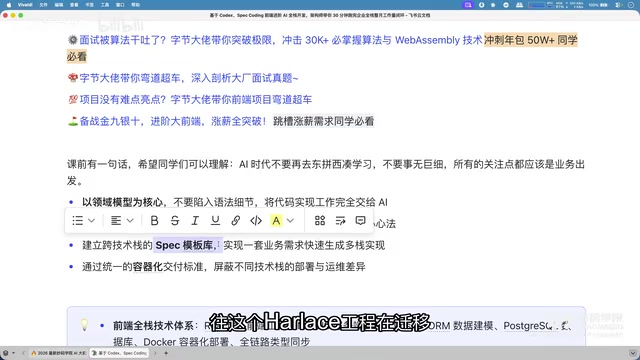
These concepts may seem overwhelming, but the instructor cut to the essence: The surface-level terminology keeps changing, but the underlying principles remain the same. The core idea is always—before letting AI generate code at scale, define the "specifications" clearly so AI works within explicit constraints and structure, rather than stumbling through trial and error in casual conversations.
This is especially important for job seekers. Mid-size companies, large enterprises, and technically strong startups increasingly value whether candidates possess systematic AI engineering capabilities, not just the ability to use a few Copilot completions.
The Core of Spec Coding: Starting from Business Requirements
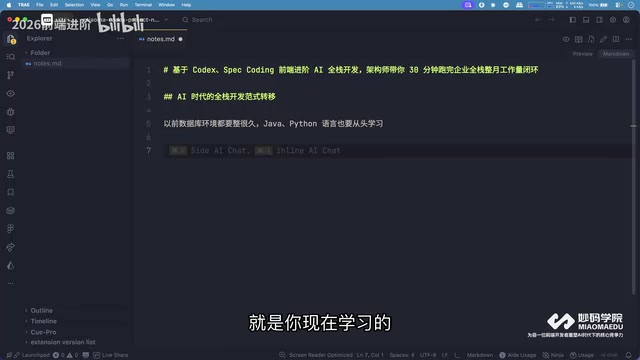
The instructor presented a key mindset shift. In the past, learning full-stack development meant getting stuck on environment configuration—setting up databases took forever, and learning Java or Python meant grinding through syntax from scratch. In the AI era, the correct path should be starting from business requirements and architecture, not from language details.
Taking a CRM system as an example, first outline the business features:
- User system: Login, registration
- Customer management
- Lead management
- Follow-up workflows
Break down the business first, then map it to technical implementation—this is the starting point of Spec Coding.
Technology Selection Strategy for Full-Stack Architecture
After identifying business requirements, the second step is architecture selection. The instructor emphasized: Regardless of what language you use, the most critical factor is the framework and ecosystem that language corresponds to.
The instructor provided a clear selection matrix:
Frontend Tech Stack
- Framework: React or Vue (pick one)
- Package manager: pnpm
- Styling system: Tailwind CSS
- Build tool: Vite
Backend Tech Stack
- Node.js option: Strongly recommended NestJS. The instructor explicitly stated that compared to frameworks like Express, NestJS's modular design is far more mature—other frameworks require extensive secondary encapsulation and systematic design.
- Python option: FastAPI for server-side
- Java option: Spring Boot for server-side
Database and Operations Layer
- Database operations: Unified database environment management through Docker / Docker Compose, completely solving the old pain point of "spending half a day just setting up the environment"
- ORM system: Prisma for Node.js, MyBatis for Java, with corresponding solutions for Python
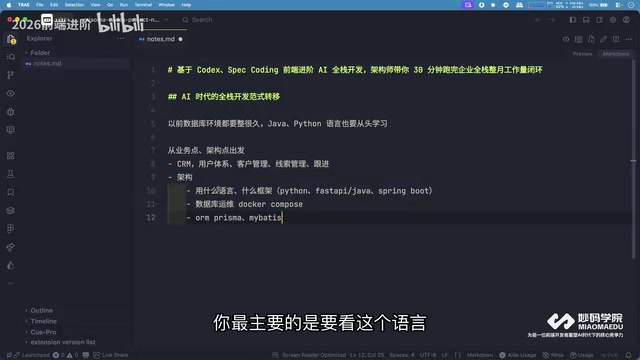
As you can see, the logic behind this selection follows a progressive structure of "business requirements → architecture selection → layered implementation." Language is just the carrier; what truly determines engineering quality is your grasp of frameworks and ecosystems.
Layered Implementation and AI Agent Closed Loop
Once architecture is defined, the implementation phase begins. The method here is completing work layer by layer per feature: first build the user system, then customer management, advancing feature by feature rather than having AI generate all code at once.
This layered progression approach is essentially putting Spec Coding into practice—each feature has clear specification boundaries, AI works within those boundaries, and humans are responsible for validation and integration.
In the live demonstration, the instructor used Codex + GPT-5 series models as primary tools, showing how to connect the three layers—frontend, backend, and AI agent development—into a complete closed loop. According to the instructor, an enterprise-grade admin system's full pipeline that previously took half a month to a month can theoretically be compressed dramatically under this methodology, achieving a complete closed loop in extremely short timeframes.
It should be noted that "completing team-level productivity in 30 minutes" is a somewhat idealized demonstration scenario. Real enterprise projects still need to account for complex business logic, edge cases, testing, and security. But the core insight is real: upgrading your methodology enables one person to achieve output approaching that of a small team.
Three Tips for Developers Advancing to Full-Stack
Drawing from this practical sharing session, here are three points worth remembering for developers looking to advance from frontend to full-stack, or to enhance their AI engineering capabilities:
-
Break out of the Vibe Coding comfort zone. Chat-based programming works for small projects, but team collaboration requires Spec Coding or even more advanced engineering approaches.
-
Establish the "Business → Architecture → Implementation" thinking chain. Don't get caught up in language syntax from the start—first think clearly about business features, then choose frameworks and ecosystems.
-
Build up your AI work methodology. Domain models, Spec systems, and team Skill accumulation—these are exactly what senior position interviews evaluate, and they represent the dividing line between "knowing how to use AI" and "knowing how to do engineering with AI."
AI hasn't made full-stack development easier—it has simply shifted the barrier from "syntax and environment" to "architectural thinking and methodology." True competitiveness is moving from writing code to defining specifications and designing constraints.
Related articles

Should U.S. College Fraternities Be Banned? A Researcher's Incisive Observations
Why not just ban U.S. college fraternities? A researcher finds the key resistance comes from decision-makers' own fraternity identities and schools' "willful ignorance."

Microsoft Discovery: Accelerating Scientific Discovery with AI Agents
Microsoft's Discovery platform runs specialized AI agents to help researchers screen and prioritize the most promising compounds and experimental paths, reducing experiments and accelerating scientific discovery.

Cambridge Heavy Industries Secretly Develops Desktop-Scale Nuclear Fusion Device
Cambridge Heavy Industries is secretly developing a desktop-scale laser-driven nuclear fusion device, targeting the equipment supply market for fusion power plants. This article analyzes its miniaturization technology path, commercialization logic, and unique positioning in the fusion startup wave.