From Zero to AI LLMs in Three Months: A Pragmatic Self-Study Roadmap

Three-month AI application entry path: prompts and APIs, then RAG, finally Agents — pragmatic, not algorithm research.
This article breaks down a pragmatic three-month path to AI application development. Core logic: "usable first, understanding later." Step one: master prompts and API calls to build model intuition. Step two: learn RAG and vector stores, where data cleaning matters more than tool selection. Step three: build an Agent and understand the ReAct loop. The endpoint is AI application development, not algorithm research — suitable for career changers, but doesn't cover training or fine-tuning. Ignore the marketing hype; the three-stage skeleton is the real value.
This tutorial series on Bilibili advertises "976 episodes, become a master in a week" — the title is designed to grab attention, but what's really worth examining is the learning path behind it: how a complete outsider can, in three months, reach the threshold of AI application development and even start getting interest from companies. Setting aside the marketing hype, the path itself is actually quite pragmatic — it doesn't ask you to grind through the mathematical derivations of Transformers, but focuses your energy on four areas that directly produce value: prompting, API calls, RAG, and Agents.

The Underlying Logic of the Three-Month Path: Usable First, Understanding Later
The smartest thing about this path is its order. Many beginners dive straight into papers and model architectures, only to give up two weeks later. The first step it requires is "get comfortable with prompts, be able to explain parameters clearly, and get APIs running on your own" — essentially building intuition about model behavior before understanding the model's internals. This "use the black box first" strategy is especially friendly to career changers, because the feedback loop is extremely short: change a prompt today, see the output change tomorrow.
According to the uploader, he followed exactly this rhythm, and three months later companies started reaching out to him about opportunities. Whether this timeframe holds for everyone depends on intensity of effort, but as a reference line, it at least shows that the entry barrier for AI application-layer work is indeed far lower than for traditional algorithm roles.
Step One: Prompts and APIs — Get the Tools in Your Hands

Prompt engineering is often mocked as having "no technical substance," but the original phrasing is accurate — the goal is to make it "not awkward." That means you can reliably get the model to output in a given format, handle multi-turn conversation context, know when to provide examples, and know when to tighten constraints. These abilities sound basic, but they're the foundation of every complex system that comes later. API calls are another hurdle: understanding token billing, streaming output, timeout and retry handling, and key management — these engineering details determine whether what you're building is a toy or something that actually runs.
This step doesn't require talent; it requires patience with repeated debugging. The original says "going slow is fine, just be steady" — that quote is worth sticking on your monitor.
Step Two: RAG and Vector Stores — Connect the Model to Your Data
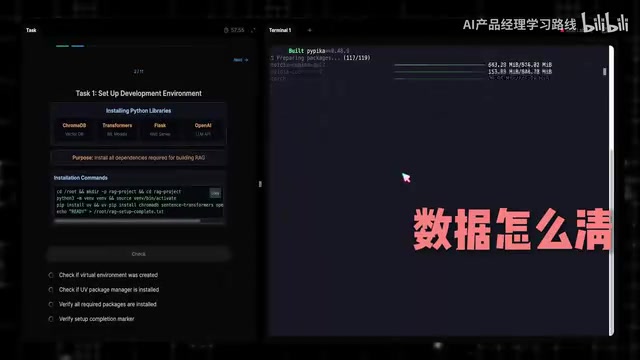
RAG (Retrieval-Augmented Generation) is currently the most heavily adopted direction for enterprise deployment, and the original is right to make it a major focus. But there's an easily overlooked detail in its framing: it discusses "how to clean the data" first, then "how to get comfortable with the vector store." This order reflects an industry consensus — RAG's performance bottleneck is often not the retrieval algorithm but data quality. Chunking strategies, metadata design, dirty data cleaning — these unglamorous chores determine how reliable the final answers are.
Choosing a vector store is actually less critical; mainstream solutions don't differ much at small-to-medium scale, and getting the pipeline of ingestion, retrieval, and reranking working end-to-end is more valuable than agonizing over selection. The original also mentions agents and knowledge graphs in passing — that's for broadening your horizons, no need to dig deep at this step.
RAG (Retrieval-Augmented Generation) is a technical paradigm that combines external knowledge bases with large language models. Its core process: documents are first chunked and converted into vectors stored in a vector database; when a user asks a question, the system retrieves the most relevant segments from the database, concatenates them into the prompt, and sends everything to the model to generate an answer. The benefit is that the model can answer questions about private data without retraining, and answers are traceable to sources. RAG's performance depends heavily on retrieval quality — if the retrieved segments are irrelevant, even the strongest model can't produce a correct answer. Therefore, data cleaning, chunking granularity, and metadata design often determine final performance more than swapping vector stores.
Step Three: Build an Agent Yourself — Understand the ReAct Loop
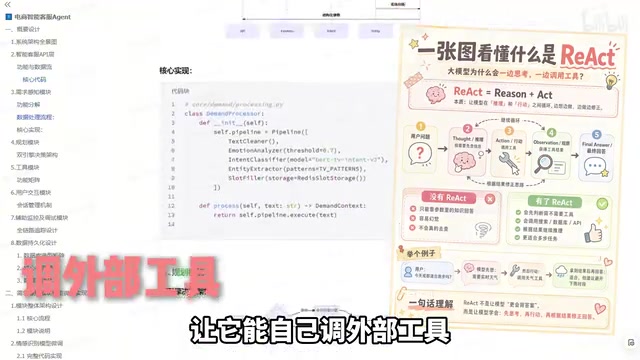
The final step is to build a small Agent that can call external tools on its own, and to understand how the ReAct "reasoning—action—observation" loop runs. This is the most valuable part of the entire path, because it ties together all the scattered abilities from before: prompts handle decision-making, APIs handle execution, and tool calls connect to the external world.
The original also mentions "trying multiple agents working together," which is an advanced direction. Multi-agent collaboration isn't yet mature in production environments, but as a learning project, it helps you understand concepts like task decomposition, role division, and message passing. After going through this full cycle, building a customer service bot or pitching a company on an AI implementation plan really isn't too difficult — because these two needs happen to be typical combinations of RAG plus Agents.
ReAct (Reasoning + Acting) is a prompting framework that has large language models alternate between reasoning and acting. In each loop iteration, the model first outputs a "thought" (e.g., "I need to check the weather"), then decides which external tool to call and with what parameters, then observes the tool's returned result, and continues the next round of reasoning based on that observation, until it reaches a final answer. This pattern enables the model to accomplish tasks it couldn't handle alone by leveraging external capabilities like search, calculators, and APIs. Understanding the ReAct loop is key to building Agents, because it reveals how the model translates natural language decisions into executable action sequences.
Multi-Agent Collaboration refers to having multiple Agents, each with specific roles and tool sets, work together to complete complex tasks. Common patterns include: a coordinator Agent responsible for decomposing tasks and dispatching them to specialized Agents (e.g., retrieval Agent, code execution Agent), with Agents sharing intermediate results through message passing. This architecture suits scenarios requiring multi-step, multi-domain knowledge, but also brings challenges like communication overhead, error propagation, and debugging difficulty. It's not yet mature in production environments, but as a learning project, it helps you deeply understand core distributed-system concepts like task decomposition, role division, and message passing.
Who This Path Is For — and Who It Isn't
The original sets a blunt threshold: under 47, mentally sharp, and not a three-minute-enthusiasm type. The first two are more like jokes; the last one is the real barrier. In a three-month self-study path, the highest dropout point is never technical difficulty — it's giving up halfway.
What you need to be clear-eyed about: the endpoint of this path is "AI application development," not "LLM algorithm engineer." It doesn't cover training, fine-tuning, or inference optimization, and it won't give you the ability to read papers and modify models. If your goal is application-layer implementation, improving your current work efficiency, or switching to an AI product-related role, this path has excellent cost-effectiveness; if you want to join a big tech company doing foundation model research, three months is far from enough — the math and systems fundamentals you'd need to build up are on another order of magnitude.
Also, phrases in the tutorial title like "zero to master in a week" and "job-ready upon completion" are typical traffic-bait language — don't take them seriously. The real value lies in the three stages it breaks out — prompts and APIs, RAG, Agents — and this skeleton holds up to scrutiny. Treat the schedule as a reference, the videos as supplementary, and run through each stage hands-on yourself — that's far more useful than bookmarking a pile of tutorials.
One-line Summary
A three-month AI application entry path: practice prompts and APIs first, then tackle RAG, finally build Agents — pragmatic, but not algorithm research.
Paragraph Summary
This article breaks down a pragmatic three-month path to getting started in AI application development. Its core logic is "usable first, understanding later": step one is getting proficient with prompts and API calls to build intuition about model behavior; step two is learning RAG and vector stores, emphasizing that data cleaning matters more than tool selection; step three is building an Agent yourself and understanding the ReAct loop, tying scattered abilities together. The article notes that this path's endpoint is AI application development, not algorithm research — suitable for career changers and efficiency seekers, but it doesn't cover model training or fine-tuning. The tutorial title's marketing hype shouldn't be taken seriously; the real value is the three-stage skeleton.
Related articles

Why Does the Tesla Roadster Need to Fly? A Deep Dive into Musk's Wild Demo
Tesla's Roadster launch showed wall-climbing, upside-down driving, and flying stunts—but The Vergecast notes the demo car may lack a battery, the Rocket version is invite-only and not street-legal, and the website terms don't guarantee delivery. After nine years of delays, why does this car still need to exist?

AI Is Not a Replacement: Human-AI Collaboration Through the Lens of Factory Root Cause Analysis
Starting from factory root cause analysis, this article explains how AI accelerates evidence chain construction rather than replacing human experts, exploring the pragmatic implementation logic and business value of 'AI supporting people rather than replacing them.'

AI Agent Decision Auditing: Building an Evidence Chain in Regulated Workflows
Starting from a Reddit discussion, this article analyzes three core issues in AI agent decision auditing within regulated workflows: what fields audit records should contain, how to handle feedback latency for erroneous decisions, and how to continuously calibrate LLM judge consistency with human judgment.