Frontend to AI Agent Development: Three Survival Paths After Pure Frontend Roles Disappear

Pure frontend roles are vanishing as AI coding leaps forward — here are three paths to pivot toward Agent + full-stack.
As models like Codex and Claude Code achieve qualitative leaps in code generation, "writing code" has rapidly shifted from high-value work to something largely automatable — directly threatening junior and mid-level frontend, backend, and QA roles. Employers are now replacing entire small engineering teams with one or two people who understand AI Agent development, driving a surge in "Agent + full-stack" demand. The article outlines three transition paths: becoming an AI Agent development engineer, pivoting to an FDE (Frontline Deployment Engineer) role, or leveraging end-to-end delivery skills for remote freelancing. The key takeaway: choosing the right direction matters more than choosing the right language, and continuous learning is the only reliable defense against career uncertainty.
Why Pure Frontend Roles Are Disappearing
If you've been submitting frontend resumes lately, you've probably noticed something unsettling: applications vanish into the void, and the rare interview you do land rarely goes anywhere. The problem usually isn't you — it's that the market itself has undergone a structural shift. Pure frontend roles are contracting fast, replaced by job descriptions featuring words like "AI," "full-stack," and "Agent."
According to a frontline architect who transitioned from frontend management into AI development, the real inflection point wasn't 2024. Tools like Cursor and GitHub Copilot were already popular by then, but they were mostly doing code completion — useful, but not threatening enough to fully replace human developers. The true disruption came with the next wave of model upgrades. After Codex and Claude Code's underlying models received major improvements, "writing code" rapidly fell from high-value work to low-value work.

Pure frontend and pure backend roles took the first hit. The day-to-day reality for many mid-level frontend developers is CRUD operations, building pages, and standard data manipulation — all wrapped in a familiar framework with plenty of copy-pasting in between. That's exactly the kind of work AI is best at replacing: faster and cheaper than any human. The author's conclusion: job listings for pure frontend work will gradually disappear, and we may soon reach a point where "frontend developer" barely appears as a standalone title in job postings.
Codex is OpenAI's large language model purpose-built for code generation — essentially a fine-tuned version of the GPT series for programming tasks and the engine behind early versions of GitHub Copilot. Claude Code is Anthropic's Claude model optimized for code understanding and generation, with strong long-context handling that lets it comprehend and modify large codebases without losing context. After their recent version upgrades, both can now generate complete multi-file project structures rather than just line-by-line completions. This leap in capability means AI has evolved from "assisting with code" to "leading code development" — dramatically compressing the core competitiveness of junior and mid-level developers who relied on familiarity and memory to handle routine coding tasks.
Why Employers Are All Hiring "Agent + Full-Stack"
The underlying logic behind this hiring market shift is simple math.

The author runs the numbers: a traditional engineering team of five or six people in a tier-one city, averaging 20K per person, adds up to well over 100K per month once social insurance and housing fund contributions are factored in. Even if today's employers don't fully understand what AI can do, what Agent development means, or what Web Coding entails, they have one straightforward intuition — hire one or two people who "know AI" and have them cover the workload that previously required four, five, or even six or seven people.
That's the core reason "Agent + full-stack" demand has surged. The author draws a parallel to the frontend-backend split of around 2015: back then, companies increasingly spun frontend into its own discipline, creating a wave of frontend-specific roles. Now the trend is reversing — roles are consolidating around Agent and full-stack positions.
In other words, the jobs haven't disappeared — they've changed shape. For developers with a bachelor's degree or above and a solid technical foundation, pivoting toward Agent + full-stack is, in the author's view, "the best investment you can make right now."
AI Agent refers to an AI system capable of autonomous planning, calling external tools, and executing multi-step tasks continuously — as opposed to a traditional chatbot that simply responds to one question at a time. In a development context, an Agent can independently break down requirements, call code execution environments, browsers, databases, or third-party APIs, and handle everything from requirement analysis to code generation, testing, and deployment without human intervention at each step. This is precisely why the core value of an "Agent development engineer" lies in designing and orchestrating that automated pipeline — not just writing code for one piece of it. This is fundamentally different from the traditional frontend role of "handling UI rendering," and it's the underlying reason employers are willing to replace an entire small engineering team with one or two people who understand Agent development.
Three Realistic Paths for Making the Transition
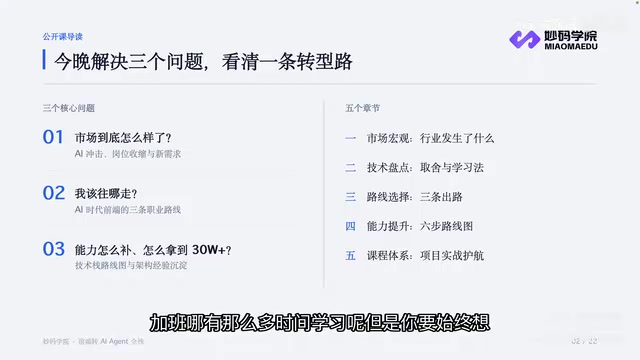
Faced with this shift, the author outlines three actionable paths suited to developers at different stages.
Path One: AI Agent Development Engineer
This is the most direct route into the job market. By combining AI capabilities, Agent development, and full-stack skills, you can lead end-to-end delivery across frontend, backend, and testing. The author emphasizes: stop aiming to become a "frontend expert" and instead position yourself as a "generalist Agent + broad frontend" hybrid.
Path Two: FDE (Frontline Deployment Engineer)
If you already have strong technical chops and some business experience, FDE-type roles are worth exploring. These positions lean toward working directly with clients and delivering solutions deep within specific business contexts. The bar for comprehensive skills is higher, but so is the ability to demonstrate the value of a senior developer.
Path Three: Remote Freelancing / Remote Work
For developers who want more autonomy, taking on independent contracts or remote work is entirely viable. Once you have end-to-end delivery capability, the possibility of independently managing projects increases substantially.
All three paths share a common prerequisite: you need to fill the gaps in AI, Agent, and full-stack skills. Without them, in today's hyper-competitive hiring environment — where employers pick and choose like shoppers at a market — landing a good offer will be an uphill battle.
FDE (Frontline Deployment Engineer) is a hybrid role that has emerged in enterprise services and SaaS industries in recent years — sometimes called a "Solutions Engineer" or "Delivery Engineer" in China. The core responsibility is working directly with clients to implement products or technical solutions in real business contexts. This typically requires a combination of coding ability (for custom development or integrations), business acumen (to translate client needs into technical solutions), and interpersonal skills (to bridge clients, product teams, and engineering). Compared to pure backend development roles, FDE positions are harder for AI to directly replace — because they involve non-standardized human judgment and context-specific adaptation. That said, the barrier to entry is higher, making this a better fit for experienced developers looking to expand horizontally rather than those just starting out.
Why Junior and Mid-Level Developers Get Hit First
The author traces several roots of the current tech inflection point — each worth reflecting on.

First, AI's ability to generate code at scale has changed qualitatively. What used to be simple completions can now produce full-project codebases.
Second, the loop from output to validation has become automated. AI doesn't just write — it also tests. The author notes that QA roles might seem like the lowest-cost pivot, but AI-driven testing can automate that work through scripts too, and the salaries aren't great to begin with. It's not a safe harbor.
Third, the barrier to entry for programming has always been relatively low. This means junior frontend, backend, QA, and ops roles are essentially collapsing all at once — the work they do is precisely what's easiest to standardize and automate.
This also explains why deep frontend knowledge and complex business challenges seem less "valuable" right now — not because they don't matter, but because the market has shifted its premium toward people who can integrate AI and connect the full delivery pipeline.
Continuous Learning Is Your Only Defense Against Uncertainty
The author puts it bluntly: when you work at a company, you're constantly in "output" mode. If you go long periods without any "input," the day you get let go, you'll realize too late that your skills haven't kept pace.
When the market is hot, companies scramble to hire and your gaps can stay hidden. When it cools down, whether you know AI, Agent development, or full-stack becomes a gauntlet of follow-up questions in every interview. Many developers spiral into energy anxiety and start questioning whether to stay in programming at all.
The author's view is that there's a massive information gap at play — the question isn't whether to learn, but what to learn, what to skip, and in what order. Given limited bandwidth, putting your time into the right direction matters far more than grinding blindly.
For developers torn between Java, Python, and Node.js, the author's advice is to first commit to the goal of transitioning into Agent + full-stack. The language is just a tool — the direction is what's decisive. Learning is an investment in yourself, and in times of uncertainty, continuous input is the only card you get to keep in your own hand.
A note of caution: the perspectives in this article come from a single frontline practitioner's experience. The market assessments reflect a personal viewpoint, and any career transition decisions should be evaluated rationally in the context of your own situation.
Related articles

Gemini 4 Argon Hands-On: AI Builds Board Games, Constructs Temples, and Trains Robots Autonomously
Gemini 4 Argon hands-on roundup: AI autonomously builds a desk racetrack and temple in Blender, writes a ray tracing engine, trains a humanoid robot to sink 7 shots, plus API pricing and developer access.

The Magic Octagonal Coin: Why Only 9% of People Can Predict Its Flip?
Only 9% of people can correctly predict the Magic Octagon coin flip. This article explains its spatial rotation mechanism, common cognitive pitfalls, and a new hypothesis based on Relevance Theory, exploring the limits of human spatial reasoning.

Sam Altman: AI Is Entering the Era of Scientific Discovery — Math Breakthroughs Will Replicate in Biology and Energy
Sam Altman says AI is entering the era of scientific discovery — math breakthroughs will replicate in biology, materials science, and energy to help develop new drugs and energy sources.