Frozen Models Can Still Transfer Reasoning: A Lightweight CoT Vector Projection Approach

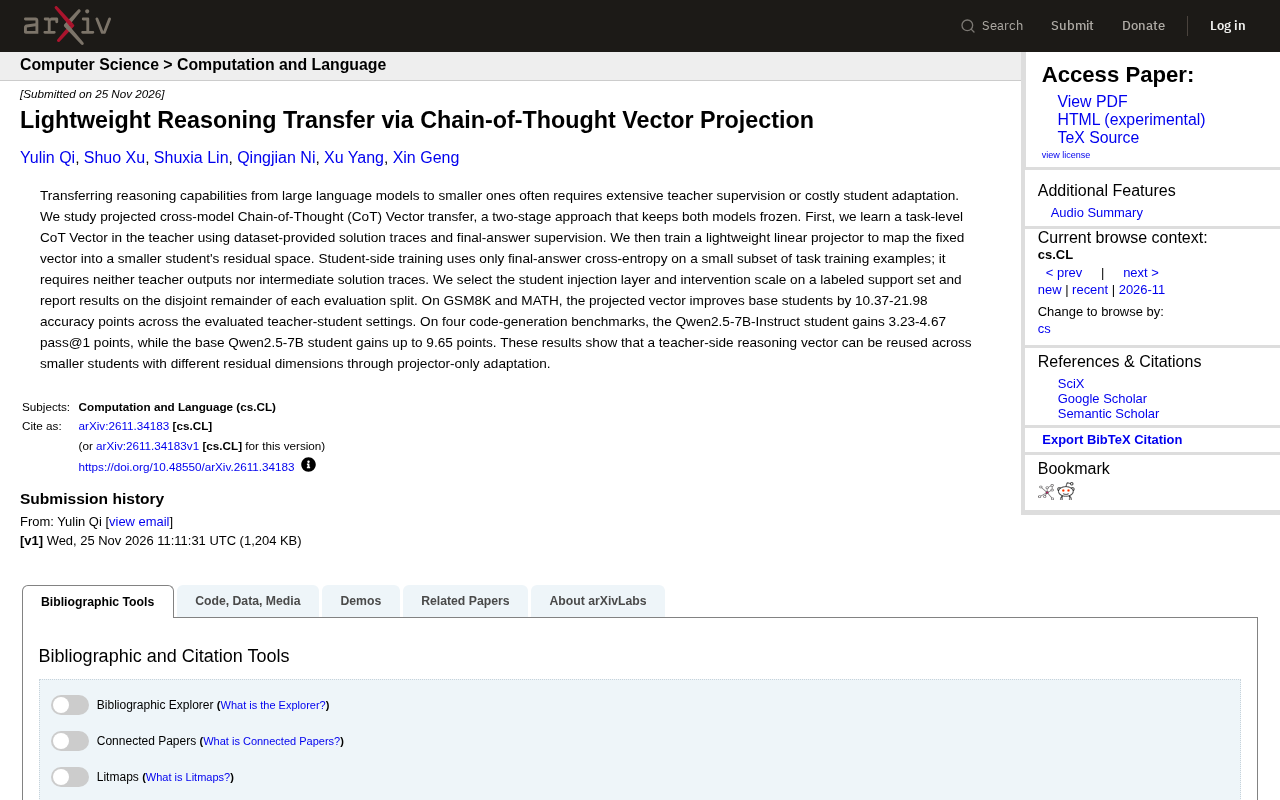
Frozen teacher and student models: a linear projector transfers teacher CoT vectors into the student's residual space for lightweight reasoning transfer.
This study proposes a lightweight cross-model reasoning transfer method: both teacher and student models are frozen; a task-level CoT vector is learned on the teacher side, and a linear projector maps it into a smaller student's residual space. Student training uses only final-answer cross-entropy. On GSM8K and MATH, base student accuracy improves by 10.37–21.98 points; on four code generation benchmarks, the instruct model gains 3.23–4.67 pass@1 points, and the base model up to 9.65. Injection layer and intervention scale are selected on a support set, with evaluation on held-out data. This offers a low-cost path for resource-limited settings, though task-level vectors and hyperparameter tuning remain limitations.
Capability transfer from large models to small models typically relies on massive teacher supervision or expensive student-side fine-tuning. A recent study proposes a lighter approach: keep both teacher and student models frozen, and use only a linear projector to map the teacher-side Chain-of-Thought (CoT) vectors into the student's residual space. On GSM8K, MATH, and multiple code generation benchmarks, this method delivers consistent accuracy improvements.
Two-Stage Pipeline: First Learn the Teacher Vector, Then Train the Projector
The method consists of two stages. In the first stage, a task-level CoT vector is learned on the teacher model. The training signal comes from the solution traces and final-answer supervision provided by the dataset; the vector itself is then fixed, and the teacher model is no longer modified.
In the second stage, a lightweight linear projector is trained to map the fixed teacher vector into the residual space of a smaller student. Student-side training uses only the final-answer cross-entropy on a small subset of the task training samples—neither the teacher model's outputs nor the intermediate solution steps are required.
This design compresses "reasoning capability" into a reusable vector, with the transfer cost falling mainly on the projector. Compared to having the student model adapt to the teacher's reasoning format from scratch, it avoids the overhead of large-scale sample generation and long-sequence distillation.
Chain-of-Thought (CoT) vector refers to a fixed-dimensional representation obtained by encoding a chain-of-thought reasoning process inside the teacher model. Unlike directly generating CoT as text, the CoT vector compresses the reasoning trace into a dense vector, making it easy to transfer and reuse across models. The residual space refers to the representation space formed by adding the output of each sublayer (e.g., attention layer, feed-forward layer) to its input in the Transformer architecture; the student model's layer activations all reside in this space. The role of the projector is to learn a linear transformation that maps the teacher-side CoT vector into the residual stream of a certain student layer, thereby injecting the reasoning direction without modifying model parameters.
Injection Layer and Intervention Strength Selected on a Support Set
Beyond the projector, there are two key design choices: the student injection layer and the intervention scale. The researchers select these two hyperparameters on a labeled support set, then report results on the remaining non-overlapping data of each evaluation split.
This detail is worth noting—the injection layer determines which layer the teacher's reasoning direction affects in the student, while the intervention scale controls the strength of that influence. Both are chosen on the support set, and the evaluation data is separated from the selection process, avoiding the appearance of tuning on the test set and making the results more comparable.
Mathematical Reasoning: Accuracy Gains of 10 to 22 Points
On the two mathematical reasoning benchmarks GSM8K and MATH, the projected vectors improve the base student model's accuracy by 10.37 to 21.98 percentage points, across multiple teacher–student combinations.
This means that even when the student's residual dimension differs from the teacher's, the teacher-side reasoning vector can still be reused through the projector. The paper explicitly states that these results demonstrate that teacher-side reasoning vectors can be reused across different smaller students with projector-only adaptation.
Code Generation: Both Instruct and Base Models Benefit
On four code generation benchmarks, the Qwen2.5-7B-Instruct student gains 3.23 to 4.67 pass@1 points, while the base Qwen2.5-7B student gains up to 9.65 points.
The difference in gains between instruct and base models suggests that the effectiveness of projection-based transfer may be related to the student's initial alignment state. The base model starts from a lower baseline and has more room for improvement, but the instruct model also achieves consistent gains, indicating that the method is not effective only for one type of student.
Boundaries and Implications of Lightweight Transfer
The core value of this work lies in reducing cross-model reasoning transfer to two steps—"vector learning + linear projection"—while keeping both teacher and student models frozen throughout. It does not rely on teacher outputs or the student's intermediate solution traces; the only training signal is the final answer.
Its limitations are also evident: a task-level vector means one vector per task, and cross-task generalization is not discussed in the paper; although the projector is lightweight, the injection layer and intervention scale still require support-set tuning. For scenarios with limited resources where one wants a small model to acquire task-specific reasoning capability, this offers a noteworthy low-cost path.
One-line Summary
Keep teacher and student models frozen, and use only a linear projector to transfer teacher CoT vectors into the student's residual space, achieving lightweight reasoning capability transfer.
Paragraph Summary
This study proposes a lightweight cross-model reasoning transfer method: both teacher and student models remain frozen throughout; a task-level Chain-of-Thought (CoT) vector is first learned on the teacher side, then a linear projector is trained to map it into the residual space of a smaller student. Student-side training uses only final-answer cross-entropy, requiring neither teacher outputs nor intermediate solution steps. On GSM8K and MATH, base student accuracy improves by 10.37 to 21.98 percentage points; on four code generation benchmarks, the instruct model gains 3.23 to 4.67 pass@1 points, and the base model gains up to 9.65 points. The injection layer and intervention scale are selected on a support set, with evaluation performed on the remaining non-overlapping data. This method provides a low-cost transfer path for resource-constrained scenarios, though task-level vectors and hyperparameter tuning remain limitations.
Related articles

Nothing CMF Buds 2A Drops to $17.89 on Black Friday: A New Low for ANC Earbuds
Nothing CMF Buds 2A wireless earbuds Black Friday deal: just $17.89 on Amazon, about $11 off retail and a record low. ANC earbuds at an entry-level price.

When AI Creation Gets Accused of "Spitting": Hacker News Heats Up Over the Glaude Controversy
A Hacker News post, "Spitting in the Face of Glaude," sparks debate on AI creation transparency and attribution ethics. This analysis examines the blurred creator identity behind the controversy and offers practical advice for AI content production.

Akai Embraces Custom Firmware: MPC Sample 1.4 Lets Users AI-Program Their Sampler
Akai embraces the modding community with MPC Sample 1.4 firmware, supporting vibe-coded custom firmware and effects. We analyze the impact of this open strategy on music hardware and AI-assisted programming.