FTC Investigates OpenAI and Anthropic: AI Product Risks Enter the Regulatory Spotlight

The FTC has formally opened investigations into OpenAI and Anthropic, bringing generative AI into the mainstream regulatory spotlight.
The U.S. FTC has launched investigations into leading AI companies including OpenAI and Anthropic, focusing on potential consumer risks from AI products — spanning misinformation, data privacy, and market competition. By targeting industry leaders first, the FTC signals that AI's era of unchecked growth may be ending. Companies face near-term compliance costs, while the long-term result could be industry-wide safety standards that shift AI development toward balancing capability with safety.
FTC Launches Investigation Into Major AI Companies
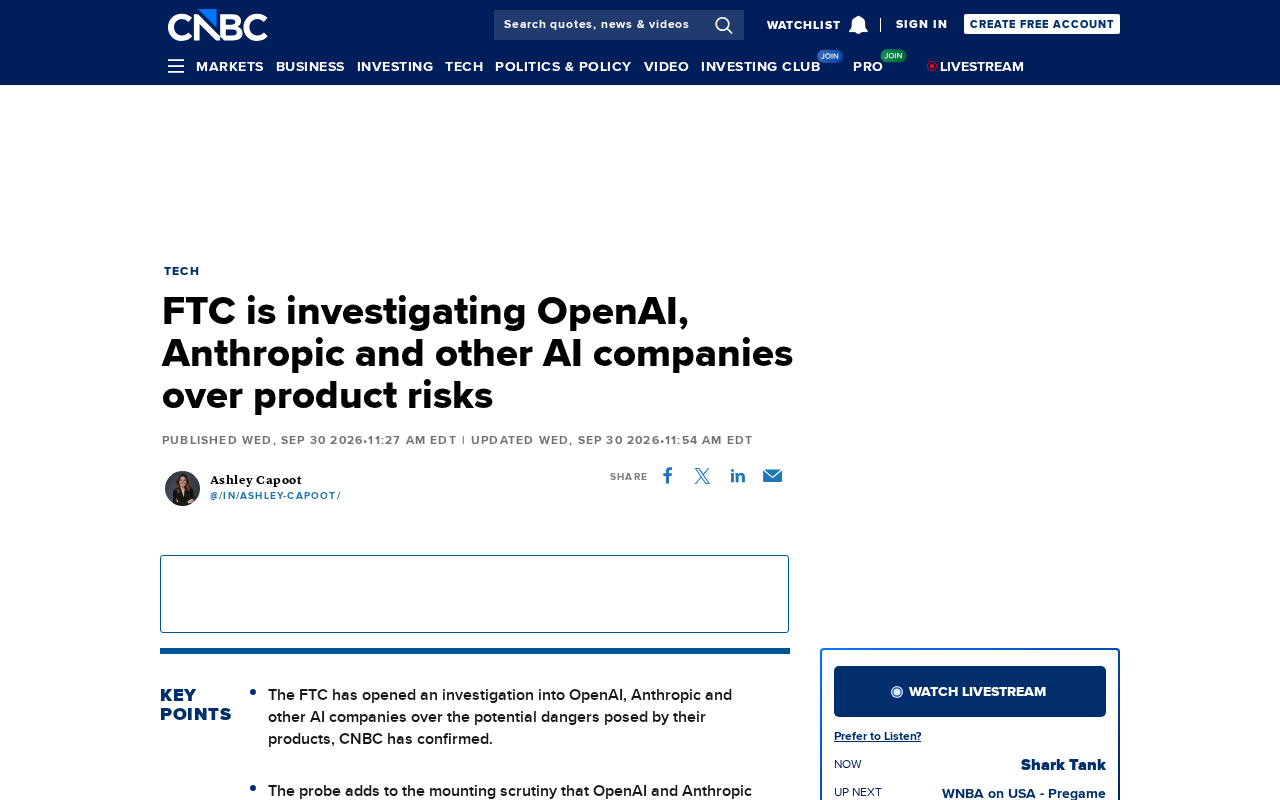
The U.S. Federal Trade Commission (FTC) has officially opened investigations into leading AI companies including OpenAI and Anthropic, with a primary focus on potential risks posed by their AI products. According to CNBC, this move marks a new phase in regulatory scrutiny of the generative AI industry.
The AI industry has expanded at a breathtaking pace, with frequent product iterations and continuously expanding capabilities. Regulatory timelines have consistently lagged behind technological development — and that gap is precisely what the FTC is now stepping in to address. The story sparked lively debate on Hacker News, accumulating 198 upvotes and 144 comments, reflecting the tech community's intense interest in AI governance.
The FTC is an independent federal agency established in 1914, responsible for consumer protection and maintaining fair market competition. Its enforcement powers include investigating unfair or deceptive business practices, reviewing and blocking anti-competitive mergers, and filing lawsuits against violating companies. In the tech sector, the FTC has in recent years launched investigations or legal actions against major platforms like Facebook (Meta) and Amazon, emerging as one of the most active federal agencies in technology regulation. Extending its reach to generative AI is consistent with the approach taken under FTC Chair Lina Khan, who has consistently pushed for stronger oversight of emerging tech platforms. It's worth noting that the FTC's jurisdiction differs from that of the Department of Justice (DOJ) antitrust division — the FTC focuses more on consumer protection, while the DOJ targets structural monopolies. The two agencies sometimes apply simultaneous pressure to the same industry.
What Product Risks Are Under the Microscope
While official disclosures remain limited, the FTC's mandate as a consumer protection and market competition regulator points to several likely areas of focus: potential harm or deception to consumers from AI products, data usage and privacy compliance, and the fairness of market competition.
The risks associated with generative AI products are multidimensional. On the content side, these include generating misinformation, harmful material, or negatively influencing vulnerable user groups through conversational interactions. On the commercial side, concerns include overstating product capabilities, opaque training data sources, and the growing market concentration driven by the capital and compute advantages held by a handful of dominant players.
The FTC's decision to simultaneously investigate both OpenAI and Anthropic — two of the most representative companies in the space — signals that regulators are not targeting isolated incidents at individual companies, but rather examining systemic risks across the entire large language model product category.
Generative AI refers specifically to AI systems capable of producing text, images, code, audio, and video based on input prompts, with large language models (LLMs) as the core underlying technology. Unlike the discriminative tasks of traditional AI, generative AI outputs are highly open-ended and unpredictable, making risk assessment far more complex than for conventional software products. Regulators face a significant challenge: training data, model weights, and inference processes are largely opaque to outside reviewers, and existing product liability legal frameworks are ill-suited to address harms caused by AI-generated content. The EU's AI Act designates high-risk AI applications as a primary regulatory target, while the U.S. currently lacks equivalent federal legislation. The FTC's investigation thus partially fills that federal-level institutional gap.
The Tension Between Regulation and Innovation
AI regulation has always faced a core tension: how to manage risk without stifling innovation. Over-regulation can slow technological progress, increase compliance costs, and make it harder for smaller companies to survive. But leaving the industry unchecked risks allowing product harms to accumulate to an unmanageable degree.
At its core, the FTC's action represents regulators trying to find a balance between these two extremes. Notably, the investigation targets industry leaders — companies that have the resources to handle compliance demands, and whose product scale means the potential impact of any risks is greatest. Starting regulation at the top is both a pragmatic choice and a clear signal: the era of unchecked growth in AI may be drawing to a close.
The reaction from the Hacker News community has been mixed. Some see regulatory intervention as an inevitable sign of industry maturation, while others worry that government investigations could devolve into political theater, or that policymakers may lack the technical understanding needed to engage meaningfully with the issues at hand.
Potential Impact on the Industry
For the companies under investigation — OpenAI, Anthropic, and others — the near-term reality means dedicating more resources to regulatory compliance, including providing product safety data, documentation of data provenance, and records of internal governance processes. Over the longer term, investigations of this kind could give rise to industry-wide compliance standards and push companies to conduct more thorough safety assessments before launching products.
For the broader AI ecosystem, regulatory signals will shape investor expectations and product strategy. Startups may need to think about compliance much earlier, rather than scrambling to catch up after they've scaled. This could shift the pace of AI product development — away from a pure race for capability leadership, toward a model where capability and safety are treated as equally important.
It's important to note that an investigation is not the same as a finding of wrongdoing. The FTC's intervention is the beginning of a process. Whether it ultimately results in meaningful penalties or a new regulatory framework remains to be seen. But one thing is clear: AI product risks have officially entered the agenda of mainstream regulatory bodies — and that trend is unlikely to reverse anytime soon.
Related articles

Reinforcement Learning Takes On Getting Over It: Distributed Training Strategies Behind 63% Progress
A developer uses deep reinforcement learning to tackle Getting Over It. The agent climbs from the bottom to 63% progress but gets stuck at the anvil. The project is open-sourced, using divide-and-conquer training and CPU-only training, seeking community collaboration to break the bottleneck.

Sigma FP2 Released: The World's Smallest Full-Frame Camera Gets Sensor and Screen Upgrades
Sigma launches the FP2 full-frame camera, retaining its smallest-and-lightest design with three key upgrades: improved sensor, articulating LCD screen, and longer battery life—built for portable video creators.

AAAI 2027 Phase 2 Decisions Imminent: Community Debates Review Fairness and Submission Ecosystem
AAAI 2027 phase 2 review results are imminent, with the Reddit community debating reviewer consistency and process transparency. This article examines pre-decision sentiment, structural tensions in top conference review, and practical strategies for authors.