Fujifilm Instax Pal 2 Mini Camera: A Meaningful Upgrade That Finally Adds a Screen

Fujifilm's Instax Pal 2 adds a screen and viewfinder, fixing the original's blind-shooting problem.
Fujifilm has launched the Instax Pal 2 as a direct follow-up to the original Instax Pal, addressing its most criticized flaw — the absence of a screen and viewfinder that left users shooting blind. The new model adds both, while also shifting from the original's rounded toy-like shape to a more traditional miniaturized camera form factor. The Instax Pal series uses a split design pairing digital capture with wireless printing to a companion device, targeting young consumers who value portability and the ritual of physical instant prints. Specific details on sensor specs, pricing, and bundling options are yet to be officially confirmed.
Fujifilm has officially unveiled the Instax Pal 2, the successor to its quirky and compact Instax Pal camera. Compared to the original model's numerous compromises from three years ago, the new release brings targeted improvements in both design and functionality — and it's shaping up to be a much more genuine miniature digital camera.
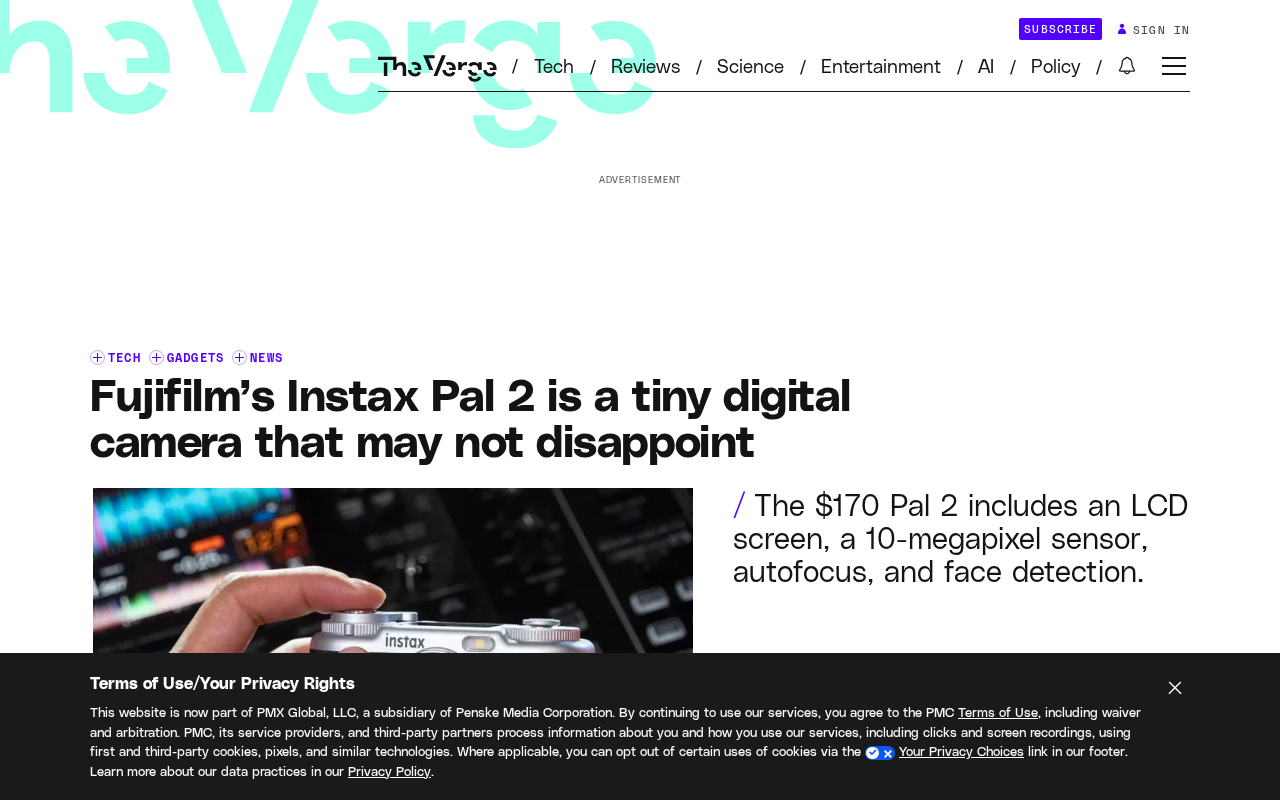
From the Original to the Pal 2: Fixing the Core Weakness
The original Instax Pal launched three years ago as a palm-sized camera bundled with a portable instant printer. It featured a distinctive rounded design, but came with one glaring usability problem: no screen and no viewfinder. That meant users were essentially shooting blind, unable to properly frame their shots and left relying on feel and luck when composing an image.
This design choice gave the original Pal more of a toy-camera personality — something fun and carefree rather than a serious shooting tool. Its positioning was clear: capture life's moments in the smallest possible package, then instantly print them out in a Polaroid-style format via a companion printer. But the inability to actually see what you're shooting was always the hard ceiling on the overall experience.
Instax is Fujifilm's instant imaging product line, with its core appeal being the ability to produce physical prints within seconds to minutes of taking a shot — no phone or computer required. The original Instax Pal had a somewhat unique role within that lineup: it was a digital camera that didn't include built-in printing. Instead, it connected via Bluetooth to companion printers like the Instax Mini Link, wirelessly transferring photos to be printed as small instant-format images. This split "digital capture + wireless printing" approach allowed the camera body to be extremely compact, but it also meant users needed to carry two separate devices to enjoy the full instant photography experience.
Pal 2's Design and Upgrade Direction
The most significant change in the Instax Pal 2 is the addition of both a screen and a viewfinder. This directly addresses the most criticized aspect of the original, finally letting users confirm their frame before pressing the shutter — improving compositional accuracy and the overall hit rate of usable shots.
Visually, the new model adopts what could be described as a "miniaturized" design language, with an overall form that resembles a tiny traditional camera rather than the original's round, toy-like shape. This shift suggests Fujifilm wants the Pal 2 to lean more toward practicality while still retaining its portable, playful character.
For fans of the Instax instant imaging ecosystem, the addition of a screen and viewfinder represents a genuinely meaningful improvement in experience — it reduces the guesswork involved in shooting and makes this little camera not just fun, but actually useful.
Who Actually Needs a Camera Like This?
In an era where smartphone photography can handle almost anything, products like the Instax Pal 2 derive their value primarily from differentiated experiences. The appeal isn't about pushing image quality to its limits — it's about the convenience of having something truly pocketable, the unique joy of a dedicated shooting device, and the ritual of holding a physical print in your hands moments after the shot.
With the screen and viewfinder now on board, the Pal 2 patches the core interaction flaw of its predecessor, evolving from a "hope for the best" novelty gadget into a mini camera capable of consistently delivering satisfying results. For young, style-conscious users who love sharing instant prints, or for anyone looking for an ultra-light backup camera for specific situations, this upgrade direction has genuine appeal.
It's worth noting that publicly available details are still limited — specifics around the Pal 2's sensor specs, pricing, and whether it will continue to be bundled with a printer have yet to be disclosed by Fujifilm. But based on the single key improvement of adding a screen and viewfinder alone, it's already a more compelling proposition than the original.
Instant cameras have seen a sustained resurgence among younger consumers in recent years, closely tied to the broader revival of film photography. Compared to pure film cameras, instant imaging products like the Instax lineup have a much lower barrier to entry — no darkroom developing required, and prints are available right at the scene, combining the ritual feel of physical photos with genuine convenience. The Fujifilm Instax lineup currently spans multiple product tiers from entry-level to creative, and digitally-enabled devices like the Pal series push the value proposition further by reducing wasted shots: users can review and select digital images before deciding what to print, avoiding the economic pressure of consuming a physical sheet of film with every single press of the shutter.
Related articles
19.8MB LLM: How a 44M-Parameter Model Achieves 1900 tok/s on CPU
SHADOW-50M is a 44M-parameter, 19.8MB LLM trained from scratch using ternary weights and frozen fingerprint embeddings, achieving ~1900 tok/s on CPU with just 41MB of RAM.

Another Google AI Safety Researcher Quits, Warning 'We Might All Die'
Another Google AI safety researcher quits, warning of human extinction risks. We examine the structural tensions, existential risk debates, and governance challenges behind these recurring departures.

Let AI Audit Its Own Docs: An Open-Source Toolkit for Verifying CLAUDE.md Accuracy
Nir Diamant open-sourced a toolkit to verify which claims in CLAUDE.md and project docs are guesses or contradicted by code — using confidence labels and reverse code verification.