Full-Stack Development for Beginners in the AI Era: Don't Write Code — Learn to Manage It

In the AI era, anyone can build products by directing AI with full-stack thinking rather than writing code.
This article explores a new path for non-technical people to build products in the AI era, centered around a zero-to-full-stack development course. Full-stack development encompasses frontend, backend, and operations, but AI-era full-stack capability no longer requires mastering each technology — it requires "orchestration ability" to understand how each stack works and use AI tools to combine them into products. AI has dramatically lowered the programming skill barrier, enabling people with conceptual knowledge to drive code production.
In the AI Era, Anyone Can Build Products
AI coding tools are emerging one after another — Codex, Claude Code, Trae, Kimi, GLM — making code generation easier than ever before. Behind these tools lies code generation technology powered by Large Language Models (LLMs): they learn to understand natural language descriptions and transform them into executable code by pre-training on massive open-source code repositories (such as billions of lines of code on GitHub). OpenAI's Codex was an early pioneer of this wave, while Anthropic's Claude Code, ByteDance's Trae, Moonshot AI's Kimi, and Zhipu AI's GLM represent the rapid expansion of this space both domestically and internationally. It seems that even without a technical background, we can build our own applications with the help of AI. But after actually getting started, many people discover: the pitfalls are far more numerous than imagined.
Bilibili creator Jericho received a flood of development questions from zero-experience users after publishing a WeChat Mini Program tutorial, which sparked the idea of creating a "From Zero to Full-Stack Development" course series. The core philosophy of this series is crystal clear: it doesn't teach you to write code — it teaches you how to use AI to manage code and ultimately build truly usable products.
This positioning itself is quite fascinating — it redefines what "full-stack development" means in the AI era.
What Is Full-Stack Development? Breaking Down Frontend, Backend, and DevOps
The "stack" in "full-stack" refers to the Technology Stack. This concept originates from software engineering practice, describing the combination of technologies, frameworks, and tools required to build a complete application. The "stack" metaphor is quite apt — different layers of technology are stacked like building blocks, with each layer depending on the capabilities provided by the layer beneath it. A complete application product consists of at least three core parts: frontend, backend, and operations.
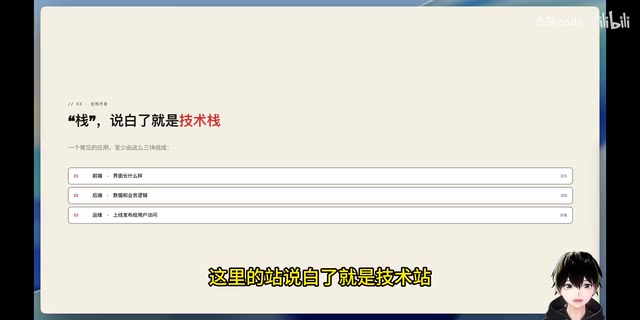
Frontend: Everything the User Sees
The frontend is what users directly see — webpage layouts, mobile app interfaces, button styles, and interactive animations all fall within the frontend technology stack. Simply put, the frontend is responsible for "presentation."
On the technical implementation level, the core trio of frontend development is HTML (defining page structure), CSS (controlling visual styling), and JavaScript (implementing interaction logic). Built on this foundation, engineers have developed modern frontend frameworks like React, Vue, and Angular, dramatically improving development efficiency for complex interfaces. For mobile, there's Swift/SwiftUI for iOS, Kotlin for Android, and cross-platform solutions like React Native and Flutter. WeChat Mini Programs represent a relatively closed frontend ecosystem using WeChat's custom WXML and WXSS syntax, though the underlying logic shares the same lineage as web frontend development.
Backend: The Processing Hub for Data and Logic
If the frontend handles how pages are presented, the backend handles how data and business logic are processed. Here's an intuitive example: when you hit "triple combo" (like, coin, and favorite) on a Bilibili video, after that action is triggered — how the like count updates, how the coin record is written, how the favorites list syncs — this entire processing logic belongs to the backend technology stack.
Core backend components typically include: server-side programming languages (Python, Java, Node.js, Go, etc.), web frameworks (Django, Spring Boot, Express, etc.), and database systems. Databases split into two major camps: relational databases represented by MySQL and PostgreSQL, which organize data in tables with rows and columns and excel at handling structured business data; and non-relational databases (NoSQL) represented by MongoDB and Redis, which have advantages in handling massive unstructured data or scenarios requiring extremely high read/write speeds. Communication between frontend and backend is typically accomplished through APIs (Application Programming Interfaces) — the frontend sends requests, the backend returns data, both sides agree on the data format (usually JSON), and each operates independently.
Operations: Making the Application Actually Run
Once an application is developed, it can't just run on your own computer. How do you deploy it to a server? How do you make it accessible to users worldwide at any time? How do you ensure the service stays stable without going down? This entire domain of work is called operations (DevOps).
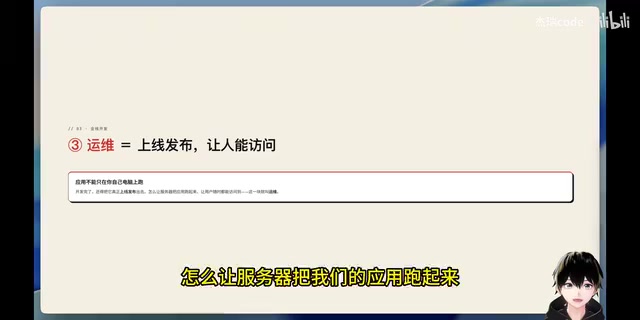
Modern operations has evolved from traditional manual server management to the new paradigms of "DevOps" and "cloud-native." Cloud computing platforms (AWS, Alibaba Cloud, Tencent Cloud, etc.) allow developers to rent computing resources on demand without purchasing physical servers; Docker container technology solves the classic problem of "it works on my machine but throws errors on the server" by packaging the application together with its runtime environment, achieving environmental consistency; Kubernetes further solves the orchestration and management of containers at scale. For individual developers and small teams, next-generation deployment platforms like Vercel, Railway, and Render have dramatically lowered the operations barrier — often you just need to connect your code repository, click a few buttons, and the application automatically goes live.
So-called "full-stack development" essentially means one person can handle all three things: frontend, backend, and operations.
Redefining Full-Stack: From "Writing Code Yourself" to "Directing AI"
At this point, many beginners might already be feeling anxious: each of these three technology stacks is a vast knowledge system — without even the basics, how could anyone possibly master them all?
Don't panic. The "full-stack" in this course series doesn't require you to master every technology in depth. Instead, it asks you to understand three things:
- What each one does
- How they work together
- How to combine them into a final product

In other words, full-stack capability in the AI era is more like a kind of "orchestration ability" — you don't necessarily need to write every line of code yourself, but you need to be able to direct AI to piece together various technology stacks and ultimately build a product that users actually need.
I strongly agree with this perspective. Code itself doesn't directly produce value — value always comes from the final product. Between code and product, there's a massive amount of non-programming work: requirements analysis, architecture design, technology selection, deployment, user feedback iteration... If you don't have an engineering background, there's a chasm in between — you simply don't know how to manage all this code.
Is It Too Late to Learn Development Now? Quite the Opposite
An unavoidable question: as AI gets better and better at writing code, are programmers going to be replaced? Is learning software development now like "joining the losing side at the last minute"?
Jericho offers an excellent analogy: Self-driving technology keeps getting stronger. If you've always positioned yourself as a driver, of course you'll feel anxious. But if you stand from a business owner's perspective, you should actually be excited.

There's a key distinction here: knowledge and skills are two different things.
- Knowledge can be acquired quickly: What is frontend, what is backend, how to call APIs, how to design databases — these conceptual things can be grasped within a few days.
- Skills require time to hone: Actually debugging code, tracking down bugs, optimizing performance — these need to be gradually accumulated through practice.
This distinction has deep theoretical foundations in cognitive science. Psychologists divide knowledge into "Declarative Knowledge" (knowing what something is) and "Procedural Knowledge" (knowing how to do something). The former can be quickly acquired through reading and listening, while the latter must be internalized through extensive repeated practice — this is why you can understand a swimming tutorial perfectly but still choke on water when you jump in. Programming skills are highly dependent on procedural knowledge, which is the fundamental reason traditional learning paths are so long. The revolutionary significance of AI coding tools is: they "outsource" to models a large amount of coding work that previously required procedural knowledge, enabling ordinary people with declarative knowledge to drive code production.
The biggest change the AI era brings is: the skill barrier has been dramatically lowered. Previously, you needed years of programming skill practice before you could build products. Now, as long as you build up the knowledge and understand how the entire technical system operates, you can develop with the help of AI tools.
It's precisely because of the AI era's arrival that ordinary people have, for the first time, a genuine opportunity to build their own products from scratch.
The Value and Insights of the Zero-to-Full-Stack Series
From a curriculum design perspective, this series has identified a very precise pain point: AI programming tutorials on the market either teach you to use a specific tool (Cursor, Copilot, etc.) or teach you to write code in a specific language, but very few systematically teach zero-experience users "how to manage code and how to turn code into products."
It's worth noting that there are structural reasons behind this pain point. Traditional programming education systems are designed to train professional engineers, naturally emphasizing skill depth over knowledge breadth; meanwhile, AI tool tutorials often focus on single-feature demonstrations, lacking systematic product thinking frameworks. Between the two exists an enormous blank space — precisely the content most needed by those who "want to build products but don't want to become engineers." This also explains why "Prompt Engineering" as an emerging capability is receiving increasing attention: how to precisely describe requirements to AI, how to decompose complex tasks, how to verify the correctness of AI output — these abilities are essentially a combination of product thinking and technical cognition, rather than programming skills in the traditional sense.
The content path this series covers is:
- Frontend basics → Understanding how pages are constructed
- Backend basics → Understanding how data and logic are processed
- Operations basics → Understanding how applications go live and run
- AI collaboration → Learning to use AI tools to connect all the above
When you truly understand all of this, AI is no longer just "a tool that writes code for you" — it becomes leverage in your hands — using knowledge to move technology, using technology to move products.
For non-technical people who want to seize opportunities in the AI era, establishing this "full-stack thinking" may be more valuable than learning any single programming language.
Key Takeaways
- Full-stack development consists of three technology stacks: frontend (page presentation), backend (data and logic processing), and operations (deployment and going live)
- The core of full-stack capability in the AI era is "orchestration ability" — you don't need to write code yourself, but you must be able to direct AI to combine technology stacks into products
- Code itself doesn't produce value; value comes from the final product. Knowledge can be acquired quickly, but skills require time to hone
- AI has lowered the skill barrier, giving ordinary people the opportunity to build their own products from scratch for the first time
- This course series is positioned to teach zero-experience users how to manage code and transform it into usable products
Related articles
 Tutorials
ChatGPT Plus Subscription Guide: Are GPT-5.5, image-2, and Codex Worth the Upgrade?
A detailed look at ChatGPT Plus features — GPT-5.5, image-2, and Codex — with a Plus vs Pro comparison and a complete step-by-step subscription guide for users outside the US.
 Tutorials
Harness AI Engineering in Practice: Using Claude Code to Master Enterprise-Level E-Commerce Development
Deep dive into Harness AI Engineering: master enterprise e-commerce development with Claude Code using the Rules, Skills, Wiki, and Changes framework.
 Tutorials
Cursor + Codex Dual-IDE Collaboration: A Practical Methodology for Open-Source Project Customization
A complete methodology for open-source project customization based on real-world experience, detailing the Cursor+Codex dual-IDE workflow, seven-stage process, MVP validation, and AI source code reading techniques.