Fulvid: A Markdown/MDX Desktop Editor for Open Knowledge

Fulvid is a local-first, open-source Markdown/MDX desktop editor built for open knowledge and LLM workflows.
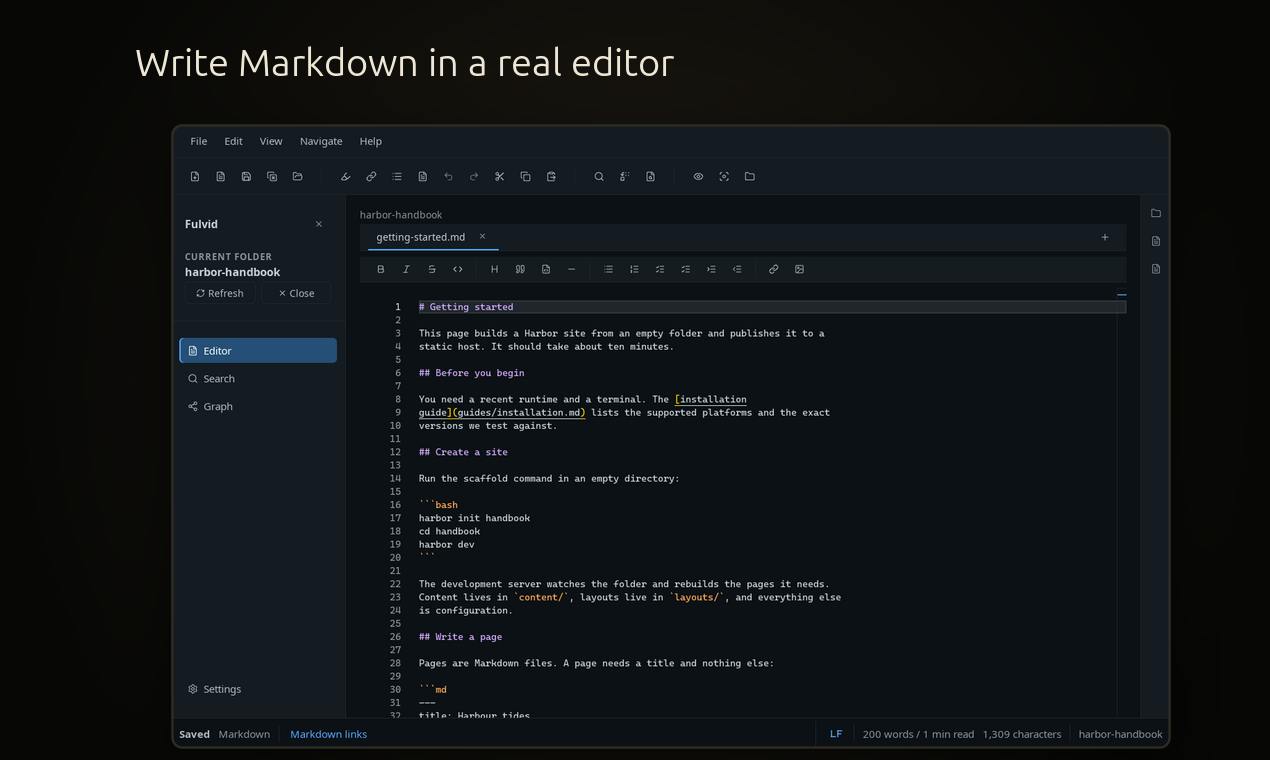
Fulvid is an open-source desktop editor by developer Manuel Gil supporting both Markdown and MDX formats, built around the "open knowledge" philosophy — all content is stored as plain text files on your local disk with no proprietary vault or cloud workspace required. It features local search, live preview, bidirectional document links, and graph navigation, all operating directly on the file system. Fulvid is explicitly positioned for LLM workflows, as standard Markdown is a natural fit for RAG and other AI applications. MDX support further extends its appeal to developers with technical documentation needs. As a newly launched product, its long-term maturity remains to be seen.
At a time when note-taking tools are increasingly moving toward cloud subscriptions and proprietary formats, Fulvid takes the opposite approach — keeping your knowledge firmly on your own hard drive. This open-source Markdown and MDX desktop editor champions the concept of "open knowledge," earning 71 upvotes and landing at #17 on Product Hunt's daily chart.
Giving Your Knowledge Back to the File System
Fulvid's core proposition is simple: your knowledge lives on your local disk as portable Markdown files. That means files are always readable, linkable, reusable, version-controllable, and free to migrate between tools.
This stands in sharp contrast to mainstream solutions like Notion or Obsidian's paid cloud sync. Many knowledge management tools lock your content inside proprietary vaults or cloud workspaces — once you cancel your subscription or the tool shuts down, migrating your data becomes a headache. Fulvid is explicit about this: No proprietary vault or cloud workspace. Everything revolves around plain Markdown files.
For users who have accumulated notes over years, this file-first design significantly reduces the risk of vendor lock-in. Your notes are just a collection of .md or .mdx files — openable in any editor and manageable with Git for version control.
Features Built Around the File System
With local files at its core, Fulvid brings common knowledge management capabilities right alongside the file system:
- Search: Find content directly within local files
- Preview: Instantly render Markdown/MDX output
- Document links: Build bidirectional connections between files
- Graph navigation: Visually browse relationships between notes
Graph navigation has become a staple feature of bi-directional linking tools in recent years. Fulvid ties it directly to files on disk rather than relying on a centralized database, making the entire knowledge network more transparent and controllable.
Ready for LLM Workflows
Fulvid specifically highlights that these Markdown files are "ready to work with across tools and LLM workflows."
This is a notably forward-looking positioning. As large language models become increasingly integrated into daily work, plain-text, well-structured Markdown files are a natural fit as AI input — whether feeding a local model for retrieval-augmented generation or connecting to various AI coding and writing assistants. Open text formats are far more AI-friendly than proprietary databases. Storing knowledge in a standard format locally also preserves maximum flexibility for future AI use cases.
Retrieval-Augmented Generation (RAG) is the dominant technical approach for combining personal knowledge bases with large language models: local documents are chunked, vectorized, and stored, then dynamically retrieved and injected into prompts during conversation — allowing the model to "know" your private notes. This pipeline has a clear preference for source file formats — plain text or structured Markdown is far easier to chunk and parse than PDFs or proprietary database formats. The Obsidian user community, for instance, has already produced a wealth of workflows connecting local Markdown vaults to local LLMs (e.g., Ollama + LangChain). Fulvid's emphasis on being "ready for LLM workflows" signals directly to this audience: your knowledge base requires no format conversion and can serve as a direct input source for AI applications.
The MDX Differentiator
Notably, Fulvid doesn't just support Markdown — it also supports MDX. MDX is an extension format that embeds JSX components within Markdown, widely used in modern documentation sites and developer blogs (such as the Next.js and Docusaurus ecosystems).
For developers who maintain both technical documentation and personal knowledge bases, a desktop editor that handles both plain notes and MDX components reduces the cost of switching between tools. This gives Fulvid a meaningful point of differentiation among the many pure Markdown editors out there.
MDX (Markdown + JSX), championed by communities around Gatsby, Vercel, and others, emerged around 2018. Its core capability is allowing React components to be imported and rendered directly within standard Markdown documents — think interactive charts, code sandboxes, or custom UI blocks — while keeping the text content readable. This lets technical writers satisfy both "readable documentation" and "interactive page" requirements from a single source file. For a desktop editor, MDX support means parsing JSX syntax, handling component references, and correctly rendering them in a preview pane — a significantly more complex implementation than plain Markdown. By choosing to support MDX, Fulvid effectively extends its target audience from general note-takers to developers with technical documentation needs.
Conclusion
Fulvid is built by developer Manuel Gil and tagged under open source, writing, notes, and GitHub. Its value proposition is clear: local files at the center, no vendor lock-in, and openness to both MDX and LLM workflows.
For users who value data ownership and want to keep their knowledge accessible in the AI era, this open-source, fully local editor offers a pragmatic choice. That said, as a newly launched product (only 2 comments on its debut day), its feature maturity, performance, and long-term maintenance remain to be proven by real-world usage. Interested users can follow its open-source repository and judge for themselves after hands-on experience.
Related articles

Gemini 4 Argon Hands-On: AI Builds Board Games, Constructs Temples, and Trains Robots Autonomously
Gemini 4 Argon hands-on roundup: AI autonomously builds a desk racetrack and temple in Blender, writes a ray tracing engine, trains a humanoid robot to sink 7 shots, plus API pricing and developer access.

The Magic Octagonal Coin: Why Only 9% of People Can Predict Its Flip?
Only 9% of people can correctly predict the Magic Octagon coin flip. This article explains its spatial rotation mechanism, common cognitive pitfalls, and a new hypothesis based on Relevance Theory, exploring the limits of human spatial reasoning.

Sam Altman: AI Is Entering the Era of Scientific Discovery — Math Breakthroughs Will Replicate in Biology and Energy
Sam Altman says AI is entering the era of scientific discovery — math breakthroughs will replicate in biology, materials science, and energy to help develop new drugs and energy sources.