FunnyPlaying Launches FPGB Mini: A Smaller, More Affordable Game Boy Handheld

FunnyPlaying's FPGB Mini offers GB/GBC cartridge support in a smaller, cheaper package — but skips GBA compatibility.
Chinese hardware maker FunnyPlaying has launched the FPGB Mini, a retro handheld positioned as a compact, budget-friendly alternative to the Analogue Pocket. It supports original Game Boy and Game Boy Color cartridges as well as ROM files, but does not support Game Boy Advance titles. Drawing on its background in GB/GBA modding accessories, FunnyPlaying's strategy is straightforward: drop GBA support to deliver a smaller device at a lower price. The move reflects a broader split in the retro handheld market between premium FPGA-based devices for hardcore collectors and more accessible options for casual enthusiasts.
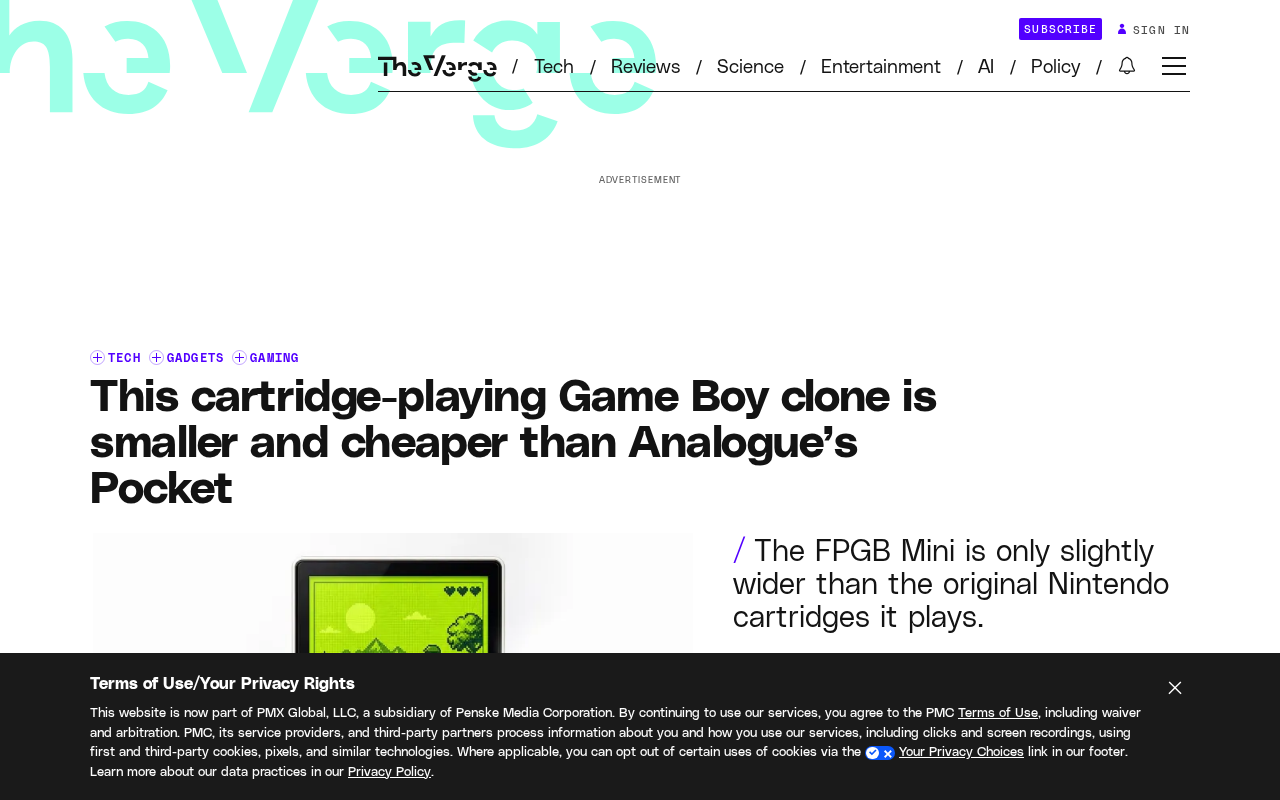
Chinese manufacturer FunnyPlaying has unveiled a retro handheld called the FPGB Mini, built around support for original Nintendo cartridges. The company — well known for its Game Boy and GBA upgrade kits — is taking aim at the coveted Analogue Pocket with a smaller form factor and a more accessible price point.
Positioning: Compact and Affordable
The FPGB Mini's most immediate selling points are its smaller size and lower price compared to the Analogue Pocket. Portability has always been a core concern for retro gaming enthusiasts, and while the Analogue Pocket is celebrated for its accuracy and build quality, it doesn't come cheap. FunnyPlaying is clearly targeting players who want an authentic cartridge experience without paying a premium.
Both the product name and its positioning reflect the experience FunnyPlaying has built up in the hardware modding space. The company's core business has been supplying screen replacements, shells, and other upgrade parts for original Game Boys and GBAs — giving it a deep understanding of how these handhelds work and how to faithfully reproduce their displays. Translating that modding expertise into a standalone retail device is a natural next step.
Cartridge Compatibility: Capable, But Bounded
One of the more noteworthy aspects of the FPGB Mini is where it draws the line on compatibility. The device supports original Game Boy and Game Boy Color cartridges, and can also run ROM files. That means players can insert their physical cart collections or load games digitally — catering to both collectors and those who prefer convenience.
However, cartridge support stops at Game Boy and Game Boy Color; Game Boy Advance (GBA) is not supported. This is the most visible gap between the FPGB Mini and the Analogue Pocket, which covers GB, GBC, and GBA cartridges, giving it a considerably deeper game library.
In other words, the FPGB Mini makes a deliberate trade-off: dropping GBA support in exchange for a lower price and smaller body. For players primarily interested in classic GB/GBC titles, that's not necessarily a dealbreaker. But for anyone who wants full compatibility across all three platforms, the Analogue Pocket remains the more complete option.
The Competitive Landscape for FPGA Retro Handhelds
FunnyPlaying's entry into this space reflects a broader trend toward segmentation in the retro handheld market. The Analogue Pocket has long held the premium end, built on FPGA technology that delivers high-accuracy hardware-level emulation. Manufacturers like FunnyPlaying are carving out a space in the mid-to-low price range by trimming features and controlling costs.
This isn't simply a race to the bottom on price — it's a divergence in target audiences. Collector-grade enthusiasts who prioritize full platform compatibility and pixel-perfect accuracy are willing to pay a premium. But a much larger group of casual retro fans may just want to replay a handful of classic handheld games on a compact device, and for them, price and portability carry far more weight.
Whether the FPGB Mini can hold its own in the market will ultimately depend on its real-world display quality, build quality, and whether its price is genuinely attractive. Based on what's been announced so far, it at least presents a focused alternative: skip the broad feature set, deliver what's needed, and keep it affordable.
FPGA (Field-Programmable Gate Array) is the foundational technology behind high-end retro handhelds like the Analogue Pocket. Unlike traditional software emulators that "translate" game logic through code, FPGA solutions reconstruct the original chip's circuit behavior at the hardware level — running games with timing and signal characteristics close to the original hardware, which typically results in superior image accuracy, audio reproduction, and input latency compared to software emulation. The Analogue Pocket built its reputation among enthusiasts on exactly this basis. It's worth noting that while "FP" in FPGB Mini stands for FunnyPlaying, publicly available information does not yet confirm whether the device uses a full FPGA architecture or relies on a traditional SoC with software emulation. This distinction directly affects the ceiling of game accuracy, and it's a key parameter prospective buyers should watch for.
Summary
The FPGB Mini marks FunnyPlaying's move from modding accessories into complete retail hardware. It offers support for original GB/GBC cartridges and ROMs in a smaller, cheaper package — at the cost of GBA compatibility. Compared to the more fully featured Analogue Pocket, it reads as a lightweight option tailored for fans of classic Game Boy titles. As the retro handheld market continues to fragment, this kind of focused, differentiated product may well find its own audience.
Related articles

OpenAI Partners with Shield: How the Astra Agent Revolutionizes IT Troubleshooting
OpenAI and Shield launch the Astra agent, which autonomously logs into computers and legacy systems to fix IT issues in real time, 35-40% faster than traditional models, with humans involved only when judgment is needed.

iPhone Duo Battery Life Tested: One Charge a Day Is Unavoidable, and the Large Screen Is the Culprit
iPhone Duo battery test: heavy use needs at least one charge a day, and about 30% remains after 6.5 hours of screen-on time. How often the large screen is unfolded is key; a MagSafe battery pack helps, and long-term degradation is also worth watching.

Kimi K3.1 Pro Open-Sourced: 2.8 Trillion Parameters Close In on Opus
Moonshot releases the open-source MoE model Kimi K3.1 Pro, with 2.8T total parameters and 104B activated, trailing Opus 5.5 by under 1 point on Terminal Bench 4.0.