FVScore: How a Neuro-Symbolic Framework Accurately Evaluates Video Generation Quality

FVScore uses neuro-symbolic reasoning to turn video evaluation into proposition verification, enabling traceable and interpretable quality diagnosis.
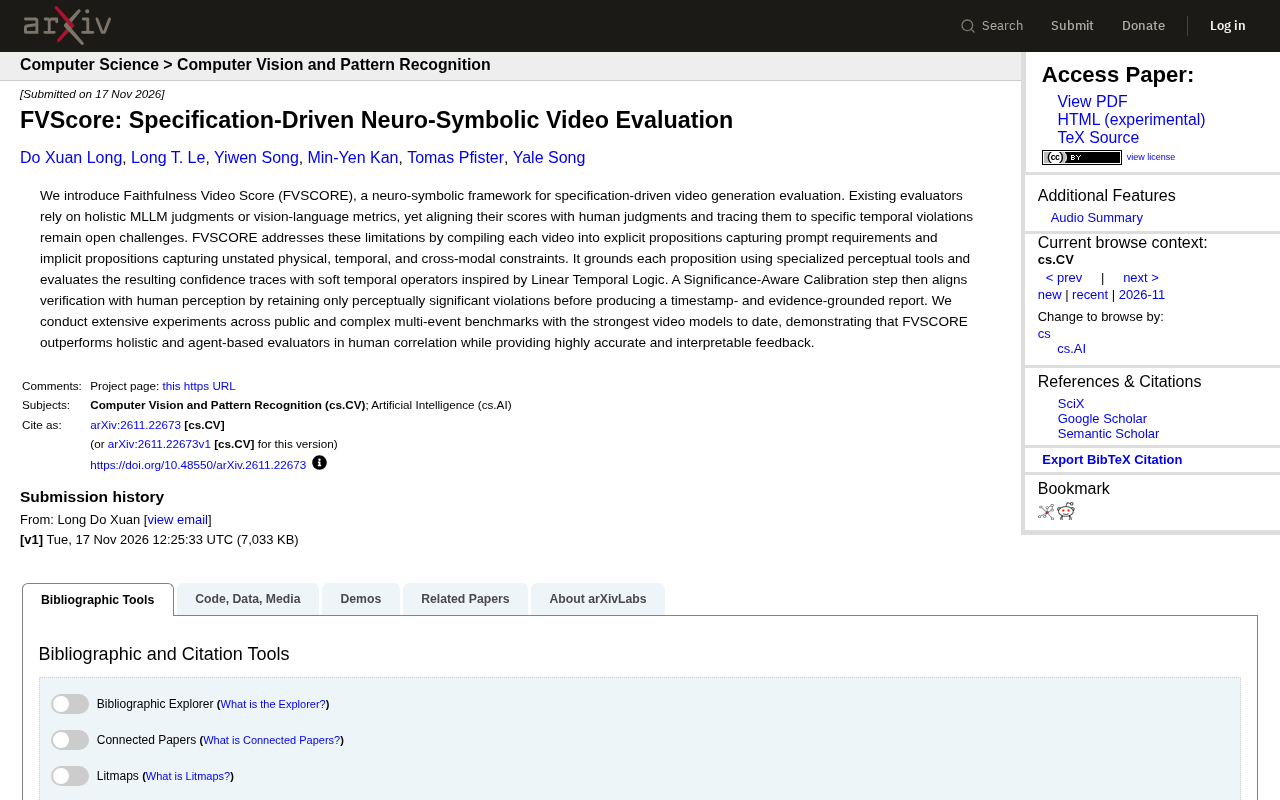
FVScore is a neuro-symbolic video evaluation framework that compiles video evaluation into explicit and implicit propositions, grounds them with specialized perception tools to generate confidence trajectories, reasons over time with soft temporal operators inspired by LTL, and filters out non-salient violations via salience-aware calibration. It outperforms holistic and agent-based evaluators in human correlation and outputs interpretable reports with timestamps, marking a shift from black-box scoring to interpretable diagnosis.
Video generation models are rapidly improving, but accurately evaluating the quality of generated videos—especially judging whether a video faithfully fulfills each requirement in a text prompt—remains an open problem. Existing methods either rely on the holistic judgment of multimodal large models or use vision-language similarity metrics; the former struggles to trace back to the specific moment of violation, while the latter has limited correlation with human perception. The recently proposed Faithfulness Video Score (FVScore) attempts to fundamentally change this: it turns video evaluation into a specification-driven neuro-symbolic reasoning process.
Two Major Pain Points of Existing Evaluators
Current mainstream video generation evaluation approaches fall into two categories. The first directly calls a multimodal large model (MLLM) to score the video and prompt holistically; although flexible, the score is a black-box output that cannot explain why points were deducted, nor can it locate which frame or time segment in the video violates the prompt requirements. The second is based on vision-language metrics (such as CLIP similarity); it is cheap to compute but only measures overall semantic alignment, and is nearly powerless against temporal logical errors and physical implausibility.
The authors of FVScore point out that both categories face two core challenges: first, insufficient alignment between evaluation scores and human judgment; second, the inability to trace scores back to specific temporal violation events. In other words, we need to know not only whether a video is "good" but also "where" and "why" it is bad.
FVScore's Core Mechanism: From Propositions to Temporal Logic
FVScore is a neuro-symbolic framework whose design can be broken down into three key steps.
Proposition Compilation: Explicit and Implicit Requirements Alike
FVScore first compiles the video evaluation task into a set of propositions. Explicit propositions directly correspond to requirements explicitly stated in the prompt text, such as "a red ball rolls down a hill"; implicit propositions capture requirements that are not stated but are implied by physical, temporal, and cross-modal constraints—for example, object motion should obey gravity, and the order of events should satisfy causal logic. This distinction moves evaluation beyond literal matching.
Neuro-Symbolic methods refer to an AI paradigm that combines neural networks (adept at perception and pattern recognition) with symbolic reasoning (adept at logic, rules, and interpretability). In FVScore, the neural part is embodied by perception tools (such as object detectors and action recognition models) that ground video content and output confidence, while the symbolic part is embodied by proposition compilation and temporal logic reasoning, which organizes perception results into verifiable logical constraints. The advantage of this hybrid architecture is that pure neural methods, despite strong perception, have opaque and untraceable reasoning, while pure symbolic methods have clear reasoning but require manually defining all rules and struggle with raw video pixels. Neuro-symbolic methods attempt to combine the strengths of both, retaining perceptual robustness while gaining the interpretability and logical rigor of symbolic systems.
Perception Tool Grounding and Soft Temporal Operators
Each proposition needs to be verified. FVScore does not rely on a single MLLM score; instead, it invokes specialized perception tools (such as object detection, tracking, and action recognition) to ground the propositions and obtain confidence trajectories. It then uses soft temporal operators inspired by Linear Temporal Logic (LTL) to reason over these trajectories, determining whether a proposition holds over an entire time span. Soft temporal operators allow a degree of fuzziness, better matching the continuously changing nature of real videos.
Linear Temporal Logic (LTL) is a formal language for describing how systems behave over time, originally widely used in model checking of hardware and software systems. LTL's core operators include "always" (G), "eventually" (F), "until" (U), and "next" (X), and can express temporal constraints such as "some condition must eventually hold" or "some condition holds until another condition becomes true." In video evaluation, LTL can be used to formalize requirements such as "the ball must remain red before rolling down the hill" or "the object will eventually stop moving." However, classical LTL deals with binary truth values and cannot directly handle the continuous confidence outputs of perception tools. Soft temporal operators are a fuzzy generalization of LTL that extends binary logic to continuous truth values in the [0,1] interval, computing the degree to which a proposition is satisfied over the timeline through aggregation operations such as min and max, thereby better accommodating the noise and uncertainty in real videos.
Salience-Aware Calibration: Aligning with Human Perception
Even if proposition verification produces confidence, not all violations are necessarily worth human perception. FVScore introduces a salience-aware calibration step that retains only those violation events that are salient to human perception, making the final score more consistent with human judgment. The final output includes not only a score but also a report with timestamps and supporting evidence that clearly indicates which segment the violation occurred in.
In video quality assessment, "human correlation" is usually measured by computing the correlation coefficient between model scores and human subjective ratings, with commonly used metrics including the Spearman Rank Correlation Coefficient (SRCC) and the Pearson Linear Correlation Coefficient (PLCC). SRCC measures consistency in score ranking, while PLCC measures the degree of linear correlation between score values. An evaluator that is highly correlated with human judgment means it can not only give scores close to the human mean opinion overall but also maintain a ranking of better and worse videos consistent with humans across different videos. FVScore's experiments emphasize that its human correlation outperforms holistic evaluators and agent-based evaluators, and this comparison is made under exactly this evaluation system.
Experimental Performance: Outperforming Holistic and Agent-Based Evaluation
The authors conducted extensive experiments on public benchmarks and complex multi-event benchmarks, testing against the strongest current video generation models. Results show that FVScore outperforms holistic evaluators and agent-based evaluators in human correlation, while providing highly accurate and interpretable feedback. This means FVScore is not only closer to humans in scoring but can also answer "why" and "where."
From a broader perspective, FVScore represents a shift in video generation evaluation from "black-box scoring" to "interpretable diagnosis." The advantage of the neuro-symbolic approach is that it combines the numerical outputs of perception tools with the reasoning capabilities of symbolic logic, retaining the perceptual power of deep learning models while gaining the temporal reasoning and traceability of symbolic systems. For R&D teams that need to iteratively improve video generation models, this fine-grained feedback is clearly more valuable than an isolated score.
Limitations and Directions for Exploration
FVScore relies on specialized perception tools to ground propositions, which means the coverage and accuracy of the tools themselves directly affect evaluation results. In addition, extracting implicit propositions still requires further research; there is currently no standard answer for how to systematically enumerate physical, temporal, and cross-modal constraints. The parameter settings of soft temporal operators may also affect calibration effectiveness, and all of these need to be validated in more scenarios. Nevertheless, the "specification-driven" idea proposed by FVScore opens a noteworthy new path for video evaluation.
One-line Summary
FVScore uses neuro-symbolic reasoning to turn video evaluation into proposition verification, enabling traceable and interpretable quality diagnosis.
Paragraph Summary
FVScore is a neuro-symbolic video evaluation framework aimed at solving the problems of existing methods being unable to trace violation moments and insufficiently aligning with human perception. It compiles video evaluation into explicit and implicit propositions, invokes specialized perception tools to ground the propositions and generate confidence trajectories, then uses soft temporal operators inspired by linear temporal logic for temporal reasoning, and finally filters out violations that are not salient to human perception through salience-aware calibration. Experiments show that FVScore outperforms holistic evaluators and agent-based evaluators in human correlation, and its output includes interpretable reports with timestamps and evidence. This work represents a shift in video generation evaluation from black-box scoring to interpretable diagnosis, but the coverage of perception tools and the extraction of implicit propositions remain directions for exploration.
Related articles
When AI Starts Blogging: Scott Aaronso…
When AI Starts Blogging: Scott Aaronson's Kitchen Wine Experiment
Scott Aaronson shares a kitchen wine AI writing experiment on his blog, sparking Hacker News debate. This analysis explores the authenticity gap in AI-generated blog content, transparency disputes, and implications for content creators.

Amazon Loses Recall Case: Liability for 400,000 Dangerous Products Established
A U.S. court ruled Amazon is a distributor, not a logistics provider, and must recall over 400,000 dangerous products. This analysis examines the ruling's impact on platform liability boundaries and e-commerce compliance.

Google Familiar Faces Comes to Walmart's Budget Cameras
Google Familiar Faces facial recognition now supports Walmart's Onn outdoor and floodlight cameras at $35 and $77, but requires a Google Home Premium subscription.