Gawain: The Show HN Project That Enforces Python Variable Type Hints
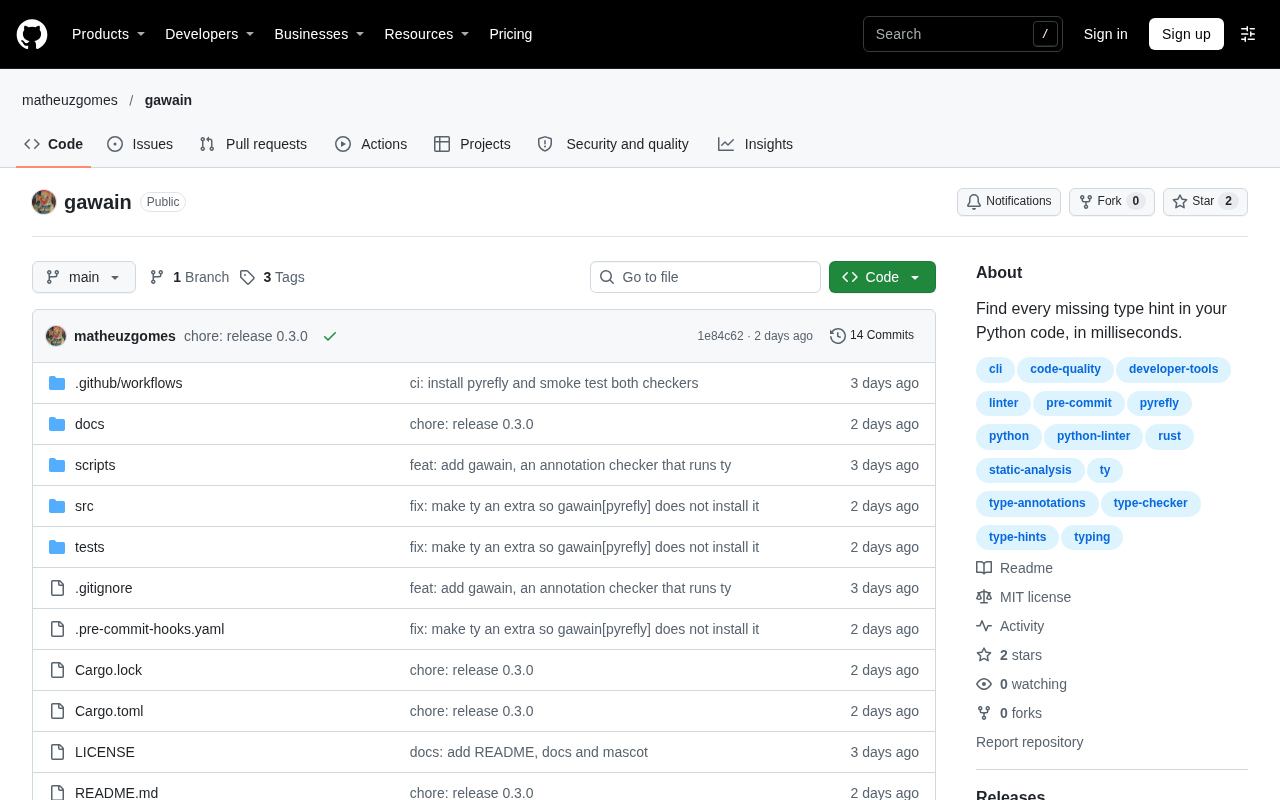
Show HN project Gawain mandates type hints on all Python variables, filling in type coverage constraints.
Gawain is a Python static checking tool published as a Show HN on Hacker News. Its core proposition is to require all variables to carry type hints, rather than annotating only function signatures. The article notes that variable-level annotations have long sat in a gray area, with developers often omitting them because local variable types seem obvious, yet in scenarios such as data pipelines, configuration objects, and cross-module state passing, actual variable types are often not intuitive, and missing annotations cause static analyzers to miss errors that could have been caught earlier. Gawain does not replace mypy or pyright, which handle type inference and consistency validation; it focuses only on whether annotations exist and can serve as a type coverage gate in CI. The article also discusses how mandatory annotations may harm conciseness and readability and the high cost of migrating existing code, concluding that it is better suited to new projects with high type-safety requirements, with engineering details and community acceptance still to be seen.
Python's type hints, introduced in version 3.5, have gradually become an important tool for improving the maintainability of large projects. But type hints have always been "optional"—developers can annotate only some function signatures, while variable-level type annotations are often ignored. Gawain, the latest Show HN project to appear on Hacker News, tries to change this: it requires all Python variables to carry type hints.
What Is Gawain
Gawain is a static checking tool for Python code, and its core proposition is very direct: all variables should have explicit type hints, rather than relying on interpreter runtime inference or developer verbal conventions. The project was published in Show HN form on Hacker News and received 9 points; there are currently no comments.
Judging from its positioning, Gawain is closer to an "enforced standard" than a "suggested standard." Traditionally, tools like flake8 and mypy can be configured to check variable annotations or not, whereas Gawain's stance is to require them by default, with no exceptions. This appeals to teams pursuing type rigor, but it also means the migration cost is not low.
Why Variable-Level Type Hints Are Worth Attention
Type hints on function signatures are already widely accepted because they are contracts between modules. Variable-level annotations, however, sit in a gray area: local variable types are often obvious, and developers consider annotation redundant.
But Gawain's approach has its rationality. As Python projects grow in scale—especially in scenarios involving data pipelines, configuration objects, and cross-module state passing—the actual type of a variable is often not intuitive. A variable that looks like a dict may actually be a nested dict[str, list[tuple[int, str]]]. Variable-level type hints let static analyzers detect type mismatches earlier, rather than waiting until runtime to throw an AttributeError or TypeError.
Relationship with Existing Type-Checking Tools
Gawain is not intended to replace mypy or pyright. Those tools handle type inference and consistency validation, while Gawain focuses on the formal requirement of "whether an annotation exists." In other words, Gawain addresses the problem of measuring and constraining type coverage, and can serve as an additional gate in a CI pipeline.
The division of labor between mypy and pyright: mypy is the most mainstream static type checker in Python's official type ecosystem, originally led by Jukka Lehtosalo during his time at Dropbox. It performs type inference and consistency validation based on the type syntax specified in PEP 484, and supports progressively stricter check levels such as --strict. pyright, on the other hand, is a type checker developed by Microsoft for VS Code's Pylance language server, implemented in TypeScript, emphasizing fast incremental analysis and more aggressive type inference, and is often discussed in the community in the form of the basedpyright fork. Both are "type semantics layer" tools: they judge whether "this annotation is compatible with the assignment." Tools like Gawain sit at the "annotation syntax layer" and only judge "whether an annotation is written." Therefore, in a pipeline they are usually chained with the former rather than competing—for example, Gawain first ensures the coverage threshold, and then mypy validates type correctness.
PEP 526 and the syntactic basis of variable annotations: Variable-level type hints were not an early native Python feature; they were formally introduced by PEP 526 in Python 3.6, with the syntax form x: int = 0, and they distinguish between "annotated assignment with an initial value" and "declaration only without assignment" (the latter does not create a variable at runtime and only writes to __annotations__). This distinction matters to static checking tools: the annotation itself incurs almost no runtime overhead, but it is stored in the module or class's __annotations__ dictionary and can be read by typing.get_type_hints(). For this reason, variable annotations are "lazy" at runtime—the interpreter does not validate them, which is precisely why static checking tools exist, and also explains why errors can only surface at runtime when annotations are missing.
Potential Controversies
Enforcing type hints on all variables is not without opposition in the Python community. Python's philosophy emphasizes simplicity and readability, and adding annotations to every loop variable or temporary variable may make code bloated. For example, in list comprehensions or short utility functions, mandatory annotations actually reduce readability.
Another practical issue is migrating existing code. For a codebase with hundreds of thousands of lines, satisfying Gawain's requirements all at once is nearly impossible, and gradual exemption mechanisms or baseline files are needed. The project has just been released, and such engineering details remain to be tested by the community.
Type coverage and gradual typing: Python's type system is designed to be "gradual." PEP 484 explicitly allows partial annotation and partial blanks, with unannotated parts treated as Any by default, thus coexisting with annotated parts. This design is key to Python type hints being accepted by large legacy projects, but it also has a side effect: Any silently "pollutes" type checking, causing checkers to let through errors that could have been found. Gawain's mandatory annotation proposition is essentially fighting the coverage blind spots brought by gradual typing. Common engineering compromises include mypy's fine-grained switches such as disallow_untyped_defs and disallow_any_expr, as well as baseline-file-based "enforce only on new code" strategies (similar to mypy --baseline or ratchet mode). These mechanisms can serve as references for evaluating Gawain's engineering maturity.
Applicable Scenarios and Observations
Gawain is better suited to new projects with strong type-safety requirements, or to situations where a team has already fully adopted mypy strict mode and wants to tighten the standard further. For script-like or prototype projects, the benefits of mandatory variable annotations may not outweigh the writing cost.
As an early-stage project on Show HN, Gawain's value lies in raising a clear question: should the "optionality" of type hints be regarded as technical debt? There is no standard answer to this question, but the attempt to toolify it is itself worth watching. What is worth paying attention to going forward is whether it provides exemption configuration, how it integrates with mainstream linters, and how the community actually accepts mandatory annotations.
Key Points
- Gawain mandates that all Python variables carry type hints and positions itself as a formal standard checking tool
- It does not replace mypy/pyright but supplements type coverage constraints
- Mandatory annotations involve a trade-off between conciseness and type safety, and migrating existing code is the main challenge
- The project is at an early stage; engineering details and community feedback remain to be seen
One-line Summary
Show HN project Gawain mandates type hints on all Python variables, filling in type coverage constraints.
Paragraph Summary
Gawain is a Python static checking tool published as a Show HN on Hacker News. Its core proposition is to require all variables to carry type hints, rather than annotating only function signatures. The article points out that variable-level annotations have long sat in a gray area, with developers often omitting them because local variable types seem obvious, yet in scenarios such as data pipelines, configuration objects, and cross-module state passing, the actual types of variables are often not intuitive. Missing annotations cause static analyzers to miss type errors that could have been caught in advance. Gawain does not replace mypy or pyright, which handle type inference and consistency validation; it only focuses on "whether an annotation exists" and can serve as a type coverage gate in CI. The article also discusses controversies such as how mandatory annotations may harm conciseness and readability and the high cost of migrating existing code, concluding that it is better suited to new projects with high type-safety requirements, and that its engineering details and community acceptance remain to be seen.
Related articles

Gemini 4 Neon Leak: A Potential Strong Contender Against Opus 5.5
A Hacker News thread suggests Gemini 4 Neon looks like an Opus 5.5 competitor. This article unpacks the product positioning behind this community signal, shifts in the top-model competitive landscape, and what it means for developers' model selection strategy.

Claude Fable 5.2's Self-Authored Short Film 'Fable' Sparks Discussion
A short film 'Fable,' credited to Claude Fable 5.2 for script, visuals, and directing, appears on Hacker News. This article analyzes the significance of full-pipeline AI creation, community reactions, and what it means for content creators.

Anthropic IPO Pricing: A Signal of AI Giants Going Public
Anthropic's IPO pricing draws attention. This article analyzes its potential impact on AI industry valuation, commercialization paths, and the competitive landscape, and highlights public-market expectations and challenges for AI companies.