GB200 NVL72 Topology-Aware Scheduling: How Slurm Unlocks Exascale Performance

NVIDIA uses Slurm topology-aware scheduling to unlock Exascale AI performance on GB200 NVL72
NVIDIA's technical blog details how Slurm topology-aware job scheduling unlocks Exascale computing performance on the GB200 NVL72 system. The GB200 NVL72 integrates 72 Blackwell GPUs in a single rack, fully interconnected via NVLink for high-bandwidth, low-latency communication, with total memory exceeding 13TB and FP8 compute reaching 1.44 ExaFLOPS.
As AI model scale and complexity continue to grow, fully leveraging the performance of modern accelerated computing infrastructure depends not only on the raw compute power of the hardware itself, but also on how workloads are placed and scheduled. NVIDIA's latest technical blog provides a detailed look at how Slurm topology-aware job scheduling can unlock Exascale-level computing performance on the GB200 NVL72 system.
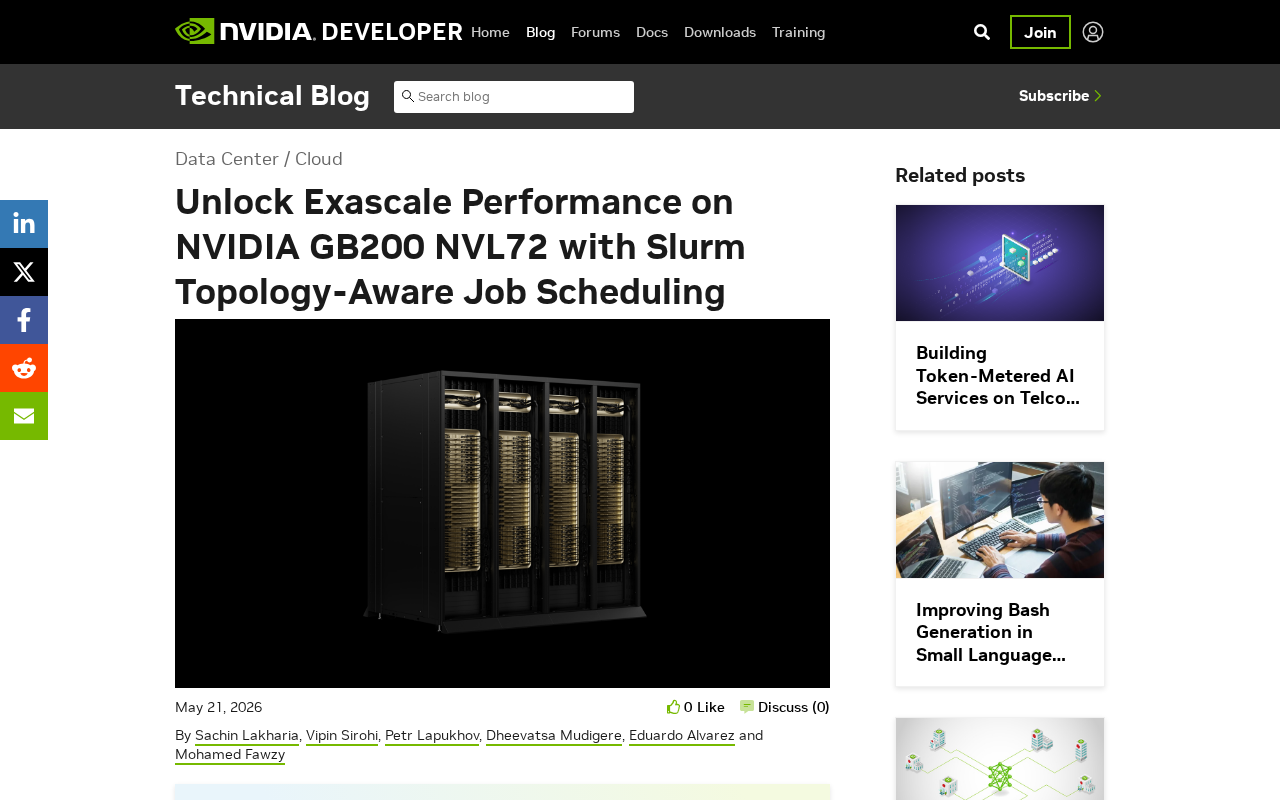
GB200 NVL72: The Next-Generation Hyperscale AI Computing Platform
The NVIDIA GB200 NVL72 is a flagship computing platform designed for hyperscale AI training and inference workloads. The system integrates 72 Blackwell GPUs within a single rack, interconnected via NVLink to create a high-bandwidth, low-latency GPU communication domain. GPU-to-GPU data exchange speeds far exceed traditional network interconnect solutions, providing a solid hardware foundation for large-scale parallel computing.
Notably, the "G" in GB200 stands for Grace CPU, while the "B" stands for Blackwell GPU. NVL72 means that 72 GPUs are fully interconnected through NVLink Switch chips. Each Blackwell GPU features up to 192GB of HBM3e memory, giving the entire NVL72 system a total memory capacity exceeding 13TB. At FP8 precision, the system delivers AI compute performance of 1.44 ExaFLOPS — which is where the term "Exascale" comes from.
Related articles
Deep Dive into AI Agent Skill Design: …
Deep Dive into AI Agent Skill Design: Engineering Practices from Anthropic and Perplexity
A deep dive into Skill design philosophy from Anthropic's Claude Code team and Perplexity's Agent team, covering the Tax Test, Gotchas Flywheel, progressive disclosure, and Eval-First practices for building high-quality AI Agent skill systems.
Deep Dive into OpenAI's Official GPT-5…
Deep Dive into OpenAI's Official GPT-5.6 Prompting Guide: The Shift from Manual to Automatic
A deep dive into OpenAI's official GPT-5.6 Sol prompting guide: conciseness-first, outcome-oriented design, autonomy boundaries, tool routing, and reasoning intensity tuning.
 Deep Dives
Deep Dive into How OpenClaw (Open-Source Crayfish) AI Agent Works
Deep analysis of OpenClaw AI Agent internals: System Prompt, tool calling, SubAgents, Skill system, memory, and Context Engineering explained.