GBClaw: Unlocking Deep Mechanistic Discovery in Grain Boundary Research with AI Agents

GBClaw uses agentic AI to automatically study general grain boundaries, revealing how defect hierarchy affects sliding resistance.
This article introduces GBClaw, an agentic AI framework designed to address the challenge of complex, difficult-to-systematically-study general grain boundaries in polycrystalline materials. GBClaw embeds LLMs in a modular architecture, coordinating specialized agents, domain tools, and hierarchical memory through an orchestrator to enable dynamic replanning and iterative workflows. On 14 general asymmetric tilt grain boundaries in nickel, the framework characterized interfacial defect structures, identified multiple deformation modes, and found that secondary GB misfit dislocations significantly affect the shear strength of boundary sliding. The study also traced an anomalously high shear resistance to a metastable boundary structure. The article notes that agentic AI can connect high-throughput simulation with deep mechanistic analysis, but still relies on researcher guidance, and its generalizability remains to be validated.
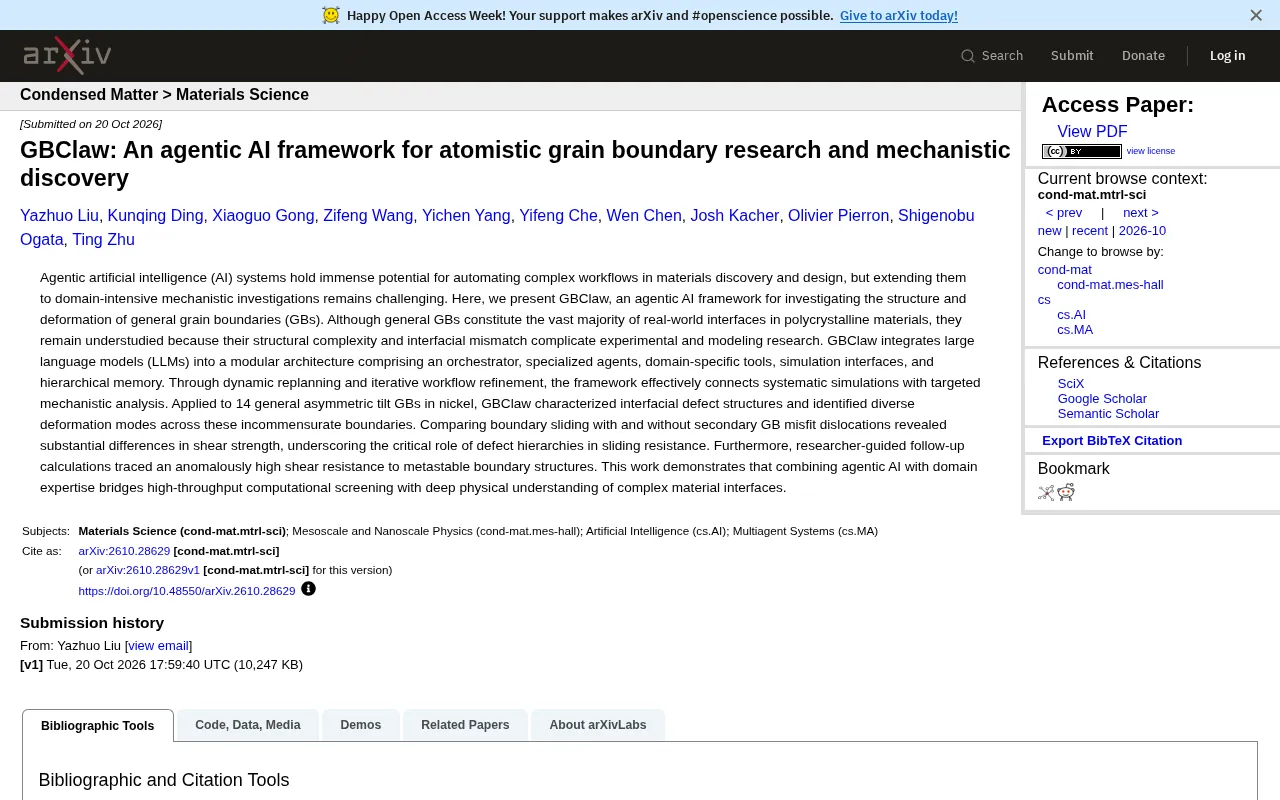
In materials science, the complex structure of grain boundaries (GBs) has long been a bottleneck for understanding the mechanical behavior of polycrystalline materials. General grain boundaries (general GBs), which are widespread, have long lacked systematic study due to their structural complexity and severe interfacial misfit. Recently, an agentic AI framework called GBClaw was proposed, aiming to combine large language models (LLMs) with domain tools to automate the simulation and mechanistic analysis workflow for grain boundary research.
Why Are General Grain Boundaries Difficult to Study?
In polycrystalline materials, general grain boundaries account for the vast majority of actual interfaces, but their atomic-scale structures are complex and their interfacial misfit is high, making both experimental characterization and computational simulation challenging. While traditional high-throughput computational screening can generate large amounts of data, it struggles to automatically extract physical mechanisms; deep mechanistic studies, on the other hand, rely on expert experience and are difficult to scale. GBClaw attempts to bridge the two: using agents to drive systematic simulations and, through dynamic replanning and iterative workflow optimization, connecting simulation results with targeted mechanistic analysis.
Grain boundary types and misfit: Grain boundaries can be classified by the misorientation between the grains on either side into low-angle grain boundaries (misorientation typically less than 15°) and high-angle grain boundaries. Among these, special grain boundaries that satisfy coincidence site lattice (CSL) relationships have lower interfacial energy, while general grain boundaries (general GBs) that deviate from these special orientations account for the majority of interfaces in polycrystalline materials, with interfacial atomic arrangements lacking periodicity and high misfit. Incommensurate interfaces refer to interfaces where the lattice periods on both sides cannot form a simple commensurate match within the interface, resulting in interfacial structures with continuous sliding or soliton-like configurations, which require atomic-scale simulations and structure identification algorithms to resolve. Secondary grain boundary misfit dislocations are additional dislocations generated by local adjustments of the interfacial structure beyond the primary misfit dislocation network; they alter the resistance to interfacial sliding.
GBClaw's Architecture: Modularity and Agent Collaboration
The core of GBClaw is embedding LLMs into a modular architecture that includes an orchestrator, specialized agents, domain tools, simulation interfaces, and hierarchical memory. This design enables the system to dynamically adjust its research plan based on intermediate results rather than executing a fixed script. The orchestrator coordinates multiple agents, each specializing in specific tasks (such as structure analysis, simulation setup, and result interpretation), and accumulates context through the memory module to avoid redundant computation.
According to the original paper, GBClaw effectively connects systematic simulation with targeted mechanistic analysis through dynamic replanning and iterative workflow optimization.
Dynamic replanning and iterative workflow optimization: In agentic systems, replanning refers to modifying the subsequent task sequence during execution based on intermediate results (such as simulation convergence or defect identification confidence) rather than strictly following an initial script. Iterative workflow optimization uses the results of one "simulation–analysis–feedback" cycle as input for the next round, progressively refining the research question. Hierarchical memory is typically divided into short-term working memory and a long-term knowledge base: the former stores the context of the current task, while the latter stores validated structural features, parameter settings, and conclusions, thereby reducing redundant computation and maintaining cross-task consistency. This architecture allows the LLM to serve as the reasoning and scheduling core, while specialized agents are responsible for invoking domain tools to perform specific computations.
Application and Findings on Nickel General Grain Boundaries
The research team applied GBClaw to 14 general asymmetric tilt grain boundaries in nickel, systematically characterizing the interfacial defect structures and identifying multiple deformation modes. These grain boundaries are incommensurate interfaces with complex structures that are difficult to analyze one by one using traditional methods. GBClaw not only completed structural characterization but also compared the boundary sliding behavior with and without secondary GB misfit dislocations, finding significant differences in shear strength and highlighting the critical role of defect hierarchy in sliding resistance.
Furthermore, researcher-guided follow-up calculations traced an anomalously high shear resistance and attributed it to a metastable boundary structure. This finding demonstrates that agentic AI combined with domain expertise can extract deep physical understanding from high-throughput screening.
Asymmetric tilt grain boundaries: Grain boundaries can be classified geometrically into tilt, twist, and mixed grain boundaries. Asymmetric tilt grain boundaries refer to cases where the grain boundary plane does not coincide with the symmetry planes of the adjacent grains, typically consisting of a set of primary misfit dislocations and possibly steps, with interfacial structures more complex than symmetric tilt grain boundaries. Boundary sliding and shear strength: Under shear stress, grain boundaries can slide relative to each other through dislocation glide, structural unit migration, and other mechanisms, with the resistance being the shear strength. The presence of secondary GB misfit dislocations alters the local atomic environment of the interface, thereby affecting sliding nucleation and motion and leading to significant differences in shear strength.
Potential and Limits of Agentic AI in Materials Research
The GBClaw case demonstrates that agentic AI can handle domain-intensive mechanistic research tasks, not just automate routine processes. By combining the reasoning capabilities of LLMs with specialized tools, it achieves a closed loop from simulation to analysis. However, this framework still relies on researcher guidance and domain knowledge injection, and fully autonomous mechanistic discovery remains some way off. In addition, the framework's generalizability to more material systems and grain boundary types remains to be validated.
Overall, GBClaw offers a new paradigm for materials interface research: combining the automation capabilities of agents with deep expert insight, with the potential to accelerate mechanistic exploration of complex material interfaces.
Agentic AI refers to systems that use large language models as reasoning engines and are capable of autonomously invoking tools, decomposing tasks, and adjusting actions based on feedback. Unlike traditional process automation, agentic AI emphasizes multi-step reasoning and decision-making in open environments. In materials science, it can be used to connect high-throughput computation, structural characterization, and mechanistic analysis, but is currently limited by the explicit injection of domain knowledge, the reliability of tool interfaces, and the verifiability of results. Generalizability refers to the degree to which a framework can adapt to unseen material systems, grain boundary types, or simulation methods, which requires the system to have transferable domain knowledge representations and tool abstraction capabilities.
Related articles

Will GitHub Die? Open Source Maintainer Burnout and the Collaboration Crisis in the AI Era
Lex Fridman podcast discussion on open source maintainer burnout and GitHub's predicament: massive pull requests overwhelm core maintainers, and AI worsens code bloat. Using math journal peer review and Poincaré conjecture verification as analogies, the article analyzes why verification in knowledge production must be deliberately slow, and how open source communities can avoid the failure mode of maintainers exiting.

Stop Building Cookie-Cutter AI Websites: 3 Tools That Transform Your Coding Agent
Three tools that boost AI coding agents: FFmpeg skill for local video editing in Claude Code and Cursor, Hallmark's 50 design themes to fix cookie-cutter AI sites, and Jailbreaks' 25+ model prompts.

How America's Gerontocracy Squeezes the Younger Generation
Americans over 55 hold nearly three-quarters of national wealth, alongside an 80-year-old president and elderly congressional leaders. The Atlantic's Idrees Kahloon explains how gerontocracy drives up housing costs, squeezes opportunities for the young, and explores zoning reform and child poverty reduction as practical fixes.