Gemini 3.1 Pro Rate Limiting Exposed: Why Paid Users Can Never Use Their Full Quota

Gemini 3.1 Pro's hidden rolling window throttling leaves paid users unable to use their full quota.
A viral Reddit post exposes how Google Gemini 3.1 Pro's aggressive rolling window rate limiting prevents paid users from consuming their weekly token quotas. Despite impressive paper numbers, short-window throttling and hours-long cooldowns fragment workflows, while zero usage visibility leaves users blindsided. The issue highlights a broader industry dilemma around AI subscription pricing, transparency, and the gap between marketed quotas and actual usability.
A Vivid Metaphor: The All-You-Can-Eat Buffet Where the Chef Keeps Slapping Your Hand
Recently, a Reddit user posted a sharp critique of Google Gemini 3.1 Pro's rate limiting mechanism. The metaphor was both hilarious and devastatingly accurate, quickly resonating across the community.
Here's how they described the experience: "It's like you ordered the most expensive meal in the restaurant, and just as you reach for your fork, the chef slaps your hand, takes the plate away, and tells you to 'let it cool down for 5 hours.'" This absurd routine repeats throughout the entire week — you slowly accumulate a theoretically massive "mountain of food," and then when the weekly quota resets, the entire table vanishes, with 60% of your so-called "generous" token allowance still untouched.
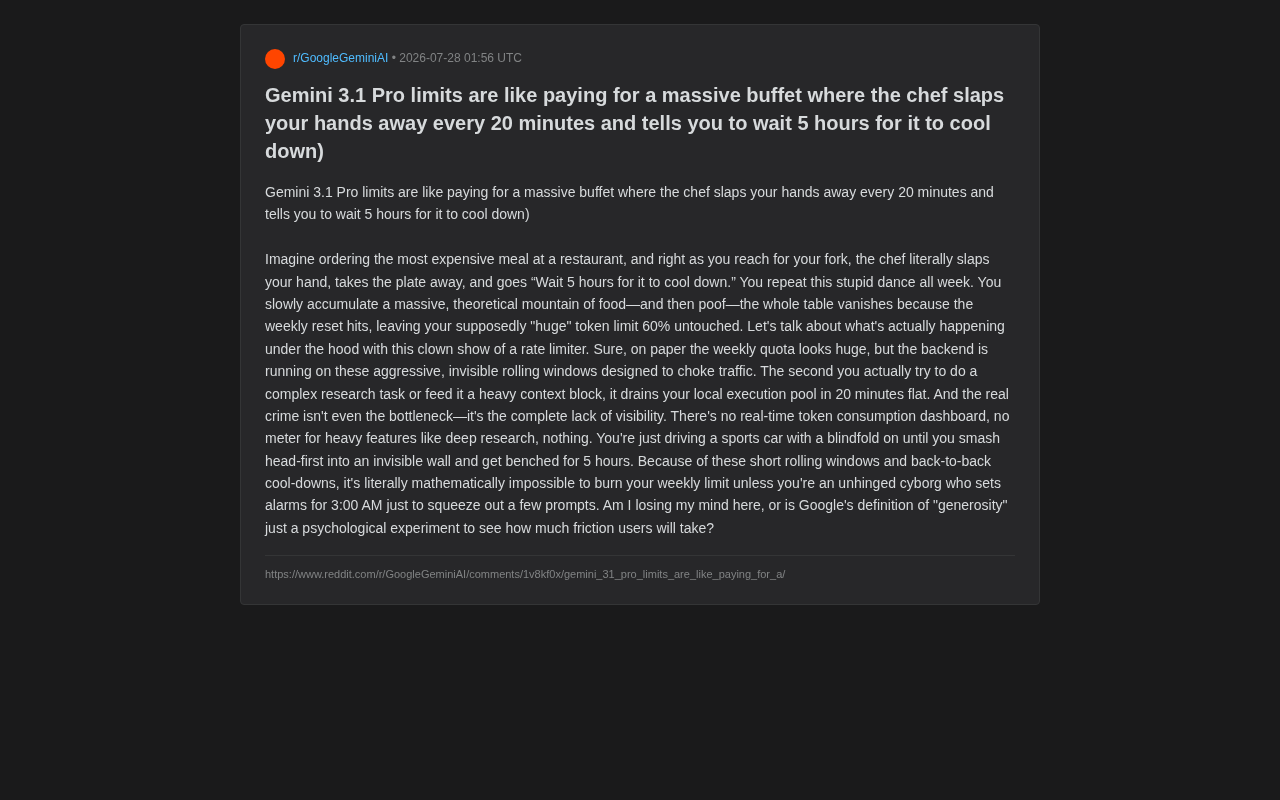
The reason this metaphor struck such a chord is that it hits on a widespread yet rarely systematically discussed pain point in today's LLM subscription services: the enormous gap between paper quotas and actual usability.
How Gemini 3.1 Pro's Rolling Window Rate Limiting Actually Works
From a marketing perspective, Gemini 3.1 Pro's weekly quota numbers look quite impressive. However, as this user pointed out, the core problem lies in an "aggressive, invisible rolling window" system running on the backend, specifically designed to throttle traffic spikes.
Understanding Rolling Windows: A Precision Traffic Control Algorithm
Rolling Window is a common traffic control algorithm in distributed systems, standing in contrast to Fixed Window approaches. Fixed windows reset their counters at the start of each time period, which makes them vulnerable to boundary burst issues — for example, at the moment windows switch over, users can consume two windows' worth of quota in an extremely short timeframe. Rolling windows smooth out the traffic curve by continuously tracking request volume over a period of time. Common implementations include Sliding Log and Sliding Window Counter approaches. In LLM API services, this mechanism typically exists in multi-layered nested form: there may be simultaneous per-minute, per-hour, per-day, and per-week limits, each operating independently. This means that even when the weekly quota is far from exhausted, users can trigger finer-grained restrictions due to concentrated usage within a short period.
How Short Windows Devour Your Quota
The rolling window means the system doesn't simply calculate totals on a weekly or daily basis. Instead, it imposes strict consumption caps at much shorter time granularities (such as a few minutes or a few tens of minutes). As the user described: "The moment you actually try to execute a complex research task, or feed it a hefty chunk of context, it drains your local execution pool dry within a solid 20 minutes."
It helps to understand the actual scale of token consumption here. Tokens are the basic units that large language models use to process text — they don't simply equate to a single character or word. For English text, one token corresponds to roughly 4 characters or 0.75 words; for Chinese, a single character is typically encoded as 1–3 tokens, depending on the model's tokenizer. In billing systems for models like Gemini, input tokens and output tokens are usually counted separately, with output tokens often costing more than input tokens. A single deep research task might involve tens or even hundreds of thousands of input tokens (including reference documents, conversation history, and other context), plus thousands of tokens of model-generated output. The token consumption of a single interaction can far exceed user expectations. This is precisely why the lack of real-time metering tools feels so frustrating — users have no intuitive way to judge how much of their resource budget a single operation will consume.
In other words, heavy-use scenarios — precisely the scenarios paid users need most — hit hidden bottlenecks within extremely short timeframes, followed by mandatory cooldown periods lasting hours. This creates a mathematical paradox: unless you're a "runaway cyborg" who sets a 3 AM alarm specifically to squeeze out a few prompts, it's virtually impossible to actually use up your weekly quota.
The Cascading Effect of Cooldown Periods
What makes things worse are the back-to-back cooldown periods. After hitting the short window cap, you face hours of waiting. When you finally regain access, just a few deep calls might trigger the cap again. This rhythm of "use for a few minutes, wait for a few hours" makes sustained, intensive workflows virtually impossible. For professional users who rely on AI for research, programming, or long document processing, this fragmented availability severely undermines the tool's practical value.
From an infrastructure perspective, there are real hardware bottlenecks behind this rate limiting. The inference process for large language models consumes enormous GPU computing resources. For a model at Gemini's scale, a single inference might require parallel computation across hundreds or even thousands of GPUs, with each generated token involving matrix operations across billions of parameters. According to industry estimates, the cost per query for GPT-4-class models ranges from a few cents to tens of cents, while features like deep research that require multi-round inference and long context processing can see costs increase by orders of magnitude. If all paid users were allowed to make heavy calls simultaneously, GPU clusters would face severe resource contention, causing latency spikes or even service outages. Cloud providers typically employ oversubscription strategies — selling total quotas far exceeding the capacity they can actually serve simultaneously — relying on the statistical distribution of usage to maintain service quality.
The Core Pain Point for Paid Users: Zero Usage Visibility
If rate limiting itself is at least understandable, what this user considers the most unforgivable "sin" is the complete lack of transparency.
They pointed out: "There's no real-time token consumption dashboard, no usage meter for heavy features like deep research, nothing at all. You're driving a sports car blindfolded until you slam into an invisible wall, and then you're benched for 5 hours."
This criticism touches on a critical UX issue in AI product design. When users pay for a service, they should have clear visibility into their resource consumption:
- No estimation possible: No way to know how much quota a single deep research session will consume
- No planning possible: No way to reasonably prioritize tasks or pace their workflow
- No early warning: No alerts before hitting the cap — users can only passively accept sudden interruptions
This "black box" rate limiting mechanism keeps users in a perpetual state of anxiety and uncertainty. Even when their quota is plentiful, they can never feel at ease using it.
Is Google's "Generosity" Truly Generous, or a Psychological Experiment?
At the end of the post, the user posed a pointed question: "Am I crazy, or is Google's definition of 'generosity' actually a psychological experiment testing how much friction users can endure?"
The Battle Between Paper Numbers and Real Experience
While emotionally charged, these words reveal a phenomenon the industry should seriously reflect on. In the competition among LLM services, providers tend to attract users with eye-catching quota numbers, but actual usability is determined by a series of opaque backend throttling policies. When figures like "millions of tokens per week" coexist with the reality of "getting rate-limited after 20 minutes," the gap between marketing and experience translates directly into intense user dissatisfaction.
The Industry-Wide Pricing Dilemma for AI Subscriptions
This phenomenon reflects a universal dilemma facing AI subscription services today: price too high and you scare users away; price too low and you can't cover inference costs. Take a $20–30 monthly subscription — if a user conducts dozens of deep conversations daily, the platform's actual inference costs may far exceed subscription revenue. This has given rise to "soft limiting" strategies — controlling heavy users' consumption through throttling rather than hard rejections. OpenAI, Anthropic, Google, and other providers all employ similar strategies; they differ only in transparency and implementation. This model is essentially a form of price discrimination: light users subsidize heavy users, while rate limiting ensures heavy users' actual consumption doesn't deviate too far from the average. The industry is also exploring more flexible hybrid billing models, such as base subscriptions plus pay-per-use elastic plans, attempting to find a balance between user experience and cost control.
The Case for Rate Limiting Design
From the platform's perspective, rolling window rate limiting has its technical justification. LLM inference costs are enormous, sudden traffic spikes can destabilize services, and short-window rate limiting is a common method for safeguarding overall service quality and preventing individual users from monopolizing resources. The question isn't "whether to rate limit" but rather "how to make rate limiting transparent and predictable."
Lessons for AI Subscription Product Design
While this rant represents a single user's subjective experience, the issues it surfaces have universal significance and are worth noting for every AI product team:
- Quota marketing should align with actual usability: Over-emphasizing paper numbers while ignoring real-world experience ultimately only damages brand trust.
- Transparency is basic respect for paying customers: Real-time usage dashboards, throttling warnings, and remaining quota displays should be standard features for any paid service.
- Rate limiting strategies must match user scenarios: For professional scenarios like intensive research and programming, rigid short-window throttling may be entirely unsuitable — more flexible tiered designs are needed.
- Friction is a hidden driver of user churn: No matter how powerful the features, persistent usage friction gradually erodes user patience and pushes them toward competitors.
It should be noted that the views in this article are primarily sourced from a single Reddit user's feedback. The specific rate limiting values and mechanism details have not been officially confirmed, and actual experiences may vary by subscription tier, region, and usage patterns. However, the widespread resonance this post generated speaks volumes about how important transparent rate limiting is to user experience.
For Google, Gemini 3.1 Pro's model capabilities are beyond question. But figuring out how to let paying users truly "eat in peace and eat their fill" may be far more critical than simply piling on bigger quota numbers.
Related articles

Chestnut: A Deep Dive into the First Open-Source Firmware eGPU Dock
Chestnut is the first eGPU dock with open-source firmware, enabling custom firmware development. This deep dive covers its architecture, open-source advantages, use cases, and challenges.

vLLM Deployment & Unsloth Fine-Tuning in Practice: A Complete Guide to LLM Inference Services
Complete guide to vLLM inference deployment and Unsloth fine-tuning, covering CLI deployment, Python integration, AutoDL cloud setup, and ModelScope acceleration with DeepSeek-OCR as a practical example.

Quickly Understanding Legacy Project Architecture with OpenSpec Explore
Learn how to use OpenSpec explore in VS Code with GitHub Copilot to automatically analyze legacy project architecture, tech stack, and core features for rapid codebase understanding.