Gemini 3.1 Pro Review: Why Its Empathetic Conversation Style Keeps Users Coming Back
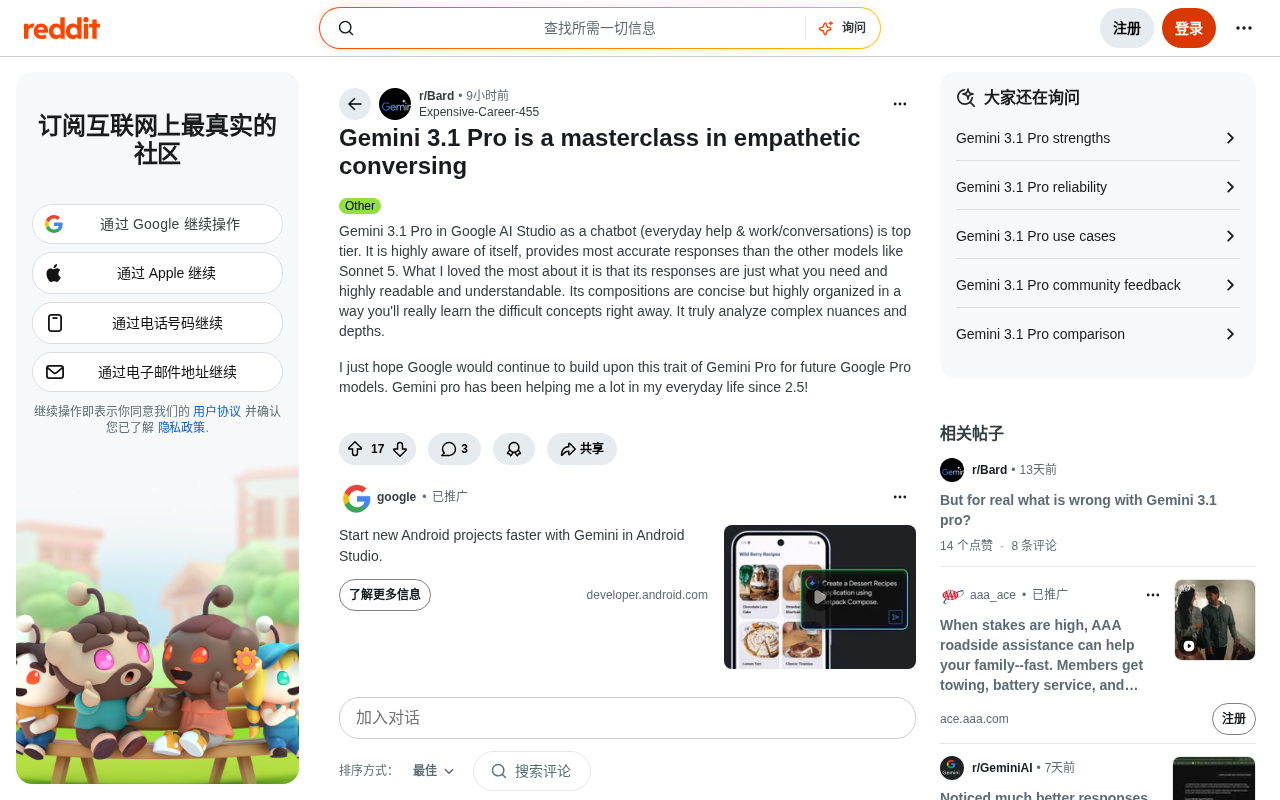
Gemini 3.1 Pro wins user loyalty through empathetic, context-aware conversation rather than raw benchmark scores.
A Reddit user's glowing review of Gemini 3.1 Pro in Google AI Studio — praising its concise, nuanced, and empathetic conversational style — highlights a broader industry shift. As top LLMs converge in raw capability, the new competitive battlefield is user experience: whether a model truly "understands" you. This piece explores the technical roots of empathetic AI, compares Gemini 3.1 Pro with Anthropic's Sonnet 5, and examines why conversational quality is becoming the defining metric for AI assistants.
A Surprisingly Delightful Everyday Experience
In the midst of fierce competition among large language models, Google's Gemini series is gradually carving out a distinctive product identity. A Reddit user recently shared their hands-on experience using Gemini 3.1 Pro as a chat assistant in Google AI Studio, describing it as "a masterclass in empathetic conversing."
It's worth noting that Google AI Studio is a free online platform Google offers to developers and advanced users, providing direct API access to the Gemini model family. Unlike consumer-facing products (such as the Gemini app), AI Studio lets users customize system prompts, adjust generation parameters like temperature, and run multi-turn conversation tests. This makes it an ideal environment for evaluating a model's "raw conversational ability" — users can experience the model closer to its underlying state, without layers of product packaging on top. As a result, user feedback from AI Studio tends to carry considerable reference value.
This kind of praise reflects a subtle but meaningful shift in how AI assistants compete — moving away from pure parameter counts, benchmark scores, and reasoning capabilities, and toward conversational experience and user understanding. For everyday users, whether a model can truly "get" what you're asking and respond clearly often matters more than a few percentage points on a leaderboard.
Industry Context: The large language model market has entered a multi-polar era. OpenAI's GPT series, Anthropic's Claude series, Google's Gemini series, and Meta's open-source Llama ecosystem together define the major competitive landscape. The gaps between these models in core capabilities — such as reasoning, coding, and multilingual understanding — are narrowing rapidly, pushing vendors to differentiate at the user experience layer.
The Gemini Series: From PaLM to a Natively Multimodal Architecture
Google's Gemini series is its flagship product line competing against GPT-4, officially launched in late 2023 as the successor to the PaLM 2 series. Gemini is built on a natively multimodal architecture, with built-in support for text, images, audio, and video — not a patchwork of modalities added after the fact.
This architectural choice carries deep technical significance. Traditional "stitched" multimodal approaches typically connect a pretrained visual encoder (such as CLIP) to a language model via an adapter layer, resulting in relatively siloed cross-modal understanding and limited cross-modal reasoning. A native multimodal architecture, by contrast, means the model ingests data from multiple modalities simultaneously during pretraining, aligning representations across modalities in a shared feature space for more natural and deeper cross-modal understanding. In short, when Gemini "describes an image," it isn't translating the picture into text and then reasoning about it — it processes visual and textual information together in a unified cognitive framework.
The Pro tier is positioned as a high-performance model for professional users, sitting between the lightweight Flash version and the flagship Ultra version, balancing capability with inference cost. From version 2.5 to 3.1, Google has continued to refine conversational quality, instruction-following, and context comprehension.
"Hitting the Mark": Gemini 3.1 Pro's Conversational Strengths
The user specifically emphasized that what impressed them most about Gemini 3.1 Pro was this: its answers are exactly what you need — not verbose padding or off-target rambling.
Concise Yet Well-Structured
In real-world work and everyday scenarios, users report that Gemini 3.1 Pro's responses share a few distinctive traits:
- Highly readable: Content is well-organized with clear logical structure;
- Concise without sacrificing completeness: Key information is retained even as length is trimmed;
- Skilled at breaking down complexity: Difficult concepts are presented in ways that are easy to grasp — you can learn something on the spot.
This ability to "simplify without dumbing down" is precisely the soft skill most users value in an AI assistant. Compared to models that default to lengthy monologues, an assistant that accurately reads user intent and delivers just the right answer fits far more naturally into daily workflows.
Understanding Complex Context and Nuance
The user also noted that Gemini 3.1 Pro can "truly analyze complex nuances and depths." This means it goes beyond surface-level information to capture implied meaning within context — which is especially critical in scenarios requiring multi-turn, in-depth exchanges.
The Technical Roots of Empathy: RLHF and Dialogue Tuning
An AI model's "empathetic" quality doesn't appear from nowhere — it's underpinned by a comprehensive technical training pipeline. Modern large language models typically go through three training phases:
- Pre-training: Learning language patterns and world knowledge from massive text datasets;
- Supervised Fine-Tuning (SFT): Using human-annotated, high-quality conversation examples to guide the model toward a desired response style;
- Reinforcement Learning from Human Feedback (RLHF): Collecting human evaluator preference data on different responses to teach the model "what kinds of answers people actually prefer" — including appropriate tone, informational precision, and the ability to infer users' unstated needs.
This carefully refined pipeline ultimately determines whether a model makes users feel "understood" in conversation. Anthropic also developed an additional technique called Constitutional AI (CAI) — its core innovation being the use of a "list of principles" in place of extensive human annotation. The model first critiques and revises its own outputs according to preset principles, then AI-generated preference data is used to train a reward model for reinforcement learning. This approach significantly reduces human annotation costs while making the model's value alignment more interpretable, and has had a lasting influence on the entire field's alignment research paradigm. Google's continuous iteration on the Gemini series has focused heavily on these "alignment" layer optimizations as well.
Side-by-Side Comparison: Gemini 3.1 Pro vs. Sonnet 5
In their post, the user directly compared Gemini 3.1 Pro with Anthropic's Sonnet 5, arguing that the former "provides more accurate answers than other models."
Background on Sonnet 5: Anthropic was founded by former core OpenAI members, with AI safety as its central research mission. The Claude series is known for its long context window (up to 200K tokens), strong document comprehension, and a relatively restrained, natural conversational style. To put 200K tokens in perspective: one token corresponds to roughly 0.75 English words, meaning 200K tokens can handle text equivalent in length to a mid-sized novel in a single pass — giving it a distinct edge in long-document analysis and large codebase comprehension. The Sonnet tier is positioned within Anthropic's lineup as the "best balance of performance and speed," making it a go-to choice for many developers and power users. Placing Gemini 3.1 Pro alongside Sonnet 5 in a direct comparison is effectively pitting two of the market's most respected conversational models against each other — and the comparison itself signals that Gemini has earned a spot among users' top-tier candidates.
It's important to note that this is a subjective experience from a single user, not a rigorous benchmark result. There's a widely discussed structural problem in current AI model evaluation: the gap between benchmark scores and real-world user experience. Mainstream benchmarks like MMLU, HumanEval, and MATH can quantify a model's capability ceiling on specific tasks, but these test scenarios differ significantly from how users actually interact with AI day-to-day. MMLU's multiple-choice format across 57 academic subjects and HumanEval's standardized code generation problems are, by nature, highly simplified controlled scenarios that cannot capture how a model actually responds to real users' vague, ambiguous, or emotionally charged inputs. A model that leads by 5 percentage points on MMLU won't necessarily feel more "useful" in actual conversation. More importantly, some vendors have been known to engage in benchmark-specific optimization ("benchmark gaming") or suffer from data contamination issues that inflate scores. This is precisely why evaluation platforms like Chatbot Arena — based on real users' blind preference votes — have gained broader recognition in recent years, and why authentic user feedback like a Reddit post, despite lacking rigorous scientific controls, can fill dimensions that benchmark data simply cannot capture.
Different models tend to have different strengths across different tasks: some excel at coding, others at long-document processing, others at conversational naturalness. So the "more accurate" assessment here more likely reflects this particular user's experience in everyday conversation and general assistant scenarios.
This also reveals a noteworthy trend: as the top-tier models' baseline capabilities have broadly leveled up, users are shifting their focus from "who's stronger" to "who understands me better." A model's expressive style and empathetic quality are becoming an important battleground for differentiation.
From Gemini 2.5 to 3.1: A Trustworthy, Consistent Evolution
You might not have noticed, but this user isn't a newcomer — they've been using Gemini Pro continuously since the Gemini 2.5 era, saying it "has been helping me with my daily life ever since."
This kind of long-term trust is the foundation of genuine word-of-mouth. From 2.5 to 3.1, the steady refinement of Gemini Pro's conversational experience has allowed longtime users to clearly perceive the improvements. The user also expressed a simple hope: that Google continues to preserve and strengthen this quality in future Pro models — that blend of professional competence and genuine attentiveness in conversation.
Why "Empathetic Ability" Is Becoming a Key AI Metric
Starting from this single piece of feedback, we can zoom out to a bigger question: why do users place such high value on "empathetic conversation"?
For the vast majority of everyday users, their interactions with AI don't happen on benchmark leaderboards — they happen in real questions, requests, and exchanges. Whether a model makes you feel "understood," whether its answers are "clear and easy to follow," and whether its tone is "just right" directly determines the quality of the experience.
There's also a deeper structural industry logic at work here. "Commoditization of large language models" is one of the most frequently debated topics among AI industry observers today. This trend has a deep technological-economic background: the Transformer architecture, introduced in 2017, has become the industry standard, and architectural differences between models are increasingly converging; the ceiling effect on pretraining data is beginning to show, as the total supply of high-quality internet text is finite and the gap in data scale between top models cannot grow indefinitely; and falling compute costs combined with the ubiquity of cloud infrastructure have lowered the barrier to training frontier models, spreading access beyond a handful of giants. As open-source models rise (such as Meta's Llama series) and compute infrastructure becomes commoditized, the gaps between top-tier models in core intelligence capabilities are shrinking at a visible pace. Against this backdrop, model vendors are shifting their competitive focus to a "second track": multimodal integration, ecosystem lock-in (such as Google deeply embedding Gemini into Gmail, Docs, Drive, and other workflows), pricing strategy, and — as this article explores — conversational experience and user understanding. This migration of competitive emphasis from "technical leadership" to "experience leadership" is reshaping the product logic of the entire AI assistant market.
This is also why more and more model vendors are investing heavily in alignment and dialogue tuning. Technical capability is the foundation, but what truly wins users over is often the experience details that can't be easily quantified. Gemini 3.1 Pro earned this kind of positive feedback precisely because it has delivered on these "soft dimensions" in ways that satisfy users.
Conclusion: Conversational Experience — The Next Frontier in the LLM Race
This brief Reddit post carries a clear signal: as large language model competition intensifies and capabilities converge, conversational experience and user understanding are becoming the defining factors in product reputation.
For users searching for an everyday AI assistant, Gemini 3.1 Pro's performance in Google AI Studio is probably worth experiencing firsthand. Of course, the final choice should still depend on your specific use cases — but one thing is clear: Google's exploration of "empathetic conversation" has already earned the long-term loyalty of a dedicated group of users.
Note: This article is based on a single user's real-world experience. The assessments reflect subjective impressions and do not represent conclusions from rigorous performance testing.
Key Takeaways
Related articles

Gemini 3.7 Flash Spotted in Google Cloud Console — Launch Countdown Begins
Developers spot Gemini 3.7 Flash in Google Cloud Console, sparking discussion about its relationship to Pro and Google's model distillation strategy.

AI-Memory: Building a Cross-Tool Long-Term Memory System for Coding AIs
AI-Memory is a Rust-based open-source project providing long-term memory for Claude Code, Cursor, Aider and other Agent coding CLIs, enabling seamless handoff between vendors.

Bullet Enters the Stage: YC Newcomer Bets on a Faster Coding Agent
YC S26 startup Bullet launches a speed-focused coding Agent targeting developer latency pain points. Analysis of its differentiation, acceleration techniques, and market opportunity against Cursor and Claude Code.