Gemini 3.5 Flash Cyber: Google's Lightweight Model Built for Cybersecurity

Google releases Gemini 3.5 Flash Cyber, a lightweight security-focused AI model for proactive vulnerability detection.
Google has unveiled Gemini 3.5 Flash Cyber, a lightweight model purpose-built for cybersecurity teams to discover and patch vulnerabilities before exploitation. Leveraging the Flash series' low-latency architecture, it targets real-time security operations like SOC alert triage and proactive defense. The release reflects a broader industry shift toward vertical-specific AI models and intensifies the AI arms race between cyber attackers and defenders.
Google Launches a Domain-Specific Model for Security
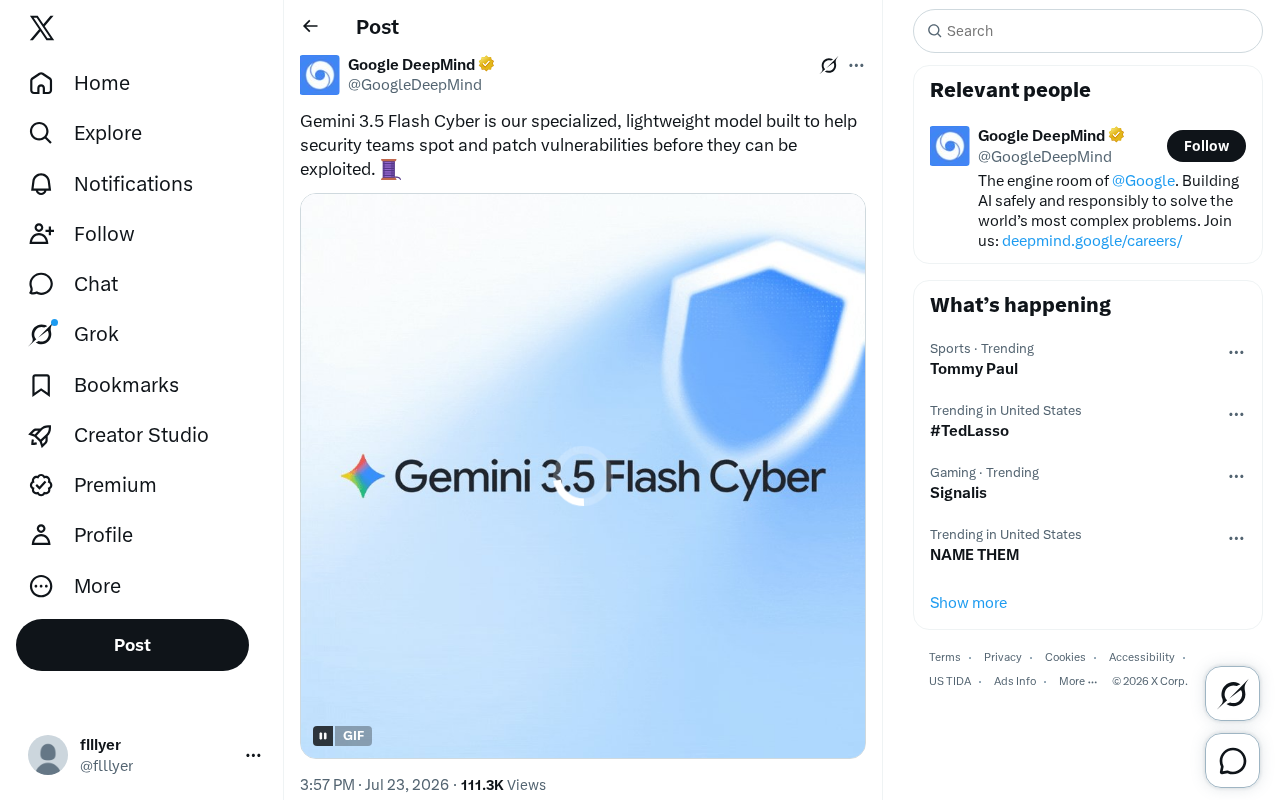
Google recently announced Gemini 3.5 Flash Cyber on its social media platform — a lightweight model purpose-built for cybersecurity teams. According to the official description, the model's core mission is to help security teams spot and patch vulnerabilities before they can be exploited by malicious actors.
This release signals that Google is accelerating its strategy of extending beyond general-purpose large models into vertical industry scenarios. Unlike flagship models that aim to be all-encompassing, Gemini 3.5 Flash Cyber conveys two key positioning choices through its name alone: first, it belongs to the Flash series, which prioritizes high speed and low latency; second, it focuses specifically on the Cyber (cybersecurity) domain.
Google's Gemini Flash series is the branch of its model product line designed for high-throughput, low-latency scenarios. Compared to flagship-tier Gemini Ultra/Pro models, the Flash series leverages techniques like Model Distillation and Sparse Activation to dramatically reduce computational overhead during inference while preserving core reasoning capabilities. This makes the Flash series particularly suited for production environments that require frequent invocations and are sensitive to response speed, such as real-time content analysis and streaming data processing. Bringing this architectural advantage into cybersecurity reflects Google's deep understanding of the real-time requirements in security scenarios.
Why "Lightweight" + "Security-Specific" Architecture
Practical Considerations Behind the Lightweight Design
Cybersecurity defense demands extremely high real-time performance. Attacks often begin within hours or even minutes after a vulnerability is publicly disclosed, leaving an extremely narrow response window. Choosing a lightweight architecture like Flash means the model can quickly process massive volumes of logs, code, and threat intelligence data with lower latency and smaller computational costs.
For Security Operations Centers (SOCs) that require 24/7 continuous monitoring, a model that can be called frequently at manageable costs delivers far more deployment value than a large but expensive general-purpose model. A SOC is the central hub of an enterprise's cybersecurity defense system, typically staffed around the clock by security analyst teams responsible for monitoring alerts from multiple data sources including firewalls, Intrusion Detection Systems (IDS), and Endpoint Detection and Response (EDR) tools. A mid-sized enterprise SOC might face tens of thousands or even hundreds of thousands of alerts daily, the vast majority of which are false positives. Analysts need to identify genuine threats amid massive noise — this is precisely the scenario where AI models can deliver value, significantly reducing the burden on human analysts through intelligent alert triage and contextual correlation analysis.
This also aligns with the current industry trend toward "small and specialized" model evolution — using targeted, optimized small models to solve specific problems rather than endlessly stacking parameters.
Shifting from "Reactive Response" to "Proactive Defense"
The key phrase emphasized by Google is "before they can be exploited." This reveals the design philosophy behind Gemini 3.5 Flash Cyber: shifting the center of gravity in security protection from post-incident reactive response to pre-incident proactive discovery and patching.
Traditional vulnerability management workflows typically rely on manual audits and rule-engine scanning, which are limited in efficiency and prone to missed detections. Complete vulnerability management follows a four-stage process of "discover-assess-remediate-verify." From the time a vulnerability is discovered by researchers or automated tools, to the vendor releasing a patch, to the enterprise completing deployment, the process often takes weeks or even months. According to statistics from security research firms like Mandiant, the average time for attackers to exploit newly disclosed vulnerabilities has shortened from several weeks in 2020 to fewer than 5 days in 2024. This time gap (the "patch window") is when cyberattacks are most concentrated, and it represents the most valuable entry point for AI to accelerate defensive response.
With a purpose-trained AI security model, security teams can theoretically locate potential weaknesses in massive codebases and system configurations more quickly, receive remediation recommendations, and thereby compress the window of opportunity for attackers.
AI Enters a New Phase of Security Offense and Defense
Applying large model capabilities to cybersecurity is not an exploration unique to Google. In recent years, vendors like Microsoft and CrowdStrike have also launched security assistant products integrating generative AI. Microsoft officially launched Security Copilot in 2024, built on GPT-4, capable of assisting security analysts with incident investigation, threat intelligence summarization, and KQL query generation. CrowdStrike integrated Charlotte AI into its Falcon platform, focusing on accelerating Threat Hunting through natural language interaction. Palo Alto Networks' XSIAM platform also deeply integrates machine learning capabilities. These products collectively form the competitive landscape of AI security assistants, while Google's launch of a vertical-specific model represents a more foundational approach to capability delivery — not layering AI functionality onto existing platforms, but providing a purpose-optimized base model for the security ecosystem to call upon.
The emergence of Gemini 3.5 Flash Cyber further confirms that AI is becoming a core tool relied upon by both sides of the security offense-defense equation.
Interestingly, AI is a double-edged sword in cybersecurity. On one hand, it can significantly enhance defenders' vulnerability discovery and response efficiency; on the other hand, attackers can equally leverage AI to automatically mine vulnerabilities and generate attack code. On the offensive side, large language models have been proven capable of automatically generating phishing emails (bypassing traditional text detection), assisting in reverse engineering binary files, and even directly generating exploit code. Multiple studies in 2024 demonstrated that GPT-4-level models, given CVE descriptions, can independently construct exploitation chains for some known vulnerabilities. This means both sides are entering an "AI arms race," where defenders need faster, more specialized AI capabilities to offset attackers' automation advantages.
Therefore, whether defenders can establish a speed advantage with the help of such specialized models will become a critical variable in future offense-defense dynamics.
Details to Be Verified and Future Outlook
As of now, Google has only previewed the model through a single tweet and has not disclosed further technical details, including the model's specific capability boundaries, supported programming languages and security scenarios, integration methods, and pricing strategies.
Based on its naming and positioning, Gemini 3.5 Flash Cyber is more likely designed as a component within security workflows, called by enterprise security teams through APIs or integration platforms, rather than a standalone product for general consumers.
For practitioners following AI's enterprise deployment, the frequent emergence of such vertical industry-specific models is a signal worth noting: the value of large models is migrating from "general-purpose conversation" to "deep industry specialization." Whoever can deliver more precise, efficient, and reliable capabilities in specific scenarios is more likely to win enterprise customers.
From a technical implementation perspective, building vertical industry-specific models typically involves three approaches: first, continual pre-training on domain data atop a general-purpose base model, injecting large volumes of security domain corpus such as CVE databases, security research reports, and malicious code samples; second, instruction fine-tuning to teach the model to execute specific security tasks like code auditing and log analysis; third, combining Retrieval-Augmented Generation (RAG) techniques, using real-time updated threat intelligence repositories as external knowledge sources. Gemini 3.5 Flash Cyber most likely employs a combination of these methods to achieve professional depth in the security domain while maintaining its lightweight nature.
Whether Gemini 3.5 Flash Cyber can deliver on its promise of "discovering and patching vulnerabilities before they are exploited" remains to be validated through real-world deployment results.
Key Takeaways
Related articles

AI Subscription Pay-to-Reset: Breaking Down the New $8 Usage Reset Billing Model
AI subscriptions now offer a pay-to-reset feature letting users spend $8 to restore monthly quotas. Analyzing this elastic billing model's impact and AI pricing trends.

Claude's Invisible Watermarks Exposed: AI Text Provenance Technology Explained
Anthropic's Claude found embedding invisible watermarks in text outputs and adding signed metadata to files. Deep dive into AI text watermarking technology, vendor motivations, privacy concerns, and industry provenance trends.

The Truth Behind Mark Twain's Bankruptcy: The Painful Lesson of Losing $190,000 on a Typesetting Machine
Mark Twain went bankrupt after losing $190,000 on the Paige Compositor. Why did this 18,000-part "mechanical marvel" lose to the simpler Linotype? A deep dive into this century-old tech investment trap.